

On this page
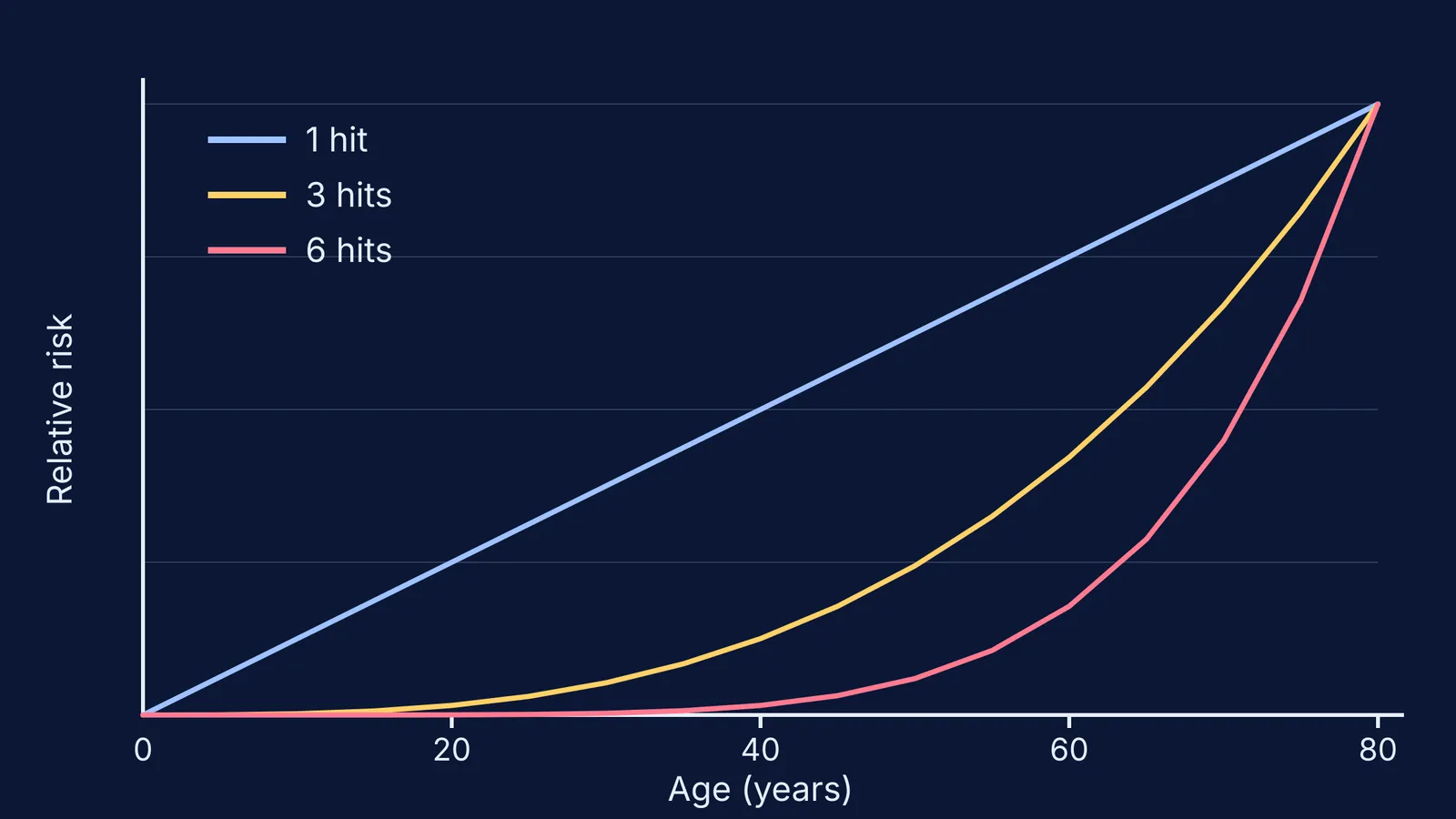
A cell has to collect several specific mistakes in its DNA before it starts dividing out of control, and every extra year gives those mistakes more time to line up. That idea, the multi-hit model, helps explain why cancer is far more common at 70 than at 17.
Why does cancer risk increase with age?
The US National Cancer Institute calls advancing age "the most important risk factor for cancer overall". Its figures show fewer than 26 cases per 100,000 people under age 20, about 350 per 100,000 at ages 45 to 49, and more than 1,000 per 100,000 at 60 and older. The median age at diagnosis is 67 years.
The WHO cancer fact sheet says incidence "rises dramatically with age", most likely because exposure to risk factors builds up over a lifetime, and adds that cellular repair tends to become less effective as we get older.
Cancer is common in India too. Researchers using National Cancer Registry Programme data estimated 14,61,427 (about 1.46 million) new cancer cases in India in 2022, and that about one in nine people are likely to develop cancer in their lifetime (Sathishkumar and colleagues, Indian Journal of Medical Research, 2022).
What are proto-oncogenes and tumour suppressor genes?
Two families of genes do most of the work. According to the American Cancer Society, proto-oncogenes help control normal cell growth and division, and a proto-oncogene that mutates or becomes too active can become an oncogene. Tumour suppressor genes are normal genes that slow down cell division or tell damaged cells to die when needed.
Think of a car: proto-oncogenes are the accelerator, tumour suppressors the brakes. The same source notes that cancer is often the result of changes in more than one of these types of genes. For what happens once growth escapes control, see our explainer on benign vs malignant tumours.
What is the multi-hit model of cancer?
Earlier work by Fisher and Hollomon and by Nordling found that cancer death rates rose roughly with the sixth power of age. In 1954, Peter Armitage and Richard Doll tested the multi-stage theory against death rates for 17 cancer types and found that cancers of the oesophagus, stomach, colon, rectum and pancreas fitted it (British Journal of Cancer; reprinted text). They suggested a process of "perhaps six or seven stages" could explain the steep rise, because a process needing k steps produces a rate that grows like age to the power k minus 1.
In 1971, Alfred Knudson used statistics on retinoblastoma, an eye cancer of childhood, and proposed that it needs two mutational events (PNAS). In inherited cases, one hit is passed down through the germ cells and only the second has to happen in the body.
A 2015 study concluded that only three sequential mutations are required for lung and colon adenocarcinomas (Tomasetti and colleagues, PNAS). A separate 2015 paper found that lifetime cancer risk across tissues correlates with the number of stem cell divisions, over five orders of magnitude (Tomasetti and Vogelstein, Science).
How do the numbers work in a worked example?
These numbers are made up; the pattern is what matters. Suppose a cell line has a chance p = 1 in 1,000 each year of picking up each hit, independently.
The chance one hit has happened by age t is about pt, as long as pt is small.
If cancer needs three hits, all three must have happened: the chance is about (pt) cubed.
At age 20, pt = 0.02, so the risk is 0.000008, or 8 in a million.
At age 40, pt = 0.04: 64 in a million, eight times higher.
At age 80, pt = 0.08: 512 in a million, 64 times the age-20 figure.
Now give the cell one inherited hit, as in Knudson's hereditary cases. Two hits remain, so the age-20 risk is (0.02) squared, or 400 in a million: 50 times higher.
With seven steps, the yearly rate grows like age to the sixth power, so doubling age multiplies it by 2 to the sixth, or 64. Real tissues are messier: some mutations make a cell divide faster, and exposures such as tobacco speed up the hits. Our post on physical, chemical and biological carcinogens covers those accelerants.
If the jump from (pt) cubed to a growth curve feels slippery, the Fermi Problem Library has worked problems with a step-by-step solver that explains the reasoning rather than printing an answer.
Does getting older mean cancer is certain?
No. The model is about odds, not fate. The WHO estimates that about 38% of cancers can be prevented by avoiding risk factors such as tobacco, alcohol, unhealthy diet, physical inactivity and air pollution, and by using existing prevention strategies (WHO).
For any worry about your own health or a family member's, talk to a doctor rather than relying on a model.
To connect the genetics and the maths in your own revision, the Fermi Concept Library gives every concept in biology and mathematics its own lesson and its place in the map.


