On this page
The cancer section of the Class 12 NCERT chapter Human Health and Disease packs this whole topic into one paragraph. It says normal cells can be turned into cancerous cells by physical, chemical or biological agents, and that these agents are called carcinogens. It is worth learning well for NEET-UG and board exams, because each type harms the cell in its own way.
What are the three types of carcinogens?
The World Health Organization's cancer fact sheet uses the same three groups:
Physical carcinogens: ultraviolet (UV) and ionising radiation.
Chemical carcinogens: asbestos, components of tobacco smoke, alcohol, aflatoxin (a food contaminant) and arsenic (a drinking-water contaminant).
Biological carcinogens: infections from certain viruses, bacteria or parasites.
The same WHO fact sheet attributes about 10% of cancers diagnosed worldwide in 2022 to carcinogenic infections, including HPV, hepatitis B and C, Epstein-Barr virus and the bacterium *Helicobacter pylori*.
NCERT adds that cancer cells have lost contact inhibition, by which contact with other cells checks growth. For growths that stay put versus spread, see benign vs malignant tumours.
How does radiation damage DNA?
NCERT names two kinds: ionising radiation such as X-rays and gamma rays, and non-ionising radiation such as UV. Both damage DNA, in different ways.
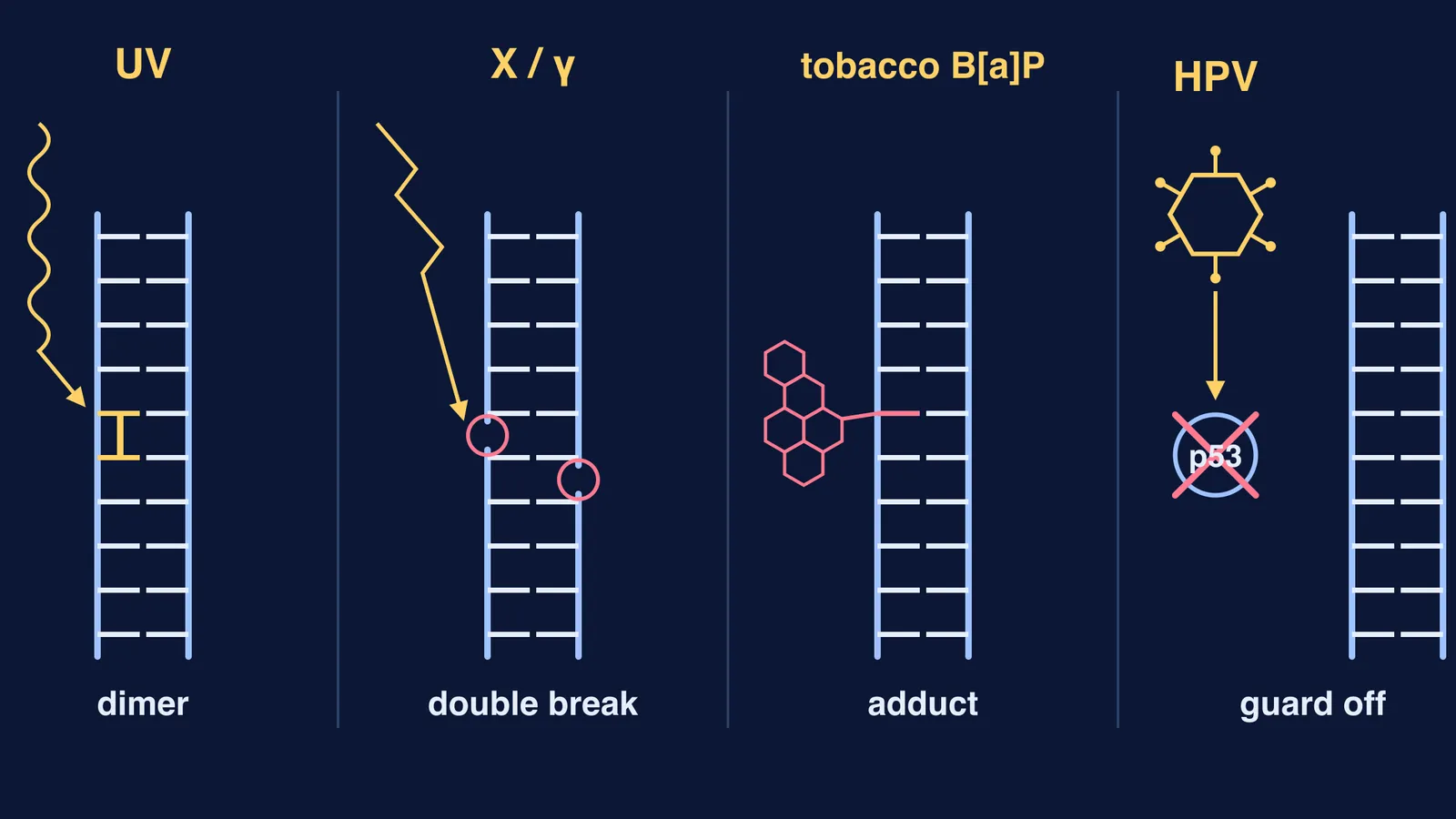
UV light. A 2010 review by Rastogi and colleagues says ultraviolet radiation, mainly UV-B (280 to 315 nm), induces DNA lesions such as cyclobutane pyrimidine dimers and 6-4 photoproducts. In a pyrimidine dimer, two neighbouring C or T bases on the same strand become chemically joined. The WHO UV fact sheet says skin cancers are caused primarily by UV from the sun or from artificial sources such as sunbeds, and counts over 1.5 million skin cancer cases diagnosed worldwide in 2020.
Ionising radiation. The WHO describes it as energy released by atoms, travelling as gamma or X-rays or as particles. A review by Santivasi and Xia (2014) calls DNA double-strand breaks, where both strands are cut, the most lethal form of damage it causes. WHO notes that studies of exposed populations showed a significant rise in cancer risk at doses above 100 mSv.
Not all radiation is ionising. The US National Cancer Institute page on radiation says lower-energy forms such as visible light and the energy from cell phones have not been found to cause cancer in people. Our post on whether phone radiation is like X-rays works through why.
How do chemicals in tobacco smoke cause cancer?
The National Cancer Institute's smoking fact sheet says tobacco smoke contains more than 7,000 chemicals, at least 250 are known to be harmful, and at least 69 can cause cancer. Its list includes benzene, arsenic, formaldehyde and polycyclic aromatic hydrocarbons (PAHs).
One PAH shows the mechanism. In 1996, Denissenko and colleagues reported in *Science* that in human cells treated with the reactive form of benzo[a]pyrene, DNA adducts (chemicals bound onto a base) formed selectively at guanines in codons 157, 248 and 273 of the p53 gene. These are the major mutation hotspots in human lung cancers. Population evidence came first: see how Doll and Hill's 1950 study linked smoking to lung cancer.
How can a virus cause cancer?
NCERT says cancer-causing viruses are called oncogenic viruses and have genes called viral oncogenes. Normal cells also carry cellular oncogenes (c-onc) or proto-oncogenes, which, when activated under certain conditions, could lead to oncogenic transformation.
HPV is the standard example. A 2007 review by Narisawa-Saito and Kiyono says high-risk types such as HPV 16 and 18 are associated with more than 90% of cervical cancers. The viral E6 protein promotes the breakdown of p53, and E7 binds the retinoblastoma protein (pRb). The virus need not break DNA; it switches off the cell's checks.
Other viruses act differently: the NCI page on infectious agents says chronic hepatitis B or C infection can cause liver cancer, and that Epstein-Barr virus may lead to cancer by causing breaks in human DNA.
How should you revise carcinogens for NEET?
Write one line per agent: type, damage, example, sourced fact. Then cover all but the agent and recall the rest.
UV (physical, non-ionising): pyrimidine dimers; sunlight and sunbeds; over 1.5 million skin cancers in 2020 (WHO).
X-rays and gamma rays (physical, ionising): double-strand breaks; significant risk rise above 100 mSv (WHO).
Tobacco smoke (chemical): adducts, such as a benzo[a]pyrene metabolite on p53 guanines; at least 69 carcinogens (NCI).
HPV (biological): E6 promotes p53 breakdown, E7 binds pRb; high-risk types such as 16 and 18 linked to over 90% of cervical cancers (review).
Worked example. Assertion: UV radiation can cause skin cancer. Reason: UV is a form of ionising radiation. Answer: assertion true, reason false. UV is non-ionising; it harms DNA by forming dimers.
If one link here is fuzzy, such as what p53 does, the Fermi Concept Library covers every concept in physics, chemistry and biology with its own lesson. For practice, the Fermi Problem Library has worked problems with a step-by-step solver that explains the reasoning rather than printing an answer.
This is exam biology; for health worries about smoking, sun or HPV vaccination, talk to a doctor.
Next step: write your four lines today, then try the assertion-reason example without looking.