

On this page
Why did lung cancer surge in the early twentieth century?
In the early twentieth century, primary carcinoma of the lung was considered a rare illness. Between 1922 and 1947, annual lung cancer deaths recorded by the Registrar-General in England and Wales surged fifteenfold, rising from 612 to 9,287, as documented in the Medical Research Council and British Medical Journal report. Statisticians debated whether this increase was genuine or merely reflected improved diagnostic imaging.
Several environmental hypotheses emerged. Researchers suggested that tarmac roads released carcinogenic bitumen dust, that motor car exhaust gases poisoned city streets, or that coal smoke and 1918 influenza scarring were responsible. Seeking definitive answers, the Medical Research Council convened a conference in 1947.
The council approached Austin Bradford Hill, Professor of Medical Statistics at the London School of Hygiene and Tropical Medicine. Hill was already renowned for pioneering modern randomized clinical trials, having designed the landmark 1948 trial of streptomycin for pulmonary tuberculosis. To investigate lung cancer, Hill partnered with physician Richard Doll, who initially suspected road tar or industrial fumes.
How did the 1950 London hospital study uncover the link?
Because researchers could not ethically assign human subjects to inhale pollutants for decades, Hill and Doll designed a case-control study. Published in September 1950 in the *British Medical Journal*, their investigation across 20 London hospitals established new standards for epidemiological rigor.
Doll and Hill enrolled 709 patients admitted with carcinoma of the lung (649 men and 60 women) and paired each with a matched control patient of the same sex, age group, and hospital, as reported in their primary 1950 findings. Hospital almoners interviewed patients before discharge, recording detailed lifetime smoking histories without knowing the final diagnosis.
The results overturned prevailing theories. Among the 649 male lung cancer patients, only 2 men (0.3%) were lifelong non-smokers, compared to 27 men (4.2%) among the 649 controls, detailed in the 1950 BMJ report. Heavy smokers consuming 25 or more cigarettes daily comprised 26.0% of cancer cases but only 13.5% of controls. Persuaded by his own data, Doll stopped smoking midway through the study in 1949.
What did tracking 34,000 British doctors reveal over 50 years?
Despite these findings, critics pushed back. Statistician Ronald Fisher argued that observational correlations could be confounded by genetics, proposing that an inherited trait might cause both smoking desire and cancer susceptibility. In 1959, Jerome Cornfield showed mathematically in the *Journal of the National Cancer Institute* that any unmeasured confounder must be at least nine times more prevalent in smokers than non-smokers to explain the observed risk, ruling out genetic confounding.
To eliminate recall bias and track mortality prospectively, Doll and Hill launched the British Doctors Study in October 1951. They surveyed 59,600 registered UK doctors, assembling a cohort of 34,439 male physicians followed over five decades, as outlined in their initial prospective cohort report.
Preliminary findings in the *British Medical Journal* in 1954 showed annual lung cancer mortality of 0.07 per 1,000 non-smokers versus 1.14 per 1,000 heavy smokers. In 2004, Richard Doll and Richard Peto published the 50-year follow-up in the *British Medical Journal*, analyzing the cohort through 2001.
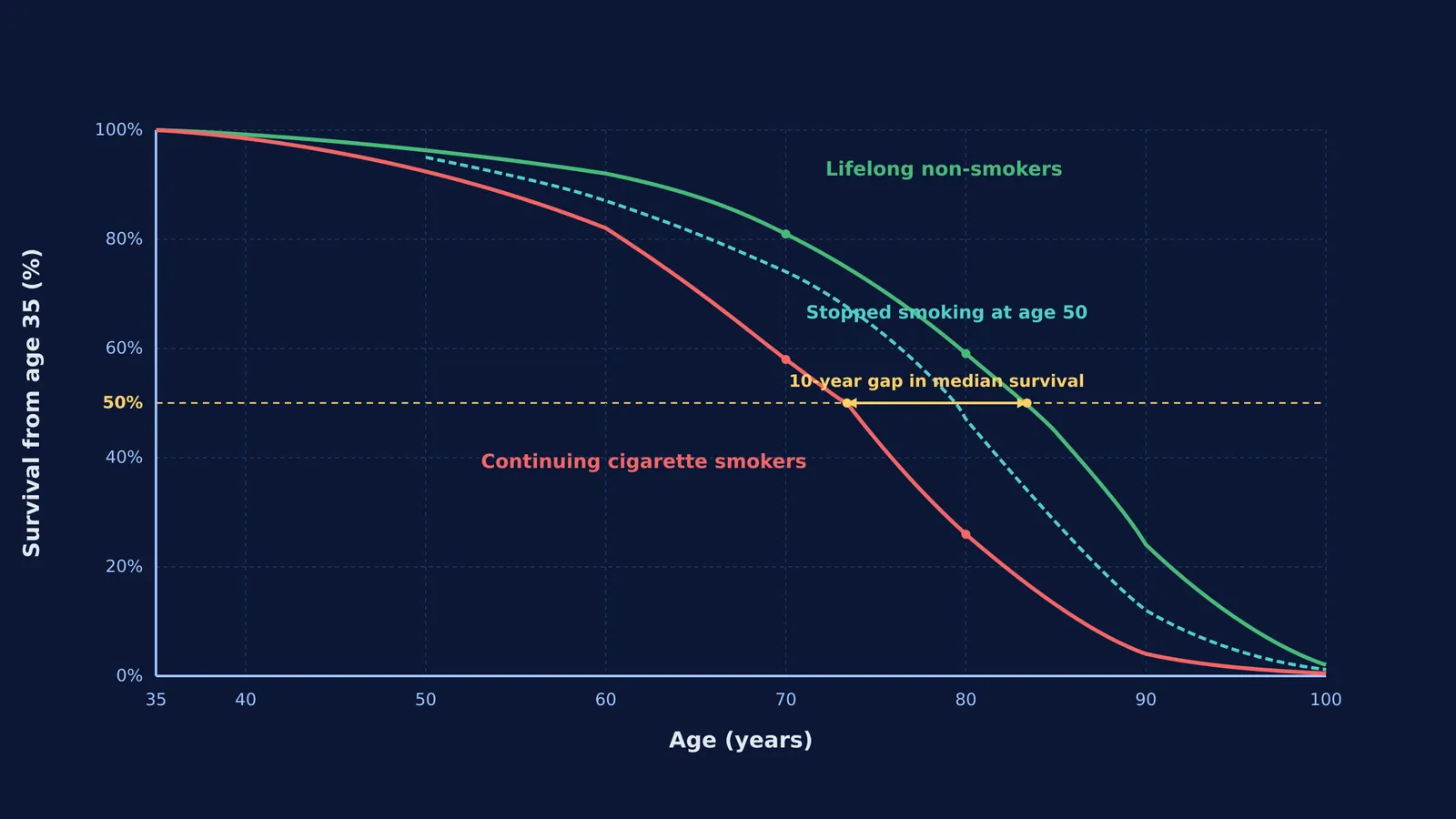
The 50-year data confirmed that persistent cigarette smokers died an average of 10 years earlier than non-smokers, as documented in the 2004 BMJ analysis. At age 70, 81% of non-smokers survived compared to 58% of smokers; at age 80, survival rates were 59% versus 26%. Yet stopping smoking worked: quitting at age 60 gained 3 years of life expectancy, quitting at age 50 gained 6 years, quitting at age 40 gained 9 years, and quitting at age 30 avoided nearly all excess mortality.
How do Bradford Hill’s criteria distinguish cause from correlation?
In his 1965 presidential address, published in the *Proceedings of the Royal Society of Medicine*, Austin Bradford Hill outlined nine viewpoints to assess causation in observational data:
Strength: large relative risks resist confounding.
Consistency: repeated findings across different populations and designs.
Specificity: exposure linked to distinct pathology.
Temporality: exposure must precede disease onset.
Biological gradient: increased dose yields increased risk.
Plausibility: mechanism makes biological sense.
Coherence: findings do not conflict with known disease history.
Experiment: removing the exposure reduces disease rates.
Analogy: similar exposures cause comparable cellular harm.
Today, the World Health Organization reports that tobacco kills more than 7 million people each year. In India, data from the National Centre for Disease Informatics and Research under the Indian Council of Medical Research indicate that tobacco-related cancers account for 48.7% of all malignancies in men, highlighting why public cessation services (including the national helpline 1800-11-2356) remain vital.
How can you apply causal thinking to your own study data?
Whether you are analyzing experimental curves in biology, evaluating research, or diagnosing errors on mock tests, distinguishing causation from correlation prevents costly missteps.
Students often confuse diagnostic scores with fixed ability, falling into survivorship bias (explore how survivorship bias distorts evidence) or drawing conclusions from small samples (as examined in the history of the t-test). Testing study interventions mirrors the logic of early controlled trials in medicine.
When you study cell division, oncogenes, or respiratory physiology in biology, the Fermi Concept Library covers every concept across biology and chemistry, each with its own lesson and place in the map.
If you get stuck distinguishing correlation from causal mechanisms in data problems, the Fermi Problem Library has worked problems with a step-by-step solver that explains the reasoning rather than printing an answer.


