

On this page
When parents watch a student study with a smartphone held close for hours, an understandable question often arises: is this invisible radiation dangerous? The word "radiation" commonly triggers fear of medical X-rays, cancer treatments, and hazardous nuclear fallout. Because mobile phone signals and X-rays are both electromagnetic phenomena that travel through the air, it is tempting to assume they carry similar biological risks.
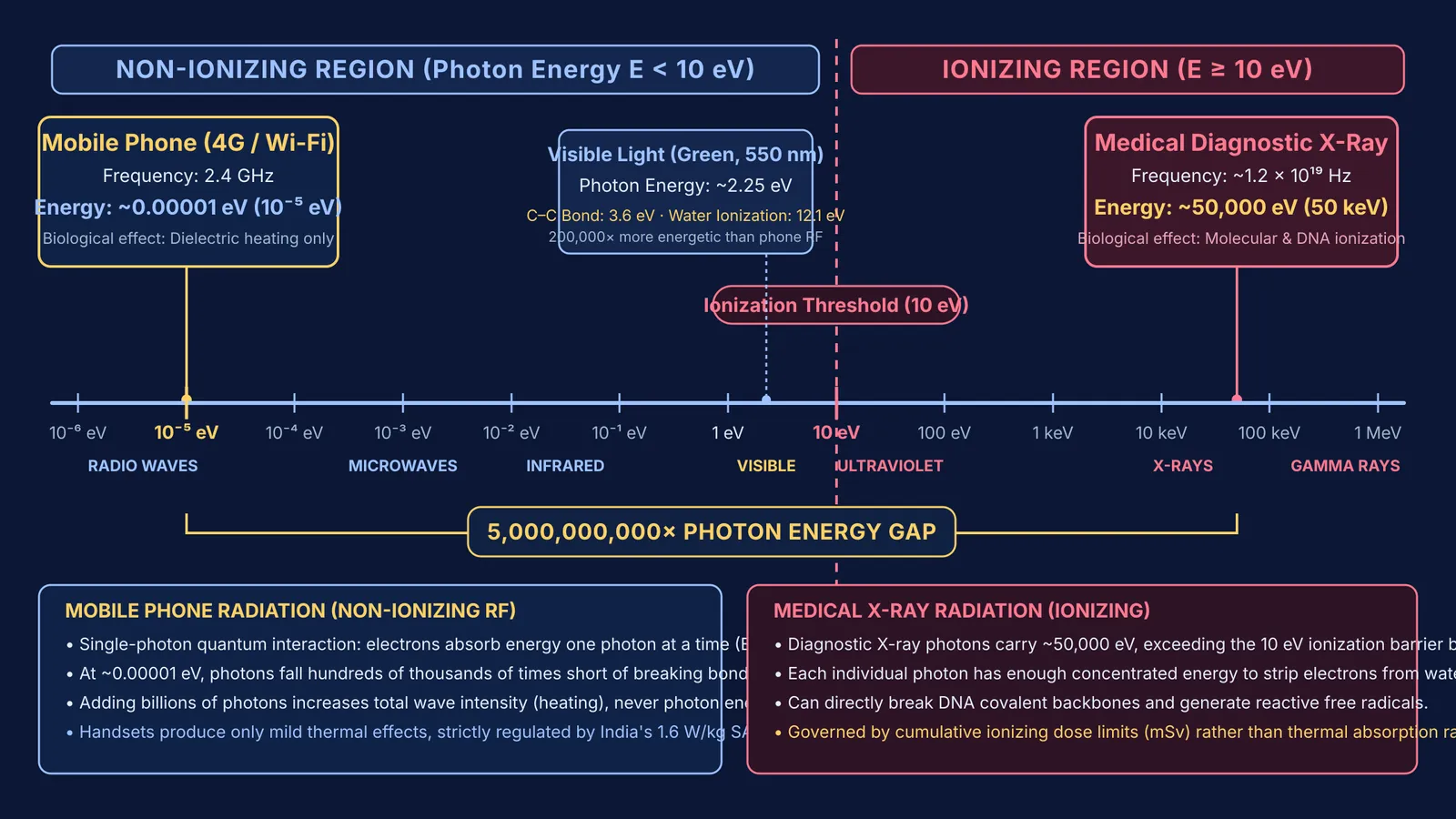
In physics, however, radiation simply describes energy moving through space as waves or particles. What determines biological impact is not the generic label, but the discrete energy carried by each individual photon. When measured by fundamental quantum mechanics, the physical divide between a mobile phone transmission and a medical X-ray spans nine orders of magnitude.
Is mobile phone radiation the same as X-ray radiation?
The short answer is no. Mobile phone signals and medical X-rays sit at opposite ends of the electromagnetic spectrum and interact with biological tissue through fundamentally different mechanisms.
As documented by the National Cancer Institute, mobile phones emit radiofrequency radiation, which is classified as non-ionising. Non-ionising radiation has low frequencies and long wavelengths. Crucially, its photons do not carry enough energy to remove orbital electrons from atoms or snap the chemical bonds of biological molecules.
By contrast, X-rays are ionising radiation. An ionising photon carries enough discrete energy to strip electrons from atoms, creating reactive ions that can shear phosphodiester bonds in DNA. If damaged DNA is misrepaired by cellular enzymes, it can trigger mutations that elevate long-term cancer risk. Between radio waves and X-rays lies ordinary visible light: a single photon of green light at 550 nanometres carries roughly 2.25 electron-volts (eV). That makes ordinary desk lamp light over 200,000 times more energetic than a smartphone photon, yet visible light cannot ionise DNA either.
How does Planck's equation explain non-ionising versus ionising radiation?
To see why mobile signals cannot alter DNA, look at Max Planck's foundational quantum relation connecting wave frequency to photon energy:
E = hf
Here, E is photon energy in Joules, h is Planck's constant, and f is frequency in Hertz. Using the exact recommended value defined by the National Institute of Standards and Technology, Planck's constant h equals 6.62607015 × 10⁻³⁴ Joule-seconds. A standard 4G LTE or Wi-Fi transmission operates near 2.4 gigahertz (2.4 × 10⁹ Hz). Multiplying h by f gives an energy of 1.59 × 10⁻²⁴ Joules, or roughly 0.00001 electron-volts (10 micro-electronvolts).
A routine diagnostic chest X-ray operates around 1.2 × 10¹⁹ Hz, delivering photon energies near 50 kiloelectron-volts (50,000 eV). Dividing 50,000 eV by 0.00001 eV demonstrates that an X-ray photon is five billion times more energetic than a mobile phone photon. As shown in our electromagnetic spectrum guide, stripping an electron from a water molecule in tissue requires roughly 12.1 eV, and breaking a carbon-carbon covalent bond requires 3.6 eV. Using the shortcut principles in our E = 1240/λ photon energy calculation, a phone photon carrying 0.00001 eV falls hundreds of thousands of times short of breaking any molecular bond.
Why can't a high number of radio photons act like an X-ray?
Parents often ask whether frequent, long-duration phone use could accumulate into an X-ray equivalent over time. Quantum mechanics demonstrates that photon absorption is a one-to-one interaction: an electron absorbs a single photon at a time. If an individual photon lacks the threshold energy to liberate an electron, adding trillions of identical photons cannot cause ionisation. As explored in our guide to calculating photons emitted per second, increasing signal strength only increases the quantity of non-ionising photons, never their individual quantum energy.
The only established biological effect of radiofrequency waves in human tissue is dielectric heating, where oscillating electromagnetic fields cause polar water molecules to rotate and produce mild thermal energy. The US Food and Drug Administration affirms that scientific evidence has not linked mobile radiofrequency radiation to adverse health consequences. Because handheld devices operate at low transmit power—typically between 0.1 and 1 watt—they produce negligible temperature increases in nearby tissue. To see how field oscillations and frequencies behave across materials, the Fermi Simulation Lab offers interactive simulations for ideas that are easier to see than to read.
How do Indian regulations and SAR limits protect your health?
To prevent excessive thermal effects, international guidelines from the International Commission on Non-Ionizing Radiation Protection (ICNIRP) establish exposure limits based on the Specific Absorption Rate (SAR), measured in watts per kilogram (W/kg).
India enforces particularly strict benchmarks. Under directives reported by the Press Information Bureau, the Department of Telecommunications mandates a handset SAR limit of 1.6 W/kg averaged over 1 gram of human tissue—ten times stricter than tower emission limits in many European nations and matching US FCC standards. When working through wave theory and radiation numericals, the Fermi Problem Library provides worked problems with a step-by-step solver that explains the reasoning rather than printing an answer.
How can you verify and manage everyday phone exposure?
Under safety guidelines issued by the Press Information Bureau and telecom authorities, simple everyday habits keep your exposure minimal while protecting study focus:
Check handset SAR compliance: Verify that your phone model meets India's 1.6 W/kg legal SAR limit, which manufacturers must display on handset packaging, in device settings, or via standard regulatory menus.
Use earphones or speakerphone: Holding the device away from your head substantially reduces exposure, because electromagnetic field intensity falls sharply with distance according to the inverse-square law.
Avoid calls in weak reception areas: Handsets automatically increase transmission power when searching for distant cell towers, so wait for stronger reception or send a text message instead.
Charge outside the bedroom: Placing the phone across the room or outside the study area eliminates overnight proximity and curtails late-night screen distractions.


