

On this page
It is the night before a birthday party, with twenty balloons to blow up. By balloon eight the room tilts and your fingers tingle. Most people guess they ran short of oxygen. The real cause is the opposite: you breathed out too much carbon dioxide.
Why do you feel dizzy after blowing up balloons?
Each balloon takes a big breath in and a long, hard breath out, repeated much faster than your body needs. That is overbreathing. MedlinePlus, the US National Library of Medicine's health site, defines hyperventilation as rapid and deep breathing, and says excessive breathing creates a low level of carbon dioxide in your blood. The symptoms it lists include light-headedness, dizziness, confused thinking and tingling around the mouth or in the arms.
The normal level of carbon dioxide in arterial blood is 38 to 42 mmHg, according to MedlinePlus's blood gas reference values. Your cells make CO2 at a steady rate and your lungs remove it. Breathe much more than you need and you remove it faster than you make it, so the level falls.
How does low CO2 make you light-headed?
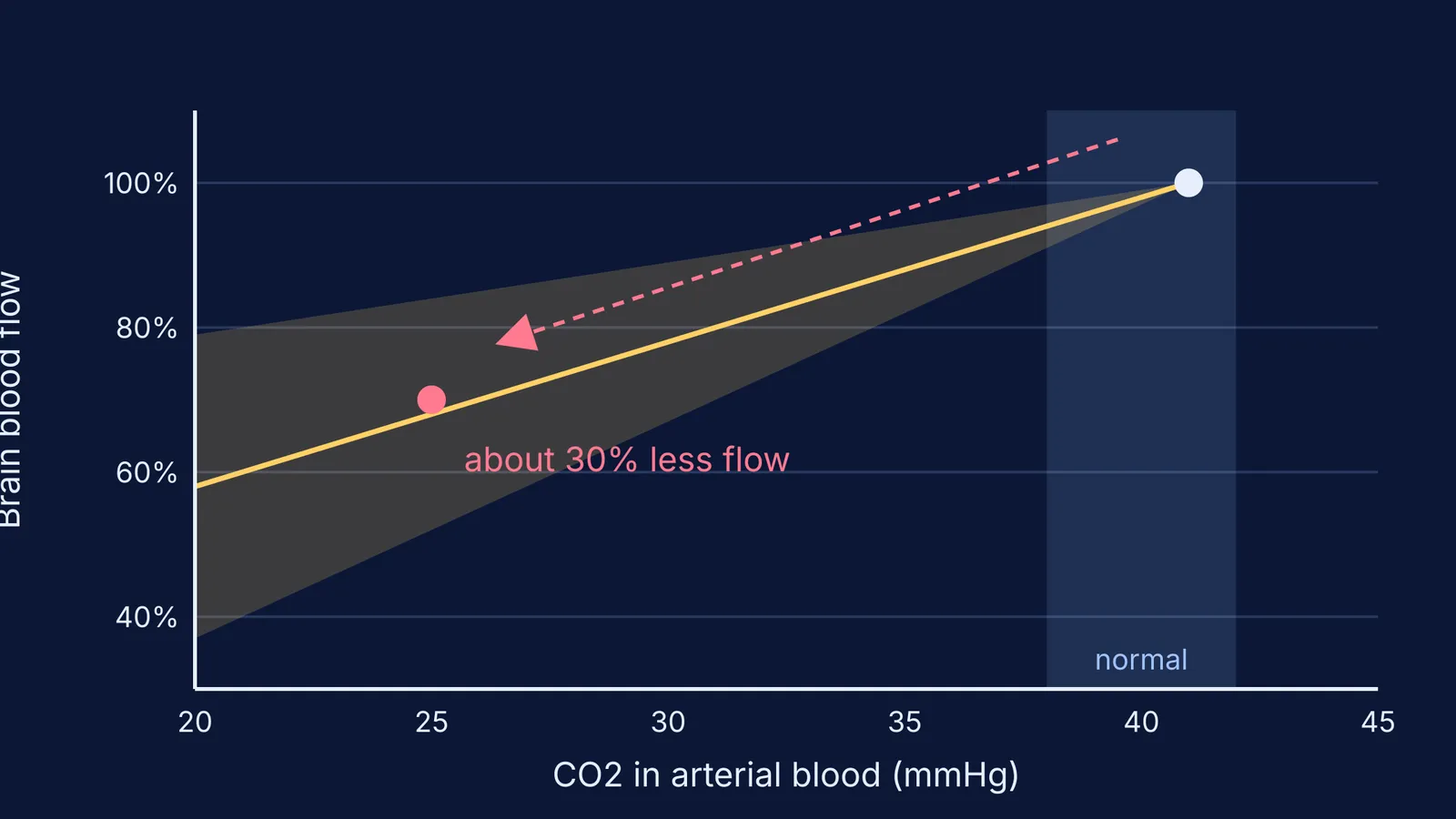
Brain blood vessels are unusually sensitive to CO2. A 2014 review in The Journal of Physiology by Willie, Tzeng, Fisher and Ainslie reports that brain blood flow falls by about 1 to 3% for every mmHg that CO2 drops below its resting level, because low CO2 raises the resistance of the brain's vessels. The authors note that this high sensitivity to CO2 is unique to the blood vessels of the brain.
The effect adds up quickly. In healthy volunteers, lowering arterial CO2 from about 41 to about 25 mmHg cut brain blood flow by about 30%, according to a 2019 review in Current Opinion in Anaesthesiology. Less blood reaching the brain is what you feel as the spins.
Low CO2 also makes your blood slightly more alkaline, a state called respiratory alkalosis. The Merck Manual lists light-headedness, confusion, tingling, cramps and fainting as its acute symptoms, and links hand and foot spasms in severe cases to a fall in ionised calcium in the blood.
Balloons may add one more push. Blowing hard against resistance is a little like the Valsalva manoeuvre, straining to breathe out against a blocked airway. In one lab study of the manoeuvre, people blew at 30 mmHg for 15 seconds, and blood pressure fell early in the blow because blood returning to the heart was held back.
A worked example. Say a quick run of balloons takes you from 41 to 33 mmHg (made-up numbers, just to show the arithmetic). That is 8 mmHg below resting. At 1 to 3% per mmHg, the range from Willie and colleagues, brain blood flow drops by roughly 8% to 24%.
Isn't it just a lack of oxygen?
No. Healthy arterial blood is already 94 to 100% saturated with oxygen, according to MedlinePlus, so extra breaths have very little oxygen left to add. Brain blood vessels also barely react to oxygen in the normal range: the 2014 review says they respond strongly to low oxygen only when arterial oxygen falls below about 50 mmHg, while the normal level is 75 to 100 mmHg.
So during overbreathing, the blood reaching your brain is full of oxygen. Less of it arrives, because the vessels have narrowed.
How can you blow up balloons without getting dizzy?
Use this checklist for party prep:
Take two or three ordinary, quiet breaths between balloons instead of gulping the next big one.
Stretch each balloon a few times first so the opening push is less of a strain.
Work in sets of three or four, sitting down, then rest for a minute.
If you feel light-headed, stop. Breathe out slowly through pursed lips, as if blowing out a candle, the technique MedlinePlus suggests for overbreathing.
For a big batch, use a hand pump or share the job.
The feeling usually passes once you go back to normal breathing. MedlinePlus advises contacting a doctor if fast breathing happens for the first time, comes with pain, fever or bleeding, or gets worse despite home care. If you notice yourself overbreathing at other times, for example when anxious before exams, talk to a doctor or call India's Tele MANAS helpline on 14416.
Where does this fit in your biology syllabus?
This is the Class 11 chapter on breathing and the exchange of gases, seen from the other side. Holding your breath does the reverse: CO2 builds up, as we explain in why we cannot hold our breath for long. The pH side is in how the bicarbonate buffer keeps blood pH at 7.4. For dizziness that starts in the inner ear, read why we feel dizzy after spinning.
If the links between CO2, pH and blood flow feel shaky, the Fermi Concept Library has a lesson for every concept in biology and chemistry, each with its place in the map. Next time the room tilts at balloon eight, you will know which gas to blame.


