

On this page
You roll up your sleeve, and the person drawing blood ties a rubber strap above your elbow and asks you to make a fist. Within seconds a bluish line rises under your skin. That strap is a tourniquet, and its trick is pressure physics, built on how differently arteries and veins are made.
What does the band on your arm actually do?
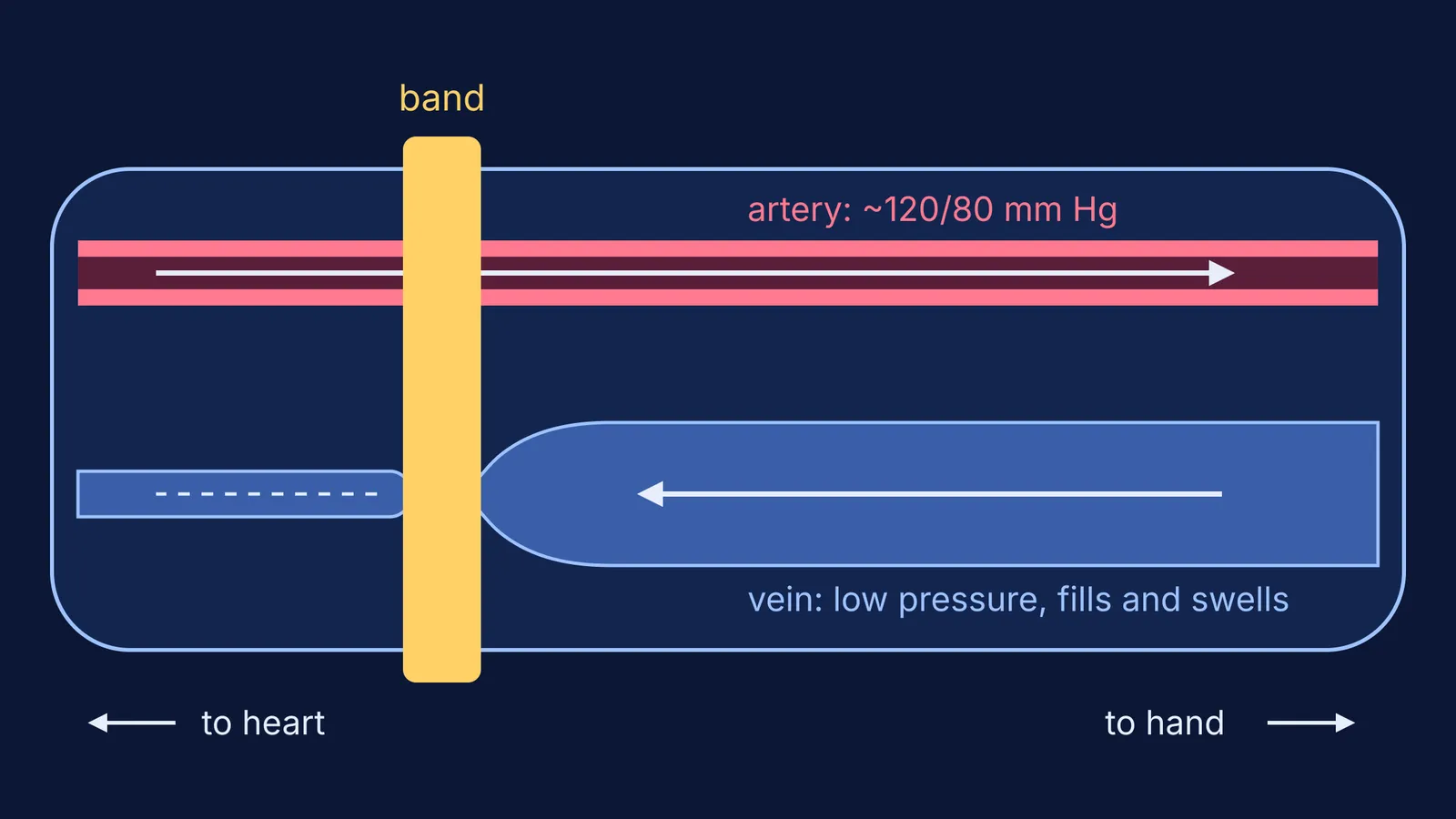
Blood reaches your hand through arteries and returns to the heart through veins, at very different pressures. A normal adult blood pressure in the arteries is 120/80 mm Hg, according to OpenStax Anatomy and Physiology. By the time blood has crossed the capillaries, pressure has dropped to about 18 mm Hg (OpenStax, capillary exchange), and the textbook notes that pressure in the veins is "normally relatively low".
The band is tied snug, not crushing. That squeeze flattens the low-pressure veins near the skin but does not stop high-pressure arterial blood pushing into the forearm. Blood keeps arriving and cannot leave by its usual exit, so it piles up in the veins below the band, which swell and rise.
Why can a band squash a vein but not an artery?
The answer is in the walls. Both vessels have the same three layers, the tunica intima, tunica media and tunica externa, as OpenStax describes. In arteries, smooth muscle and elastic fibres dominate the thick middle layer, built to withstand high pressure. Veins have "thin walls with large lumens".
A thin, floppy wall with low pressure inside flattens under a modest squeeze. A thick, muscular wall with high pressure inside pushes back.
That floppiness is also why veins can swell so much. Systemic veins hold approximately 64 percent of the blood volume at any given time, which is why they are called capacitance vessels, according to OpenStax.
Why are blood samples taken from veins and not arteries?
Most routine tests use venous blood, and the wall structure explains why:
Veins at the elbow crease lie close to the surface, so they are easy to reach.
Low pressure inside means the puncture stops bleeding with gentle pressure afterwards.
Arterial punctures hurt more. A 2015 randomised trial in PLOS ONE notes in its introduction that "arterial punctures are more painful than venous punctures", a difference believed to come from the nerves supplying the artery.
Arterial samples are kept for special cases, such as an arterial blood gas test, which measures oxygen and carbon dioxide in blood fresh from the lungs. To see what high arterial pressure does when a vessel is cut, read why blood spurts from an artery but flows from a vein. For a full side-by-side, see artery vs vein vs capillary differences.
How long should the band stay on?
One hospital venipuncture procedure says to apply the tourniquet 3-4 inches (roughly 8-10 cm) above the site, not tightly, and for no more than 1 minute (Akron Children's Hospital). It also says to make a fist and hold it rather than pump, and to remove the tourniquet before the needle comes out.
Why the hurry? While blood is trapped, raised pressure in the capillaries pushes extra fluid out into the tissue (the filtration explained by OpenStax), so what stays in the vein becomes more concentrated. A 2011 study in Biochemia Medica compared five tourniquet times in 250 adult volunteers. At 30 seconds it found no statistically significant increases in the chemistry tests; at 60 seconds, glucose, total protein, albumin, potassium and calcium, among others, had risen; at 180 seconds, every test evaluated showed a significant increase. A band left on too long can skew a report like the one in how to read a CBC blood test report.
Can you predict what happens if the band changes?
The band is so tight it stops arterial flow too. The veins do not fill, because nothing is coming in.
The band is tied below the elbow, but the needle goes in at the elbow crease. That vein will not bulge: above the band it drains freely towards the heart.
Why release the band before the needle comes out? With the band on, pressure in the vein stays high and blood would push out of the puncture.
Why does a fist help? Contracting muscles squeeze the veins around them and raise the pressure there, the skeletal muscle pump described by OpenStax, so the trapped veins get firmer.
If any of these felt shaky, the pressure picture is easier to see than to read. The Fermi Simulation Lab has interactive simulations for ideas like this, and the Fermi Concept Library gives each biology concept its own lesson and its place in the map.
Next time the strap goes on, watch the vein rise: that is the pressure gap between arteries and veins at work.


