

On this page
A blood report is typically a printout with three columns: the test, your result, and a reference range. If you have studied Body Fluids and Circulation in Class 11, you already know most of the lines. Here is how to read each one, and why a number just outside the range is a question for your doctor, not a diagnosis.
What does a CBC measure?
A complete blood count is a group of tests that measure the number and size of the cells in your blood, according to MedlinePlus, the US National Library of Medicine's health site. The main lines on the report are:
Haemoglobin (Hb): the iron-rich protein in red cells that carries oxygen from the lungs to the body.
RBC count: the number of red blood cells.
Haematocrit (often printed as PCV): the share of whole blood made up of red cells.
MCV: the average size of your red cells.
WBC count (total leucocyte count): the cells that fight infection; a differential count splits it into neutrophils, lymphocytes and the rest.
Platelets: cell fragments that help blood clot.
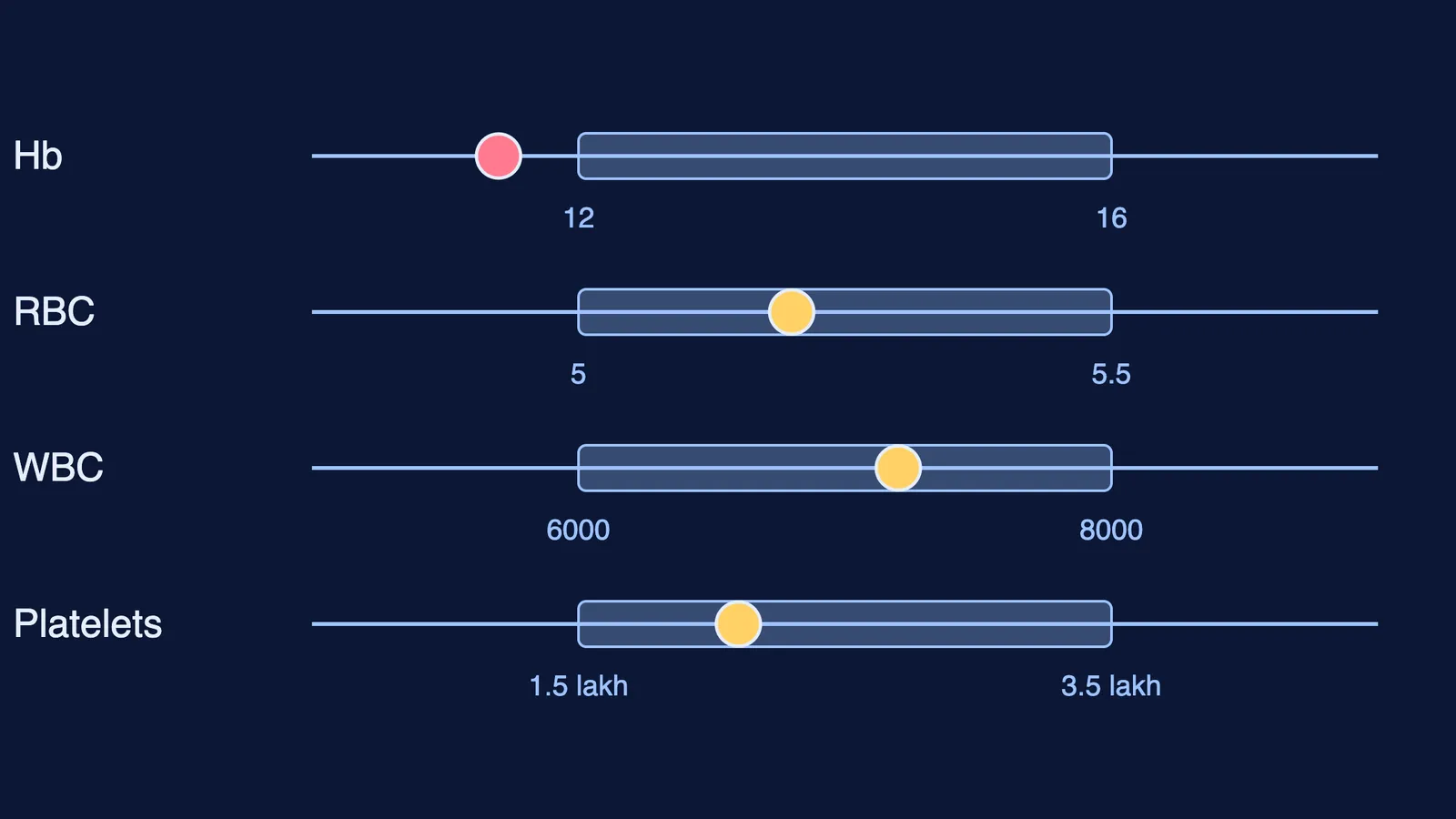
NCERT gives the textbook values in Class 11 Biology, chapter 15, Body Fluids and Circulation. A healthy individual has 12 to 16 g of haemoglobin in every 100 mL of blood. A healthy adult man has, on average, 5 to 5.5 million RBCs per mm³ of blood. WBCs average 6,000 to 8,000 per mm³. Blood normally contains 1,50,000 to 3,50,000 platelets per mm³. The same chapter says red cells live about 120 days; we explain why in why red blood cells live only about 120 days.
How do you read the units on an Indian lab report?
Reports print the same quantity in different ways, so translate before you compare:
g/dL means grams per decilitre, which is grams per 100 mL, the unit NCERT uses for haemoglobin.
g/L is grams per litre, so the number is ten times larger: 12 g/dL is 120 g/L. WHO uses g/L.
cumm means cubic millimetre, and 1 mm³ equals 1 microlitre, so /cumm and /µL mean the same thing.
lakhs/cumm for platelets: 2.1 lakh is 2,10,000.
millions/cumm for RBCs: 5.2 million is 52,00,000.
What does a reference range actually mean?
A reference range is a statistical boundary, not a line between healthy and ill. The WHO 2024 guideline on haemoglobin cutoffs to define anaemia sets its cutoffs at the 5th percentile of healthy people, so 5% of healthy individuals would still have a value below the cutoff. In that guideline, haemoglobin below 120 g/L counts as anaemia for children aged 12 to 14 and for non-pregnant women aged 15 to 65, and below 130 g/L for men aged 15 to 65. Its severity table calls 110 to 119 g/L mild anaemia for ages 12 to 14.
MedlinePlus adds that an abnormal level does not always mean a condition that needs treatment: diet, activity, medicines, a menstrual period and not drinking enough water can all shift the numbers.
A worked example: how do you read a sample CBC report?
Here is a made-up report for a 14-year-old, read line by line.
Hb 11.4 g/dL. Convert first: 114 g/L. WHO's cutoff for ages 12 to 14 is 120 g/L, and 114 sits in its mild band of 110 to 119 g/L. This is the line to ask about.
RBC 5.2 millions/cumm. Within NCERT's 5 to 5.5 million, an adult-man figure; use the lab's range.
WBC 7,200/cumm. Within NCERT's average of 6,000 to 8,000.
Platelets 2.1 lakhs/cumm. That is 2,10,000, inside NCERT's 1,50,000 to 3,50,000.
What could an out-of-range value mean? MedlinePlus lists dehydration, anaemia, heart disease and too little iron among the reasons red cell results can be abnormal. It says a high white cell count may be a sign of infection or a reaction to a medicine, and a low one may point to an autoimmune disorder, a bone marrow disorder or cancer. Only a doctor who knows your history can tell which applies, so do not start iron tablets or diets on your own. For the biology of why low haemoglobin feels like tiredness, read why anaemia makes you tired.
What should you ask the doctor?
Take the printout and these questions:
Which values are outside the range, and do they matter for me?
Could anything on the day, such as a period, a recent illness or not drinking enough water, have changed them?
Do I need a repeat test, and when?
Does this change anything about food, sport or my study routine before exams?
For the story behind the machines that do the counting, read how Wallace Coulter counted blood cells with a tiny hole. And if a line on the report sends you back to a chapter you half remember, the Fermi Concept Library has every concept in biology, each with its own lesson and its place in the map.


