On this page
Before the 1950s, counting the red cells in a drop of blood meant a technician, a microscope and a grid of tiny squares. Wallace Coulter, an engineer from Arkansas, replaced the eye with an electric circuit, and you can follow his physics with Class 12 current electricity.
What is the Coulter principle?
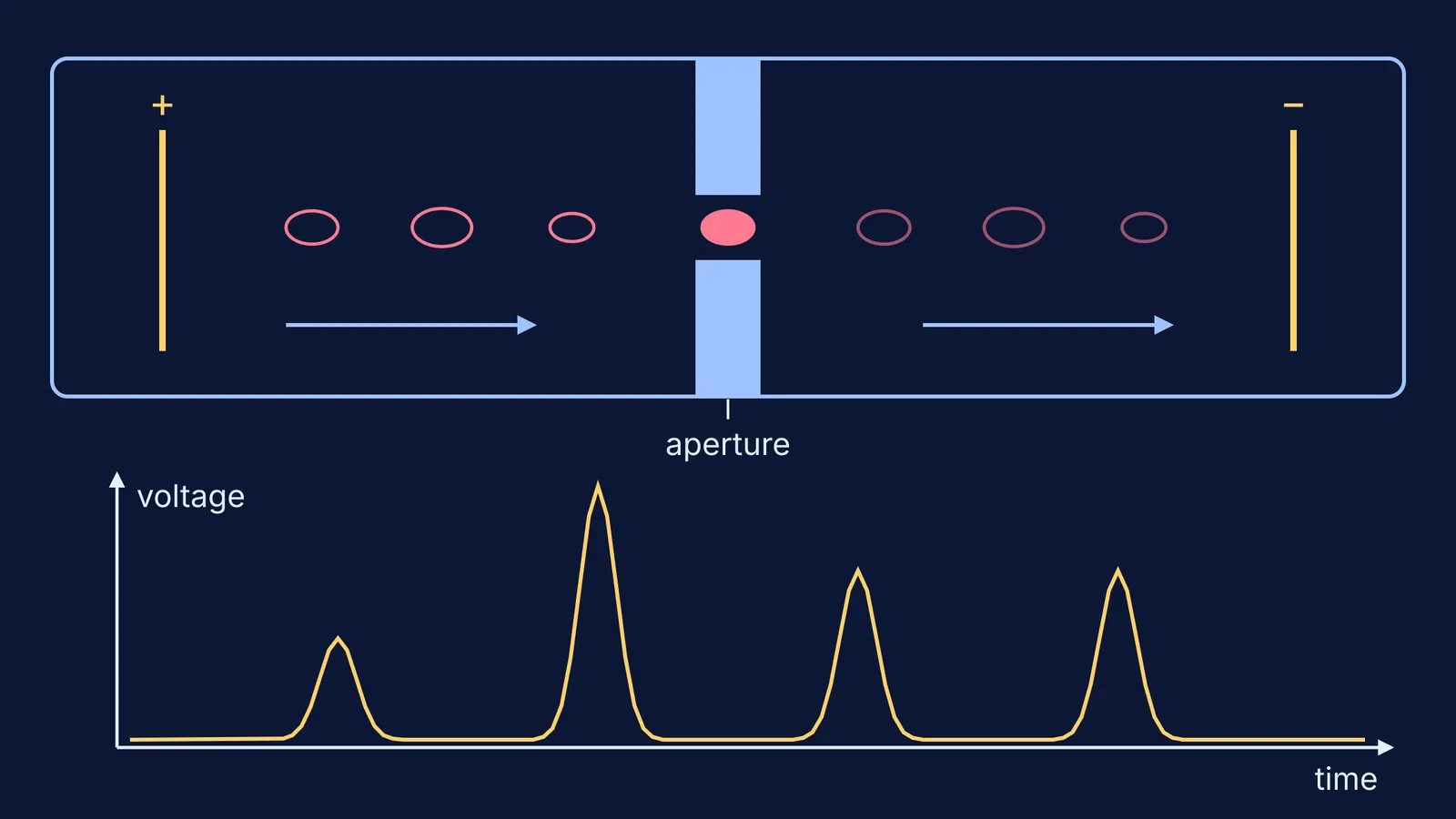
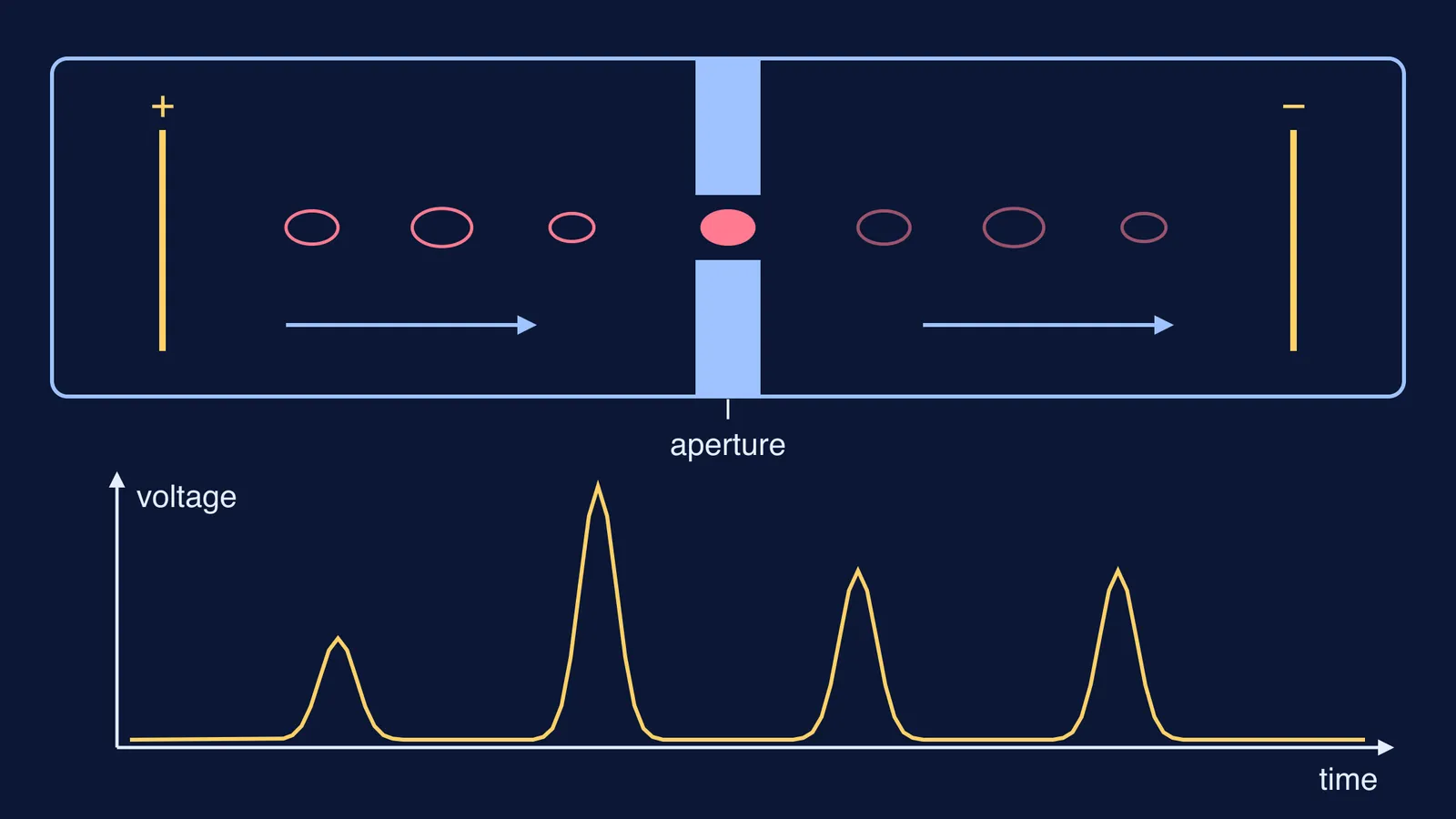
The Coulter principle says that a particle passing through a small hole that carries an electric current changes the resistance of that hole, and the pulse it makes is proportional to the particle's volume (Beckman Coulter short course).
Two chambers of a weak salt solution (an electrolyte) are joined by one tiny opening, the aperture, with an electrode on each side. Cells conduct far worse than the salt water. Coulter's patent says "there must be a difference between the electrical conductivity of the fluid and that of the particles" (US Patent 2,656,508). When a cell enters the aperture, it pushes out an equal volume of conducting liquid, the resistance rises, and the circuit records a voltage pulse.
How did Wallace Coulter invent the blood cell counter?
After the Second World War, Coulter kept a laboratory in the basement of his home, and "using blood, a needle and some cellophane" he invented the Coulter principle, according to Drexel University's Coulter biography. Beckman Coulter says he developed the method while working under contract to the United States Navy in the late 1940s (Beckman Coulter).
He filed the patent, titled "Means for counting particles suspended in a fluid", on 27 August 1949, and it was granted on 20 October 1953 (Google Patents record). For red cells, the patent says the bore would be "of the order of a thousandth of an inch or less in diameter", which is about 25 micrometres.
Coulter described the counter in his only technical paper, "High speed automatic blood cell counter and cell size analyzer", for the National Electronics Conference; Marshall Don Graham's history, The Coulter Principle: Foundation of an Industry00023-6), cites it in the conference's 1956 proceedings. In 1956 George Brecher and colleagues published an evaluation of the electronic red blood cell counter. In 1958 Wallace and his brother Joseph founded Coulter Electronics (Encyclopedia of Arkansas).
Why does a cell change the resistance so little?
You already know the formula for a wire, R = ρL/A; this simulation post on how a wire's length and thickness set its resistance lets you test it. Treat the aperture as a short cylinder of salt water. A cell of volume v that blocks part of the cross-section for a short length raises the resistance by roughly ρv/A². Divide by R and the lengths cancel:
ΔR / R ≈ v / (A × L) = cell volume ÷ aperture volume
Now put in numbers. Suppose an aperture 50 µm wide and 60 µm long. Standard apertures range from 10 to 2,000 micrometres in diameter (Beckman Coulter).
Aperture volume = π × (25 µm)² × 60 µm ≈ 117,800 µm³.
Use 1 µm³ = 1 femtolitre (fL), since (10⁻⁶ m)³ = 10⁻¹⁸ m³ = 10⁻¹⁵ L.
A normal red cell is 79 to 95 fL (MedlinePlus), so take 90 fL.
ΔR / R ≈ 90 ÷ 117,800 ≈ 0.00076, a change of about 0.08%.
Three lessons follow. The signal is tiny, so Coulter needed sensitive electronics. Double the cell's volume and the pulse doubles, so pulse height measures size. Double the aperture's width and A grows four times, so the relative change shrinks to a quarter, which is why the patent asks for a fine bore. The estimate ignores the cell's exact shape and how the current bends around it, but it gets the size of the effect right.
If resistivity and resistance still blur together, this explainer on resistivity versus resistance separates them. You can also open the topic in the Fermi Concept Library, where each concept in physics and biology has its own lesson and its place in the map.
What did the Coulter counter change for blood tests?
Drexel's biography says the counter handled more than 6,000 cells per second, cut the time for an analysis from 30 minutes to 15 seconds, and reduced error about tenfold compared with counting under a microscope (Drexel University). The cells it counts are the ones in your biology notes on the formed elements of blood.
Coulter died in August 1998 and was added to the National Inventors Hall of Fame in 2004 (Encyclopedia of Arkansas).
What can a student take from Coulter?
His idea joins two chapters you keep in separate notebooks. Try this with any formula.
Ask what physical thing the formula measures (here, a cylinder of salt water).
Ask what could block or change it (a cell).
Estimate how big the change is, in numbers.
Ask what would make the change easier to detect (a smaller hole).
If you get stuck at step 3, the Fermi Problem Library has a step-by-step solver that explains the reasoning rather than printing an answer.