

On this page
Why does wire geometry change electrical resistance?
When an electric potential difference drives current through a metallic conductor, conduction electrons drift through a crystal lattice, colliding with vibrating metal ions. The electrical resistance R measures this opposition to steady current. As OpenStax University Physics derives from microscopic current density, a uniform conductor's resistance depends on three physical properties: material resistivity ρ, length L, and cross-sectional area A.
The relationship is R = ρ × L / A. Resistance is directly proportional to length because a longer wire places more lattice collisions in series. Resistance is inversely proportional to cross-sectional area because a wider cross-section provides more parallel paths for charge carriers. For a cylindrical wire with diameter d, the cross-sectional area is A = π × (d/2)² = (π × d²) / 4, giving R = 4 × ρ × L / (π × d²). In Indian curricula, this geometry underpins CBSE Class 10 practicals, including measuring wire resistivity with Ohm's law.
What happens when you double length or diameter?
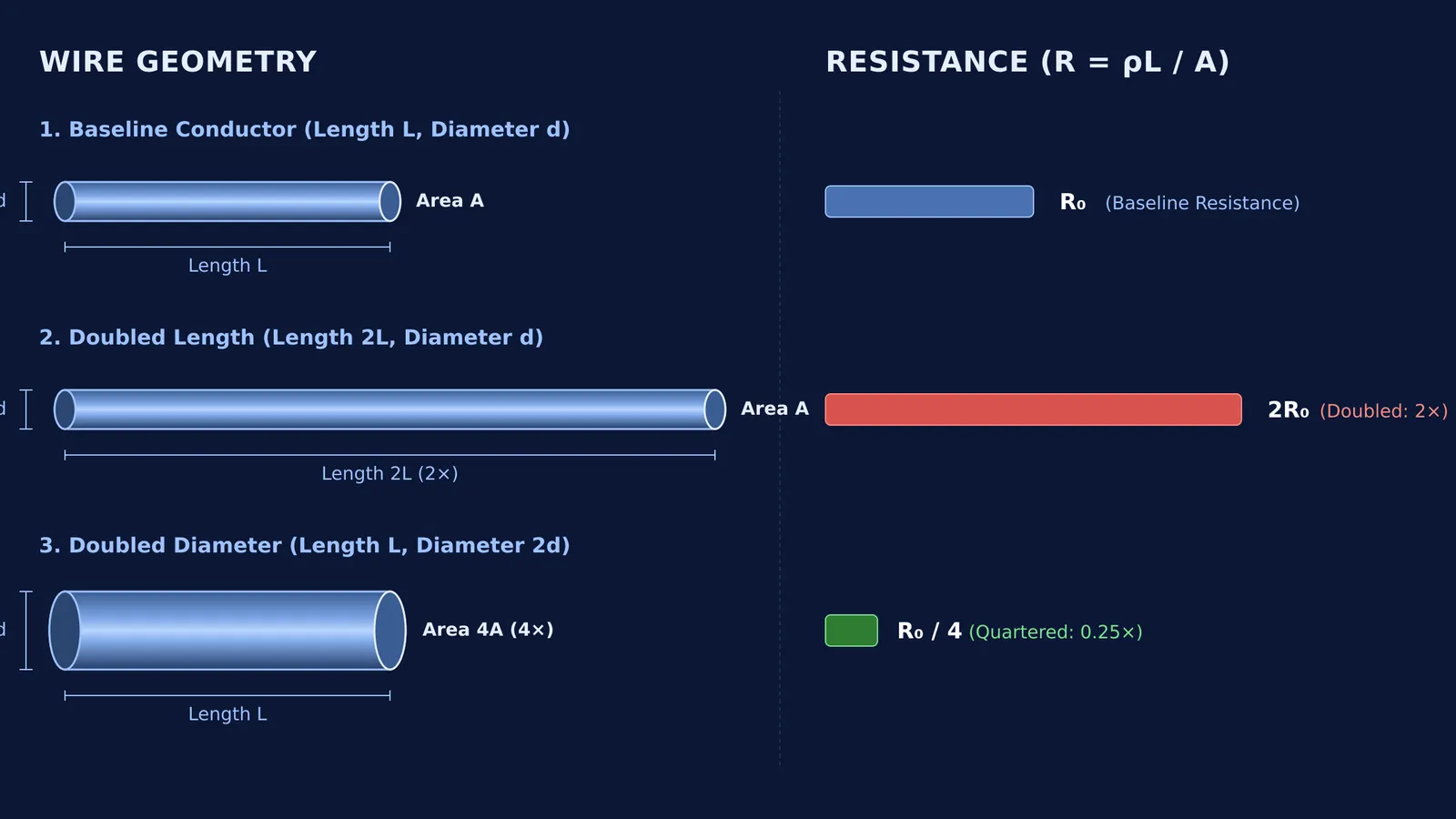
To see how geometry changes resistance, consider a copper wire with length L = 1.0 m and diameter d = 1.0 mm (radius r = 0.5 mm = 0.5 × 10⁻³ m). According to standard resistivity data in OpenStax College Physics, annealed copper has a resistivity of approximately 1.7 × 10⁻⁸ Ω·m at 20 °C. The baseline area is A = π × (0.5 × 10⁻³ m)² ≈ 7.85 × 10⁻⁷ m², yielding a baseline resistance R₀ = (1.7 × 10⁻⁸ Ω·m × 1.0 m) / (7.85 × 10⁻⁷ m²) ≈ 0.0216 Ω.
Now test two separate geometric modifications:
Doubling length (L → 2.0 m, diameter fixed at 1.0 mm): Resistance doubles to R₁ = ρ × (2L) / A = 2 × R₀ ≈ 0.0433 Ω. A 2-fold increase in length produces an exact 2-fold increase in resistance.
Doubling diameter (d → 2.0 mm, length fixed at 1.0 m): The new radius is 1.0 mm, quadrupling area to A₂ = π × (1.0 × 10⁻³ m)² ≈ 3.14 × 10⁻⁶ m². Because area scales with diameter squared, doubling diameter cuts resistance to R₂ = ρ × L / (4A) = R₀ / 4 ≈ 0.0054 Ω.
Why do students predict thicker wires resist more?
Despite the clean mathematics, many students stumble when predicting the effect of thickness. In a study published in the *American Journal of Physics*, researchers Paula Vetter Engelhardt and Robert J. Beichner evaluated conceptual understanding across 454 high school students and 681 university students using the DIRECT diagnostic test. In questions probing the physical determinants of resistance, only 31% to 36% of students answered correctly, and roughly 35% of high school students mistakenly believed thicker wires offer greater electrical resistance than thinner wires of identical length and composition.
This error stems from an intuitive "more is more" heuristic. Novice learners picture a thicker wire as containing "more matter", reasoning that extra material presents more obstacles to moving charge. They picture a hallway becoming more crowded, rather than recognising that cross-sectional area determines the width of the corridor. A thicker wire provides more parallel channels for electron flow, reducing resistance. Similar intuitive errors appear throughout introductory circuit analysis, as explored when testing circuit misconceptions with interactive simulations.
How do you use the predict-observe-explain routine with simulations?
Simply memorising that R scales with 1/A rarely dislodges this intuitive error. In *Probing Understanding*, educators Richard T. White and Richard F. Gunstone introduced the Predict-Observe-Explain (POE) routine to drive conceptual change. Before adjusting any slider, learners write down a specific prediction and justify their reasoning. Committing to a prediction creates cognitive investment: when the observed outcome contradicts their guess, the surprise forces them to confront and revise their mental model.
Interactive digital simulations make this routine especially effective. In *Physical Review Special Topics - Physics Education Research*, Noah D. Finkelstein and colleagues demonstrated that students investigating circuits through interactive simulations developed stronger conceptual mastery than peers working exclusively with physical equipment. Simulations isolate variables cleanly, allowing students to double diameter while holding length and temperature strictly constant. As Carl E. Wieman, Wendy K. Adams, and Katherine K. Perkins reported in *Science*, dynamic visual feedback allows learners to test cause-and-effect hypotheses rapidly.
In the Fermi Simulation Lab, students explore interactive simulations for ideas easier to see than read, adjusting conductor dimensions dynamically to watch resistance values and electron flow respond in real time.
What separates changing dimensions from stretching a wire?
In physics examinations such as CBSE Class 12 and JEE Main, examiners frequently test the difference between replacing a wire and stretching one. When you swap an existing wire for a separate wire of twice the length (L → 2L) while keeping diameter constant, resistance simply doubles because the volume of metal has increased.
By contrast, when a single wire of fixed volume V = A × L is stretched to twice its initial length, metal volume remains constant. As derived in standard electrodynamics texts such as OpenStax University Physics, volume conservation requires that doubling length (L' = 2L) forces cross-sectional area to halve (A' = A / 2). The stretched wire's resistance becomes R' = ρ × (2L) / (A / 2) = 4 × R. Stretching a wire to twice its length quadruples its resistance rather than doubling it, a distinction detailed in how stretching a wire changes its resistance. The Fermi Problem Library provides worked problems with a step-by-step solver that explains the reasoning rather than printing an answer, helping students master volume-conservation traps during revision.


