On this page
Your bone marrow makes red blood cells, your blood uses each one for about four months, and then your body breaks it down. Erythrocytes live up to 120 days in the circulation, after which the worn-out cells are removed, says the open textbook OpenStax Anatomy and Physiology 2e. The short reason: a red cell gives up the tools it would need to fix itself.
Why can't a red blood cell repair itself?
As an erythrocyte matures in the red bone marrow, it pushes out its nucleus and most of its other organelles, according to OpenStax. Mature red cells lack endoplasmic reticulum and do not synthesise proteins, the same chapter notes. They also lack mitochondria, so they rely on anaerobic respiration and do not use up the oxygen they carry.
That trade-off has a cost. An ordinary cell replaces damaged proteins by building new ones from its genes. A red cell cannot, so the enzymes and membrane proteins it leaves the marrow with must last its whole life.
A 2021 review by Perumal Thiagarajan, Charles Parker and Josef Prchal, How Do Red Blood Cells Die? in Frontiers in Physiology, describes the result. The activity of several glycolytic enzymes falls as red cells age. A small fraction of the oxygen released from haemoglobin forms reactive oxygen species, and older cells show greater oxidant injury.
How do narrow capillaries wear red cells out?
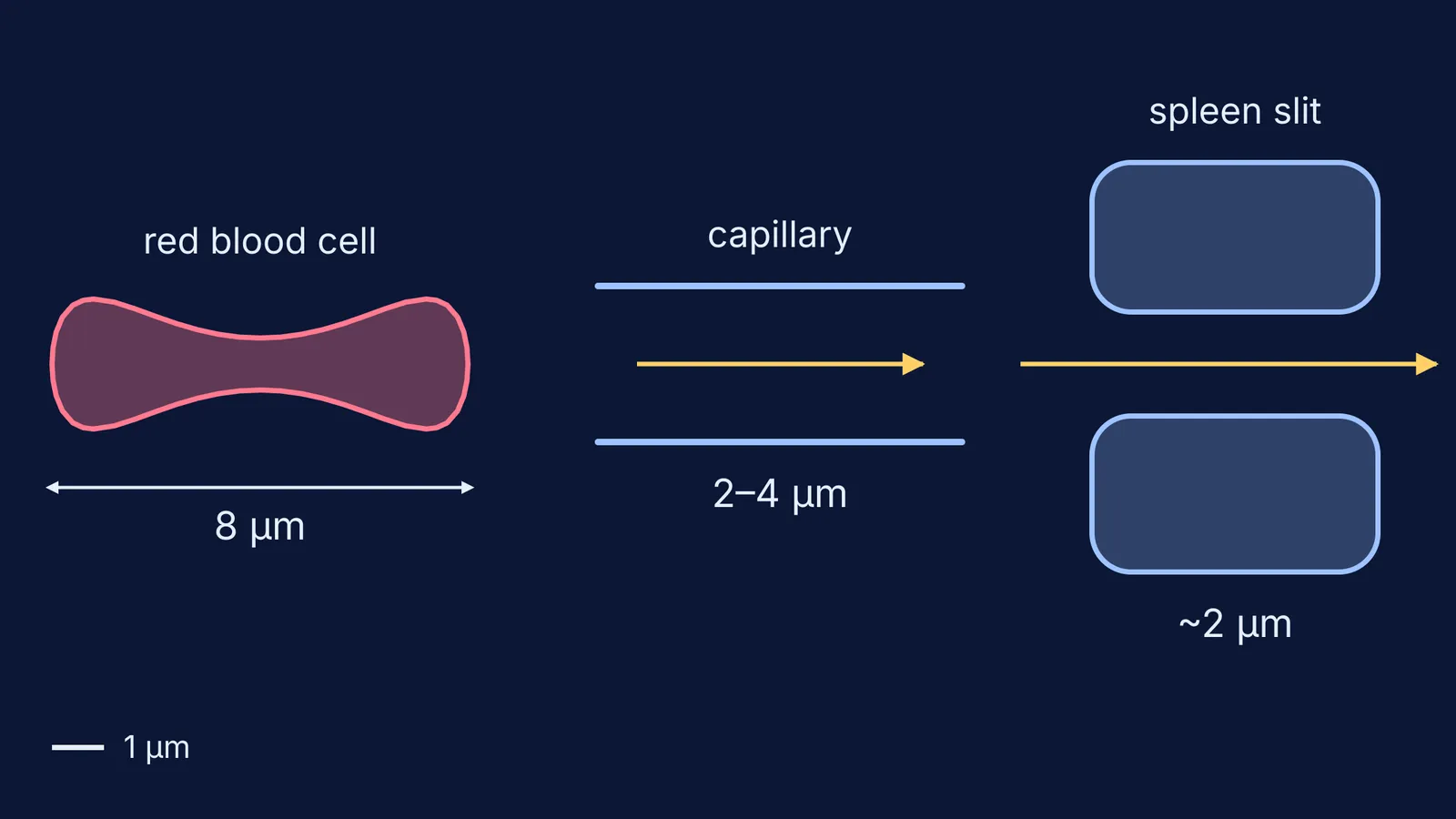
A red blood cell is a biconcave disc 8–10 µm across, 2.5 µm thick at the edge and 1 µm thick at the centre, according to the Thiagarajan review. The same review says it must pass, innumerable times in its life, through capillaries about 2–4 µm wide without rupturing: a gap between a fifth and a half of its own width.
Flexible structural proteins such as spectrin let the cell bend over on itself and spring back when it reaches a wider vessel (OpenStax). But time takes its toll. The review notes that ageing red cells lose haemoglobin and membrane by shedding tiny vesicles, and that they gradually lose deformability.
How does the spleen decide a red cell is too old?
The spleen is the hardest test. The physical stress on red cells is especially severe when they pass through slits about 2 µm wide between the cells lining the venous sinuses of the splenic red pulp (Thiagarajan et al., 2021). The review describes old red cells being engulfed by macrophages in the spleen and liver; OpenStax places these macrophages primarily in the bone marrow, liver and spleen (OpenStax).
Exactly how macrophages spot an old cell is not settled. The 2021 review lists three leading ideas: new surface antigens, the lipid phosphatidylserine appearing on the cell's outer surface, and reduced deformability. These changes go with ageing, but their causal role in removal has not been established, the authors write. For the organ's other jobs, read our post on the functions of the spleen.
How many red blood cells die every day?
About 5 million red cells, the average number in one microlitre of blood, are removed from circulation every second, according to Thiagarajan et al. (2021). Worked example: 5 million cells × 86,400 seconds in a day = 432,000,000,000, or about 4.3 × 10^11 cells a day. To keep your count steady, the marrow must replace them at the same pace. The hormone that drives this is covered in our post on erythropoietin and ANF, and the same replacement explains how your body replaces donated blood.
Little is wasted. Globin is broken down into amino acids. Iron is stored in the liver or spleen as ferritin or hemosiderin, or carried by transferrin back to the marrow. The rest of the haem becomes green biliverdin, then yellow bilirubin, which the liver uses to make bile (OpenStax). When a failing liver cannot clear bilirubin, the body takes on the yellowish tinge of jaundice.
How should you write this in a biology exam?
Examiners reward a chain of reasons, not a list of facts. Use four links, in this order:
Cause: no nucleus and no endoplasmic reticulum, so no new proteins.
Damage: oxidative injury plus repeated squeezing through 2–4 µm capillaries.
Result: glycolytic enzymes run down, haemoglobin and membrane are shed, the cell becomes less deformable.
Removal: macrophages, mainly in the spleen and liver, engulf old cells (how they recognise them is still debated); iron is recycled and haem becomes bilirubin.
Before you hand in, check for three common slips:
Writing that red cells have no organelles at all. They lose most, not all.
Treating 120 days as a fixed timer. It is an average.
Saying red cells use the oxygen they carry. Without mitochondria, they rely on anaerobic respiration.
If one link in the chain feels shaky, the Fermi Concept Library has a lesson on every concept in biology, each with its place in the map, so you can trace erythrocytes back to cell structure. For practice questions, the Fermi Problem Library has worked problems with a step-by-step solver that explains the reasoning rather than printing an answer.