

On this page
In short
The spleen is the body's primary blood filter and a key command centre for the immune system. It receives about 5% of cardiac output to scan for pathogens and remove aged red blood cells. It also serves as an emergency reservoir, storing red blood cells and platelets.
The spleen sits tucked under your ribcage on the left side, quietly receiving about 5% of your heart's output every minute (source). For NEET and biology students, understanding this organ means mastering how the cardiovascular and lymphatic systems meet. It acts as the body's primary blood filter and a key command centre for immune cells. Here is how its two main zones—the red pulp and the white pulp—divide the work.
Before exploring the spleen, make sure you are confident with the formed elements of blood, including the roles of circulating white blood cells.
How does the spleen filter old red blood cells?
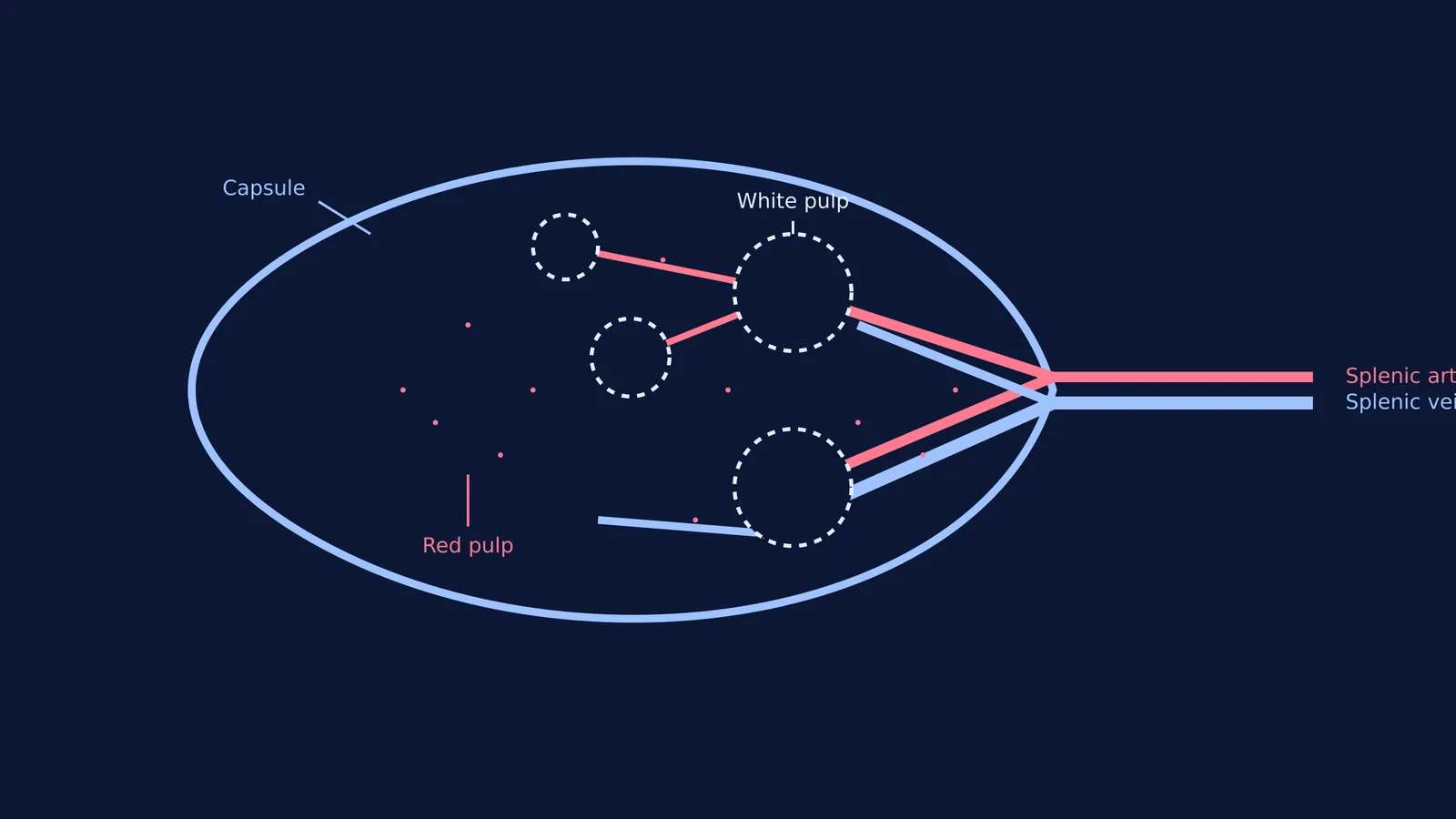
Red blood cells carry oxygen tirelessly, but they lack a nucleus to repair themselves. Their typical lifespan is about 120 days (source). After this, their membranes become rigid and less elastic. The spleen's red pulp, which makes up 75% to 80% of the organ's volume, serves as a strict quality control checkpoint (source).
Blood enters the spleen and flows into the open spaces known as the "cords of Billroth". To return to the main circulation, blood cells must squeeze through the narrow slits of the splenic sinuses. Young, flexible red blood cells bend and slip through easily. Old or damaged cells get stuck in the mesh. Macrophages waiting in the red pulp then engulf and destroy these trapped cells. They break down the haemoglobin and recycle the iron, sending it back to the bone marrow to build new red blood cells.
What is the spleen's role in the immune system?
While the red pulp handles the blood's plumbing, the white pulp acts as a military base. Taking up approximately 25% of the spleen, the white pulp is a secondary lymphoid organ (source). This means it does not create lymphocytes from scratch—the bone marrow does that—but it houses them and lets them encounter pathogens.
The white pulp is highly organised. T-cells gather around central arterioles in areas called periarteriolar lymphoid sheaths (PALS), while B-cells cluster in lymphatic follicles. Blood flowing through the spleen is constantly scanned by these lymphocytes. If an unwelcome microorganism is detected, they multiply and launch a targeted adaptive immune response, producing antibodies that are released into the bloodstream. This immune response relies on helper T cells, the exact same cells targeted during HIV replication. Because it filters the blood directly, the spleen is a primary defence against blood-borne infections.
How much blood and platelets does the spleen store?
The spleen is also an emergency reservoir. It holds about 30 mL to 50 mL of red blood cells, which it can push into the circulation if you experience sudden blood loss or intense physical stress (source).
More significantly, the spleen stores approximately 33% of the body's total platelets at any given time (source). Platelets are essential for clotting. By keeping a third of them in reserve, the body ensures it has a steady supply ready to deploy if you sustain an injury.
If you struggle to picture how the spleen's cords and sinuses fit into the wider lymphatic system, the Fermi Concept Library contains every concept in physics, chemistry, biology, mathematics and computing, each with its own lesson and its place in the map. Tracing these biological routes visually makes them much easier to remember.
What happens if the spleen is removed?
Although it performs all these critical tasks, you can live without a spleen. A splenectomy (surgical removal of the spleen) is sometimes necessary after severe abdominal trauma, as the organ is highly vascular and prone to bleeding if ruptured. It may also be removed to treat certain blood disorders where the spleen becomes overactive and destroys healthy cells too quickly.
When the spleen is removed, the liver and bone marrow take over most of its blood-filtering and storage duties. However, losing the white pulp leaves a gap in the immune system. Without the spleen's rapid antibody response, a person becomes significantly more vulnerable to infections from encapsulated bacteria, such as *Streptococcus pneumoniae*. To manage this risk, patients require specific vaccinations before or shortly after the surgery.
Checklist for NEET: Key spleen facts to remember
Examiners often test the spleen because it bridges multiple physiological systems. Use this checklist to verify your notes:
Location: Left upper quadrant (hypochondriac region), tucked behind the stomach and protected by the 9th to 11th ribs (source).
Weight and Size: Averages 150 grams and measures about 12 cm long (source).
Red Pulp: 75% to 80% of the spleen (source); destroys senescent (120-day-old) red blood cells (source) and recycles iron.
White Pulp: Approximately 25% of the spleen; a secondary lymphoid organ housing T-cells and B-cells for antibody production (source).
Storage: Sequesters 33% of the body's platelets (source).
Foetal function: Acts as a major site of blood cell production (hematopoiesis) between the 10th and 25th weeks in utero, before the bone marrow takes over (source).


