

On this page
When we think of hormones, we usually picture glands like the thyroid or pancreas. But some of your most vital hormones come from organs you might not expect. Your heart and your kidneys do not just pump and filter; they constantly monitor the state of your blood and release hormones to correct it.
If your blood pressure climbs too high, the heart releases a signal to bring it down. If your oxygen levels drop, the kidneys send a message to build more red blood cells.
How does atrial natriuretic factor lower blood pressure?
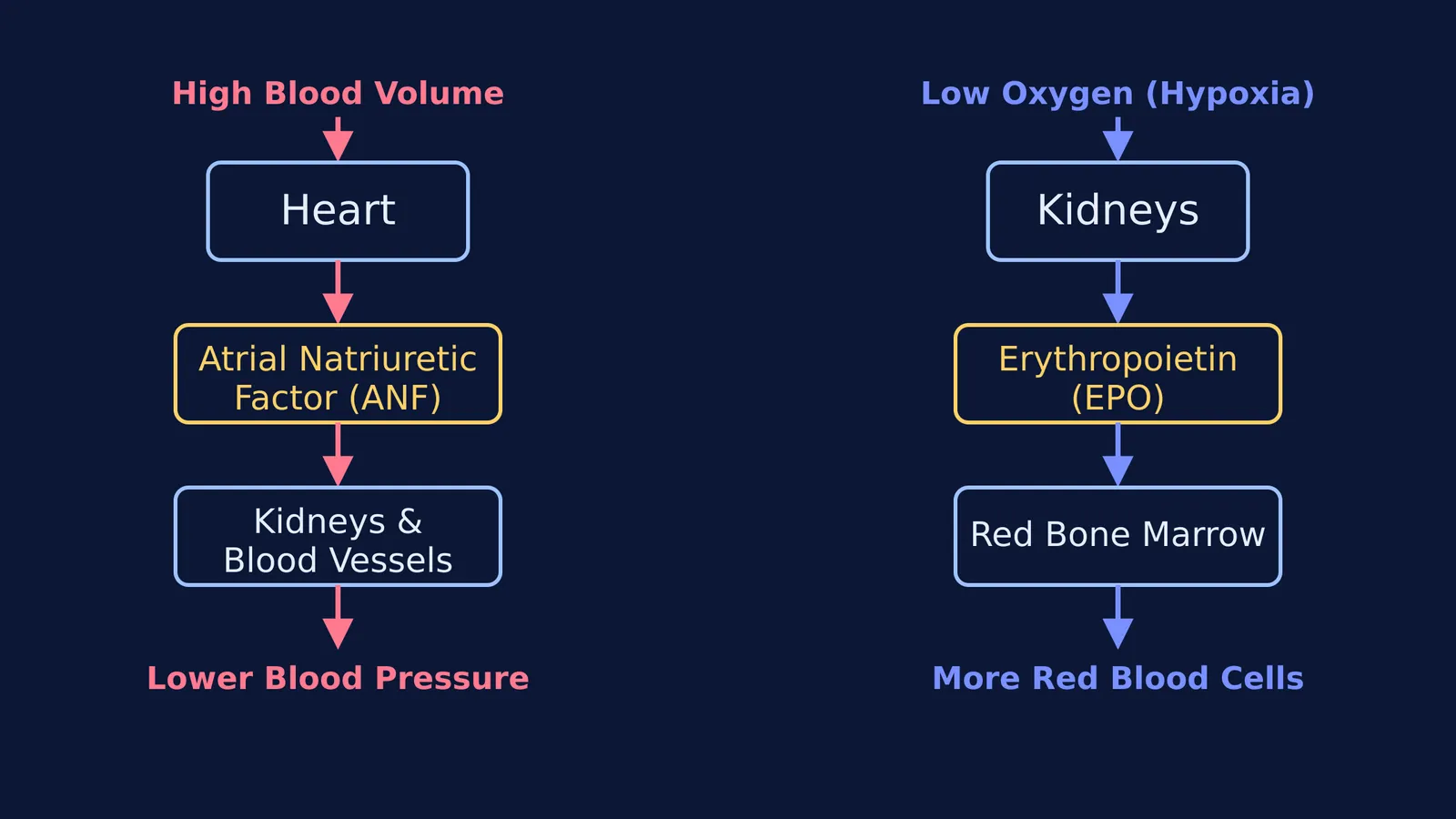
When the volume of blood returning to the heart is too high, the walls of the atria (the upper chambers) stretch. This mechanical stretch triggers the heart's muscle cells to release atrial natriuretic factor (ANF). Atrial natriuretic peptide is a 28-amino acid peptide (Wikipedia).
When ANF enters the bloodstream, it has two main targets:
Blood vessels: It relaxes the smooth muscles in your arteries and veins, causing them to widen (vasodilation). This immediately gives the blood more room to flow, reducing the pressure against the vessel walls.
Kidneys: It tells the kidneys to excrete more sodium (natriuresis) and water (diuresis) into the urine. By flushing out water, your total blood volume drops, which lowers blood pressure further.
It also blocks the release of renin and aldosterone, hormones that normally work to retain salt and water. For a deeper look into that opposing system, read our guide on regulating kidney function: ADH, the RAAS and ANF explained.
How does erythropoietin stimulate RBC formation?
While the heart watches over pressure, the kidneys monitor oxygen. If you move to a high altitude, lose blood, or simply do not have enough red blood cells to carry oxygen (hypoxia), the kidneys sense this shortage. In adults, 90% of erythropoietin is produced in the kidneys and 10% in the liver (Wikipedia).
Once released into the blood, EPO travels to the red bone marrow, the factory inside your bones. It binds to receptors on the cells that are destined to become red blood cells. This binding stops them from dying off early and speeds up their maturation. The result is a surge in new erythrocytes entering your circulation, restoring your blood's oxygen-carrying capacity. You can review the different types of cells in our guide on the formed elements of blood.
If you struggle to remember the different production sites and targets for hormones, the Fermi Concept Library maps out each endocrine pathway clearly so you can trace the steps.
How to study non-glandular hormones for exams?
Exams like NEET often test your knowledge of organs that have a secondary endocrine function. Instead of memorising a list, trace the feedback loops. Fermi's AI tutor can help you with this: ask it to draw the ANF pathway on a board, and it will check your understanding of each step before moving on.
When reviewing these topics, use this framework:
The trigger: What makes the organ release the hormone? (Atrial stretch for ANF; hypoxia for EPO).
The source: Exactly which cells produce it? (Atrial walls; peritubular cells near the capsule that filters blood in the kidney).
The target: Where does it go? (Blood vessels and kidneys; bone marrow).
The result: What changes? (Lower blood pressure; more red blood cells).
By learning the complete loop rather than isolated facts, you will see how beautifully the cardiovascular and excretory systems work together to keep your body in balance.


