

On this page
Every September, as the Sun climbs back over Antarctica, ozone 14 to 20 km above the ice starts to vanish. By early October, NOAA reports, it is essentially zero over that whole altitude band at the South Pole. The textbook chlorine chain cannot do this on its own. Here are the missing steps: where the chlorine hides, how frozen polar clouds free it, and why the damage waits for spring.
Why can't the textbook chlorine chain explain the ozone hole?
The Class 12 chain, Cl + O₃ → ClO + O₂ then ClO + O → Cl + O₂, is the one Mario Molina and Sherwood Rowland proposed in 1974. You also meet it in freons, DDT and CCl₄. Over Antarctica it has two weak points.
Its second step needs free oxygen atoms. ClO + O → Cl + O₂ only runs fast where ultraviolet light keeps splitting O₂ into O atoms. NOAA's Twenty Questions and Answers About the Ozone Layer: 2022 Update says this cycle matters most above about 30 km. The polar losses happen lower down, near 14 to 20 km, where O atoms are scarce.
Most chlorine is not free. After CFCs break up, most of their chlorine ends up in two harmless "reservoir" molecules: hydrogen chloride, HCl, and chlorine nitrate, ClONO₂. Neither attacks ozone. In Antarctic autumn, NOAA notes, HCl is high and ClO is very low.
What are chlorine reservoirs, and what are their oxidation numbers?
Use H = +1 and O = −2, except in a peroxide, where O = −1.
HCl: H is +1, so Cl is −1.
ClONO₂ (structure Cl–O–NO₂): N is +5 here, as in nitric acid. Then Cl + 5 + 3(−2) = 0, so Cl is +1.
Cl₂: an element, so 0.
HOCl: 1 + Cl − 2 = 0, so Cl is +1.
ClO: Cl + (−2) = 0, so Cl is +2. ClO is a radical.
Cl₂O₂ (structure Cl–O–O–Cl, a peroxide): O is −1, so each Cl is +1.
The two reservoirs carry chlorine at −1 and +1.
How do polar stratospheric clouds release chlorine?
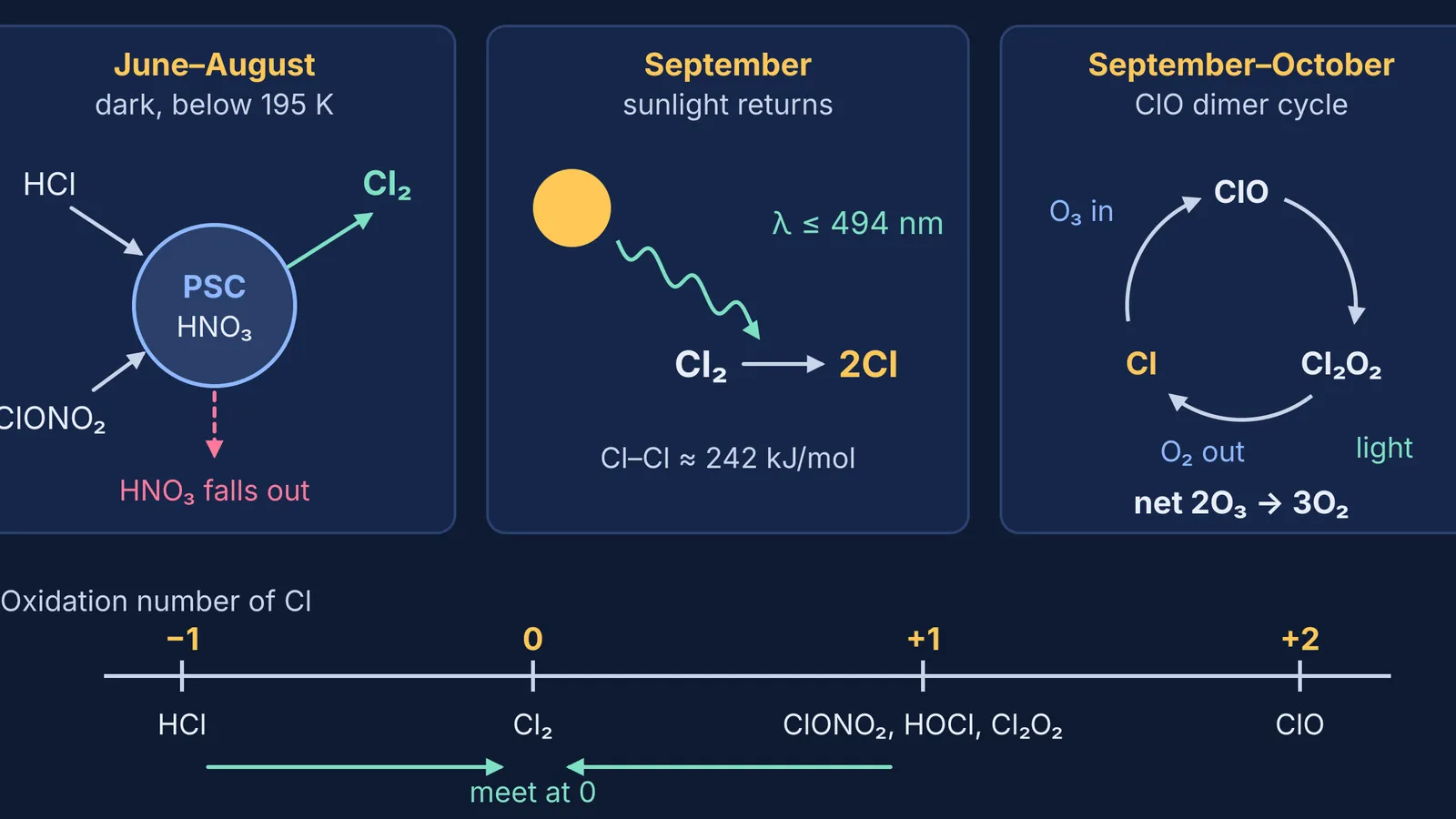
In the polar night, a ring of winds called the polar vortex seals off the air above Antarctica and it cools steadily. NOAA gives the thresholds: polar stratospheric clouds (PSCs) of nitric acid and water form below about −78 °C (about 195 K), and ice particles form below about −85 °C (about 188 K).
On the surfaces of these particles, the two reservoirs react with each other:
ClONO₂ + HCl → Cl₂ + HNO₃
Check the balance. Left: Cl 2, O 3, N 1, H 1. Right: Cl 2 in Cl₂; H 1, N 1, O 3 in HNO₃. Charges are zero on both sides.
Now look at chlorine: one atom goes from +1 to 0 and the other from −1 to 0. That is comproportionation, two oxidation states of one element meeting in the middle. It is the reverse of Cl₂ disproportionating in alkali. Nitrogen stays at +5 throughout. A second route does the same job: ClONO₂ + H₂O → HOCl + HNO₃, then HOCl + HCl → Cl₂ + H₂O.
Two details matter:
HNO₃ stays in the particles. NOAA explains that large PSC particles sink several kilometres in a few days, carrying nitric acid down. This is denitrification. Without that nitrogen, chlorine cannot easily be locked back up as ClONO₂.
Cl₂ just waits. In total darkness nothing splits it, so it builds up through July and August.
Why does the ozone hole open in spring and not in winter?
Ozone destruction needs light. Find each photon threshold from a bond enthalpy, using E = hc/λ per mole of photons: λ = Nₐhc ÷ E.
Constant: Nₐhc = 6.022 × 10²³ × 6.626 × 10⁻³⁴ × 2.998 × 10⁸ ≈ 0.1196 J m mol⁻¹.
Cl–Cl, 242 kJ/mol: λ = 0.1196 ÷ 242,000 ≈ 4.94 × 10⁻⁷ m, about 494 nm (blue-green light).
O=O, 498 kJ/mol: λ = 0.1196 ÷ 498,000 ≈ 2.40 × 10⁻⁷ m, about 240 nm (hard ultraviolet).
H–Cl, 431 kJ/mol: about 278 nm.
A bond enthalpy only sets the minimum energy. A molecule breaks only if it actually absorbs the photon. Cl₂ absorbs most strongly near 330 nm in the near ultraviolet, with a tail into violet light, according to the NASA JPL chemical kinetics data evaluation. HCl absorbs only far below its 278 nm threshold, which is why it was a safe reservoir in the first place.
So when sunlight returns in late August and September, Cl₂ + light → 2Cl straight away.
How does chlorine destroy ozone without oxygen atoms?
The answer, proposed by Luisa and Mario Molina in 1987, is the ClO dimer cycle. ClO meets ClO instead of an O atom. A NASA JPL report describes how ClO molecules combine to form chlorine peroxide, Cl₂O₂.
2Cl + 2O₃ → 2ClO + 2O₂
ClO + ClO → Cl₂O₂ (a third molecule carries away the extra energy)
Cl₂O₂ + light → Cl + ClOO
ClOO → Cl + O₂
Add them. ClO, Cl₂O₂ and ClOO cancel. Two Cl go in at step 1 and two come out in steps 3 and 4, so chlorine cancels too. Net: 2O₃ → 3O₂. Check oxygen: 6 atoms on each side.
A second cycle, ClO with BrO, adds bromine to the loss. NOAA says these two cycles cause most polar ozone loss, at rates up to 2 to 3% per day.
Worked example: how can a few ppb of chlorine remove ppm of ozone?
The figures below are approximate, rounded values typical of satellite and balloon measurements inside the vortex.
Ozone at 15 to 20 km before depletion: about 2 to 3 ppm (parts per million).
ClO at the peak: about 1 to 2 ppb (parts per billion).
Ratio: 2.5 × 10⁻⁶ ÷ 1.5 × 10⁻⁹ ≈ 1,700. Each active chlorine atom has to destroy on the order of a thousand ozone molecules.
Is that plausible? At NOAA's 2.5% per day, ozone after 60 days is 0.975⁶⁰ ≈ 0.22 of its starting value. Two sunlit months remove about four-fifths, more where losses run faster.
Here ppm is a mixing ratio at one height. The ozone hole itself is defined by total column ozone below 220 Dobson units, a measure explained in the post on Joseph Farman's discovery of the Antarctic ozone hole.
For more practice turning bond enthalpies into wavelengths, the Fermi Problem Library has a step-by-step solver that explains the reasoning at each line.
Why doesn't the Arctic get the same hole?
The Arctic vortex is weaker and warmer. NOAA says PSC temperatures last one to four months there, against about five over Antarctica, so less chlorine is activated and less HNO₃ is removed. Arctic losses are usually smaller.
Quick checklist
Most stratospheric chlorine sits in HCl (Cl −1) and ClONO₂ (Cl +1).
Below about 195 K, PSCs form and ClONO₂ + HCl → Cl₂ + HNO₃, a comproportionation.
Sinking particles remove HNO₃ (denitrification), so chlorine stays active.
Cl₂ needs only near-UV or violet light; its 494 nm threshold is at a far longer wavelength than O₂'s 240 nm.
The ClO dimer cycle needs no O atoms: net 2O₃ → 3O₂.
ClO has Cl at +2; Cl₂O₂ has Cl at +1.
The ozone hole means total column below 220 DU, not a ppm value.


