

On this page
When elephants scrape at a bank of red earth, or parakeets cling to a mud cliff, they are not short of food. The question is what soil gives them that leaves and seeds do not.
What is geophagy, and why do animals do it?
Geophagy is the deliberate eating of soil, usually at spots animals return to again and again: salt licks, mineral licks or, for South American parrots, clay licks called collpas.
There are two main explanations. Sodium: the soil supplies salt that a plant diet lacks. Detoxification: clay binds harmful plant chemicals in the gut, so less reaches the blood. Different animals in different places seem to eat soil for different reasons.
Why do elephants and deer need salt licks?
Plants and animals treat sodium very differently. In a 2020 review in Ecology Letters, ecologist Michael Kaspari noted that in plants, sodium is found in low concentrations and has little metabolic function, while animals need it to run the sodium-potassium pumps (Na-K ATPases) in their cells. He called sodium a '7th macronutrient' whose shortfall falls on two groups in particular: herbivores and detritivores.
That pump is the one in Class 11 biology; see our explainer on why the sodium-potassium pump moves 3 Na+ out for every 2 K+ in. An elephant, sambar or chital living on plants gets little sodium from its food, so it must find salt elsewhere.
A study in Hwange National Park, Zimbabwe, tested this. Holdø, Dudley and McDowell (2002) found that in the dry season, sodium in woody plants and natural water may fall short of what elephants need, and that the soils elephants ate held more sodium than other soils nearby. Females, which need more sodium during pregnancy and nursing, ate more soil than males did.
Why do parrots eat clay?
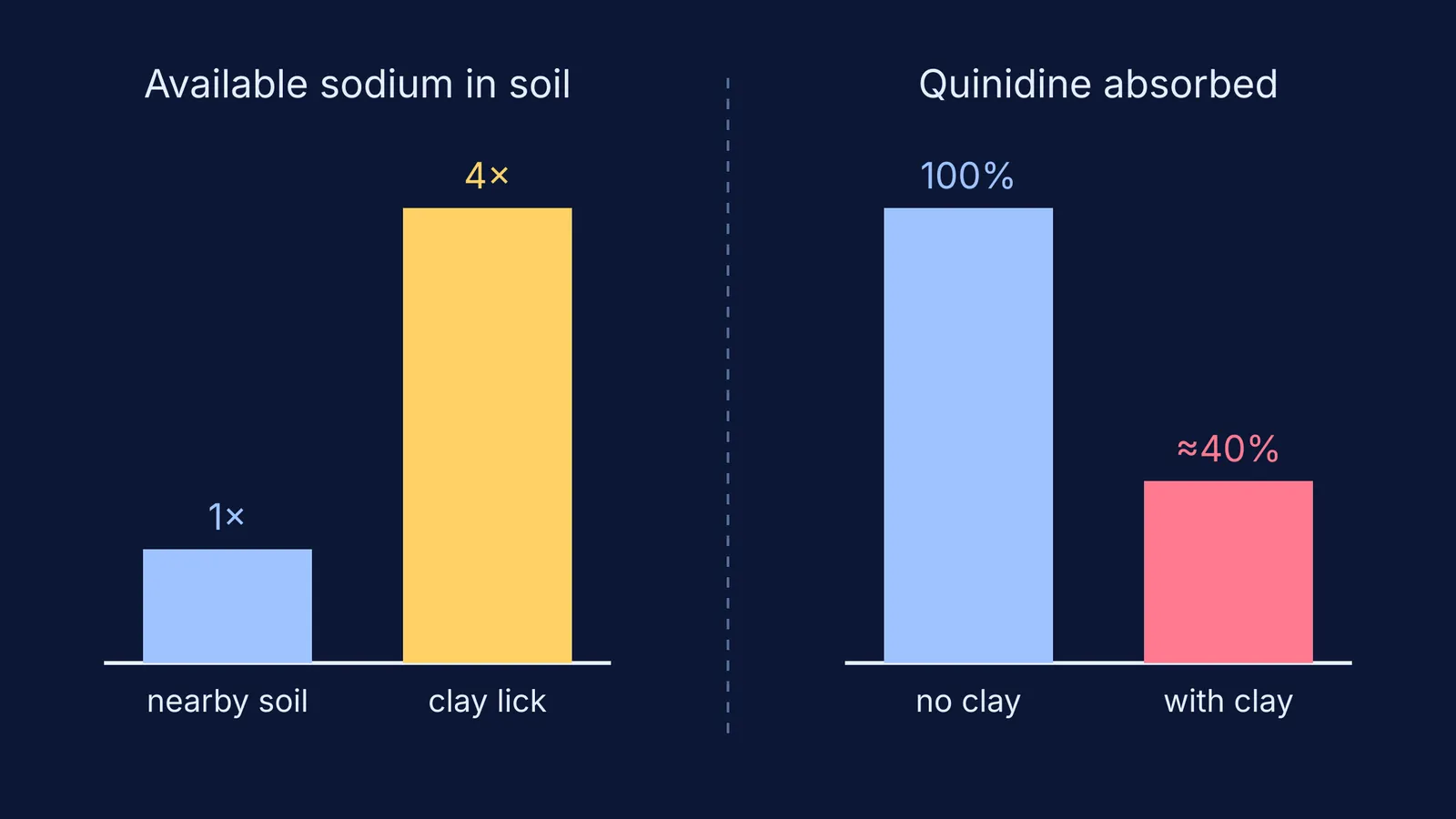
In captive Amazona parrots, Gilardi and colleagues (1999) found that clay given by mouth cut the uptake of quinidine, a plant alkaloid, by roughly 60%. The clay also stayed in the lower gut for more than 12 hours, which the authors suggested could help protect the gut lining. They argued that this would let parrots eat a wider range of chemically defended seeds.
Then the sodium idea came back. In south-eastern Peru, soils from 18 parrot clay licks averaged four times more available sodium than nearby soils the birds ignored, and how much clay a lick contained did not match how much sodium it held. Later work along Peru's Tambopata River, described by Texas A&M University in 2017, linked clay eating to the breeding season and suggested that protection from food toxins was not a driver there.
What do salt licks look like in India and Sri Lanka?
For Asian elephants the answer can differ. At Udawalawe National Park in Sri Lanka, Chandrajith and colleagues compared soil from eight sites where elephants ate earth with soil from sites they left alone. The chemistry was much the same, but the eaten soils were richer in the clay minerals kaolinite and illite. The authors concluded that these elephants most likely eat soil for detoxification, not to top up minerals.
The plant chemicals that clay can bind are mostly secondary metabolites such as alkaloids and tannins. Our posts on primary and secondary metabolites and on how Calotropis defends itself against herbivores explain why plants make them.
In Indian forests, staff add licks where natural ones run short. The Hans India reported in May 2023 that forest officials in and around Telangana's Kawal Tiger Reserve make salt licks from about 70% raw salt and 30% tank silt or clay, as a small mound near a water body, because a shortage of salt in summer can make animals ill.
How can you tell which explanation is right?
Write down what each explanation predicts, then check the evidence.
If sodium is the reason, expect:
lick soil with more sodium than the soil around it
more soil eating when need is higher: breeding, pregnancy, nursing or a dry season
less soil eating where animals get salt from water or food
If toxin binding is the reason, expect:
lick soil richer in particular clay minerals such as kaolinite or illite, but not in salt
more soil eating when the diet holds more bitter or toxic plants
in experiments, less toxin absorbed when clay is added
Now apply it to the studies above:
Hwange elephants: sodium-rich soil, and females eat more. Verdict: sodium.
Tambopata parrots: four times the sodium, tied to breeding. Verdict: sodium.
Udawalawe elephants: same chemistry, different clays. Verdict: toxins.
Same behaviour, different verdicts. Matching claims to evidence is also the skill behind assertion-reason questions.
This topic joins cell biology (the Na-K pump), surface chemistry (adsorption on clay) and ecology. If one of those feels shaky, the Fermi Concept Library gives each concept its own lesson and its place in the map.
Pick one study above and run the prediction checklist yourself.


