

On this page
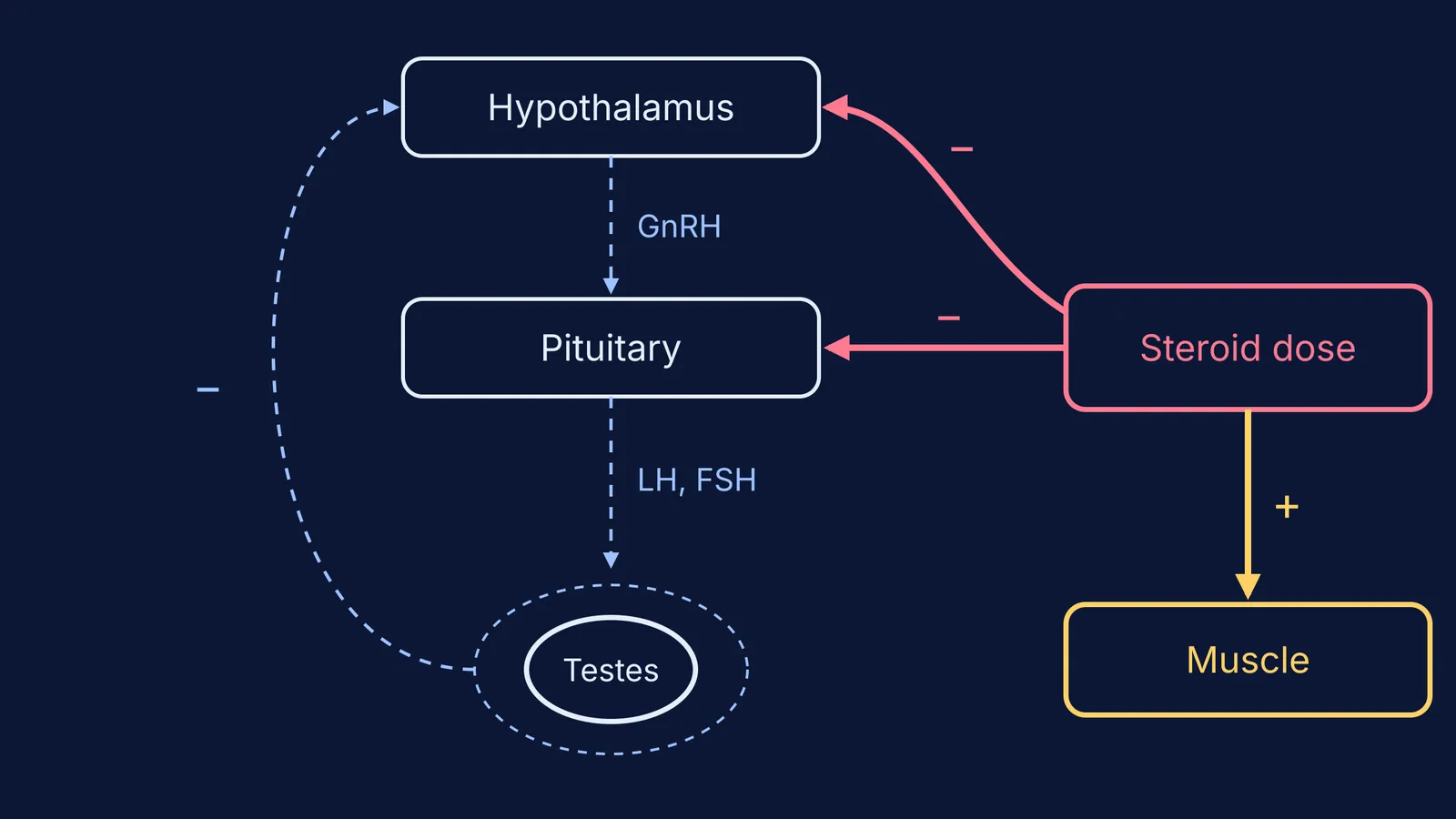
A shot of extra testosterone does two things at once. It tells muscle to grow, and it tells the brain that the body has plenty of testosterone, so the brain stops asking the testes to make any. That second message is a big reason sport's anti-doping rules treat these drugs so seriously.
What are anabolic steroids?
Anabolic androgenic steroids (AAS) are testosterone and lab-made drugs built to act like it. "Anabolic" means tissue-building; "androgenic" means they also produce male traits. The World Anti-Doping Agency's 2026 Prohibited List puts them in class S1, "Anabolic agents", and bans AAS "when administered exogenously", meaning taken into the body from outside. Examples on the list include boldenone and fluoxymesterone.
The same list notes that some of these substances are found in medicines for male hypogonadism, a condition where the body makes too little testosterone. The ban is about what they do in a healthy athlete.
How do anabolic steroids build muscle?
The clearest test is a 1996 trial in the New England Journal of Medicine led by Shalender Bhasin. Researchers randomly split 43 healthy men into four groups: placebo or testosterone, each with or without weight training. The testosterone groups got 600 mg of testosterone enanthate by injection every week for 10 weeks, a supraphysiologic dose, above the body's normal range.
Men who took testosterone and trained gained 6.1 kg of fat-free mass, and their squat capacity rose by 38 kg. Even among men who did not train, those on testosterone grew bigger arm and thigh muscles than those on placebo. The authors concluded that doses above the body's normal range, "especially when combined with strength training", increase muscle size and strength.
Why do steroids shrink the testes?
Your hormones run on a thermostat, explained in our guide to how hormonal feedback loops keep levels steady. The hypothalamus releases GnRH, the pituitary answers with LH and FSH, and the testes respond by making testosterone and sperm. When testosterone rises, it signals back to slow the whole chain.
Flood the body with outside steroids and that brake jams on. A 2016 PLOS ONE study by Rasmussen and colleagues describes "severe hypothalamic-pituitary-gonadal (HPG)-axis suppression due to negative feedback mechanisms". In the 37 current users it studied, LH and FSH were significantly suppressed and markers of the testes' sperm-making cells fell. With little LH and FSH to drive them, the testes shrink.
In that study, the effects did not simply vanish after stopping. The 33 former users, on average 2.5 years after their last dose, had testes 4.8 ml smaller than the 30 non-users, and 27.2% had testosterone below the normal range, against none of the controls. A 2023 scoping review in Endocrine Connections found that recovery of testis size and sperm production takes months to years and depends on age and how heavily the drugs were used.
What happens to the hormone loop when an athlete takes steroids?
Here is how to reason through the exam question "An athlete injects testosterone for 10 weeks. What happens to LH, FSH, sperm count and testis size?"
Blood testosterone rises far above normal.
The hypothalamus and pituitary sense it, so GnRH falls, and with it LH and FSH.
Low LH means the testes' own testosterone production drops.
Low FSH and low testosterone inside the testes means sperm production falls.
With less work to do, the testes shrink.
Stop the drug, and the loop can take months or longer to restart.
If any step feels shaky, the Fermi Concept Library has a lesson for every concept in biology, so you can revisit the hypothalamus-pituitary link before the next step.
Why are anabolic steroids banned in sports?
WADA adds a substance to its list when it meets at least two of three criteria: it can enhance performance, it poses an actual or potential health risk, or it violates the spirit of sport, as the International Paralympic Committee's summary of the 2026 list explains. WADA does not say which criteria each drug meets, but the research above shows steroids can boost performance and harm health. WADA lists the whole S1 class as "prohibited at all times", in and out of competition, not just on match day.
For more on the other banned classes and how testing works, see doping in sports: types, side effects and tests.
What should a young athlete or parent do?
If a coach, gym friend or website offers anything for "fast muscle", ask what is in it and do not take it on trust.
If a doctor prescribes any medicine, say that you play competitive sport so they can check it against the anti-doping rules.
Remember that your body is still building its own hormone system; read up on what androgens and oestrogens normally do.
A parent might say: "I'm not accusing you. I just want to know what's in anything you take, because some things are banned for health reasons, not just to keep sport fair."
If the feedback idea still feels abstract, Fermi's AI tutor can draw the figure and check your understanding as you go.


