

On this page
The cloaca turns up in frog diagrams, bird questions and, sooner or later, a question about the platypus. Several vertebrate classes have one, but NCERT names it in only one class description. Here is the list, the mammal exceptions and the textbook's exact words.
What is a cloaca?
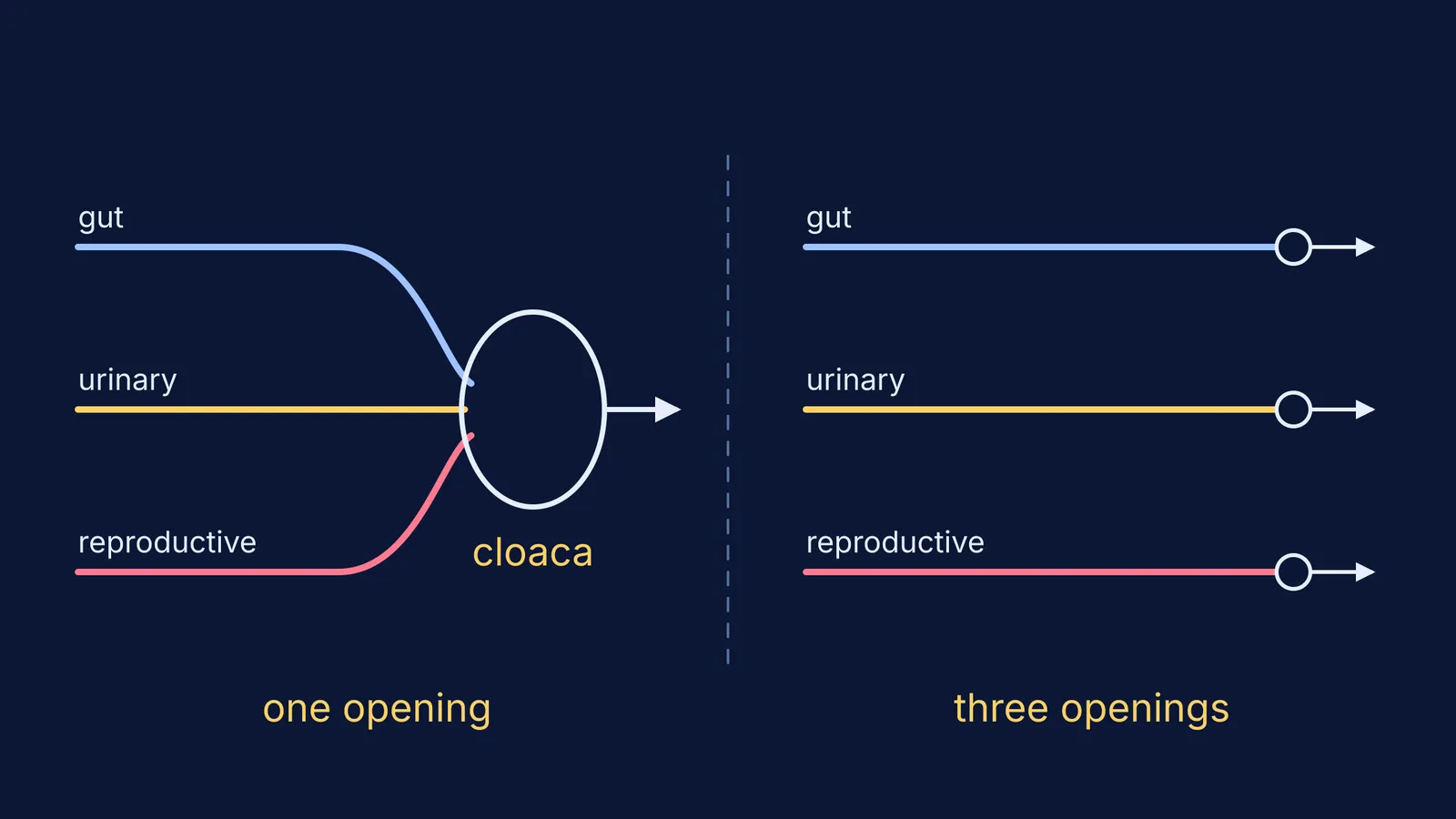
A cloaca is the single rear opening shared by the digestive, urinary and reproductive tracts of many vertebrates, as the cloaca reference entry puts it.
NCERT's definition sits inside its description of amphibians, and it is the one to learn word for word: "Alimentary canal, urinary and reproductive tracts open into a common chamber called cloaca which opens to the exterior" (NCERT Class 11 Biology, Chapter 4: Animal Kingdom).
Notice the two parts: a common chamber where three tracts meet, and one opening from that chamber to the outside. Write both and your definition is complete.
Which vertebrate classes have a cloaca?
Here are NCERT's seven vertebrate classes in textbook order (NCERT Chapter 4), with the anatomy from the cloaca entry:
Cyclostomata (lamprey, hagfish): in lampreys only part of a cloaca remains, and the anus opens separately.
Chondrichthyes (sharks, rays): yes, all cartilaginous fish have one.
Osteichthyes (bony fish such as rohu and catla): mostly no; some ray-finned fishes keep part of one, while lobe-finned fishes have a true cloaca.
Amphibia (frogs, toads, salamanders): yes, all.
Reptilia (lizards, snakes, turtles, crocodiles): yes, all.
Aves (birds): yes, all.
Mammalia: mostly no, with a few exceptions.
So the short answer is amphibians, reptiles, birds and cartilaginous fish, plus the egg-laying mammals and a few others. For the frog in detail, read why a frog has a cloaca instead of separate openings; for birds, see why most birds have no urinary bladder.
Do any mammals have a cloaca?
Yes, and the monotremes are the example to know. Monotremes have a single duct, the cloaca, for their urinary, digestive and reproductive systems, and their name comes from the Greek monós (single) and trêma (hole) (Monotreme entry). There are five living monotreme species, the platypus and four echidnas (Monotreme entry). Platypuses and echidnas are also set apart from all other mammals because they lay eggs (Australian Museum).
They are not the only ones. The cloaca entry also lists marsupial moles and afrosoricids, such as tenrecs and golden moles, and notes that pikas, beavers and some shrews keep a cloaca as adults. These animals are outside the NCERT syllabus, so name the platypus in your answer.
Most other mammals have moved away from a cloaca. In marsupials the genital tract is separate from the anus, though a trace of the cloaca remains on the outside (cloaca entry). Placental females, humans included, have three separate openings: the urethra, the vagina and the anus (Monotreme entry).
How does NCERT phrase it in each class description?
This is where students get caught. In the 2026-27 reprint of NCERT's Animal Kingdom chapter, the word cloaca appears in only one class description. Here is what each class description says about reproduction:
Chondrichthyes: "In males pelvic fins bear claspers. They have internal fertilisation and many of them are viviparous." No cloaca.
Osteichthyes: "Fertilisation is usually external." No cloaca.
Amphibia: the full cloaca sentence quoted above. This is the only class where NCERT uses the word.
Reptilia: "Sexes are separate. Fertilisation is internal. They are oviparous and development is direct." No cloaca.
Aves: the same four sentences as reptiles, word for word. No cloaca.
Mammalia: lists "Oviparous-Ornithorhynchus (Platypus)" as an example, but says nothing about a cloaca.
How should you write a cloaca answer in an exam?
Worked example. Question: Define cloaca. Name the vertebrate groups that have one and the mammal that is an exception. (3 marks)
A model answer, one line per mark, using only NCERT example animals:
A cloaca is a common chamber into which the alimentary canal, urinary and reproductive tracts open, and which opens to the exterior.
It is present in amphibians (Rana), reptiles (Calotes), birds (Columba) and cartilaginous fishes (Scoliodon).
Most mammals have separate openings, but monotremes such as Ornithorhynchus (platypus), an egg-laying mammal, have a cloaca.
Before you write, check: chamber and opening, not just hole; NCERT genera; cartilaginous fish included; platypus named.
For more questions like this, the Fermi Problem Library has worked problems with a step-by-step solver that explains the reasoning rather than printing an answer. If the link between the cloaca, excretion and reproduction still feels loose, the Fermi Concept Library gives every biology concept its own lesson and its place in the map.
For the rest of the chapter in one place, read our Animal Kingdom Class 11 overview of phyla, coelom and chordate classes.


