

On this page
Watch a humpback surface and you see only a slick back, a puff of mist and a low whoosh. The whale never lifts its head out of the sea to breathe. The reason sits on top of its head: the blowhole, which is simply a nose in an unusual place.
Why do whales breathe through a blowhole?
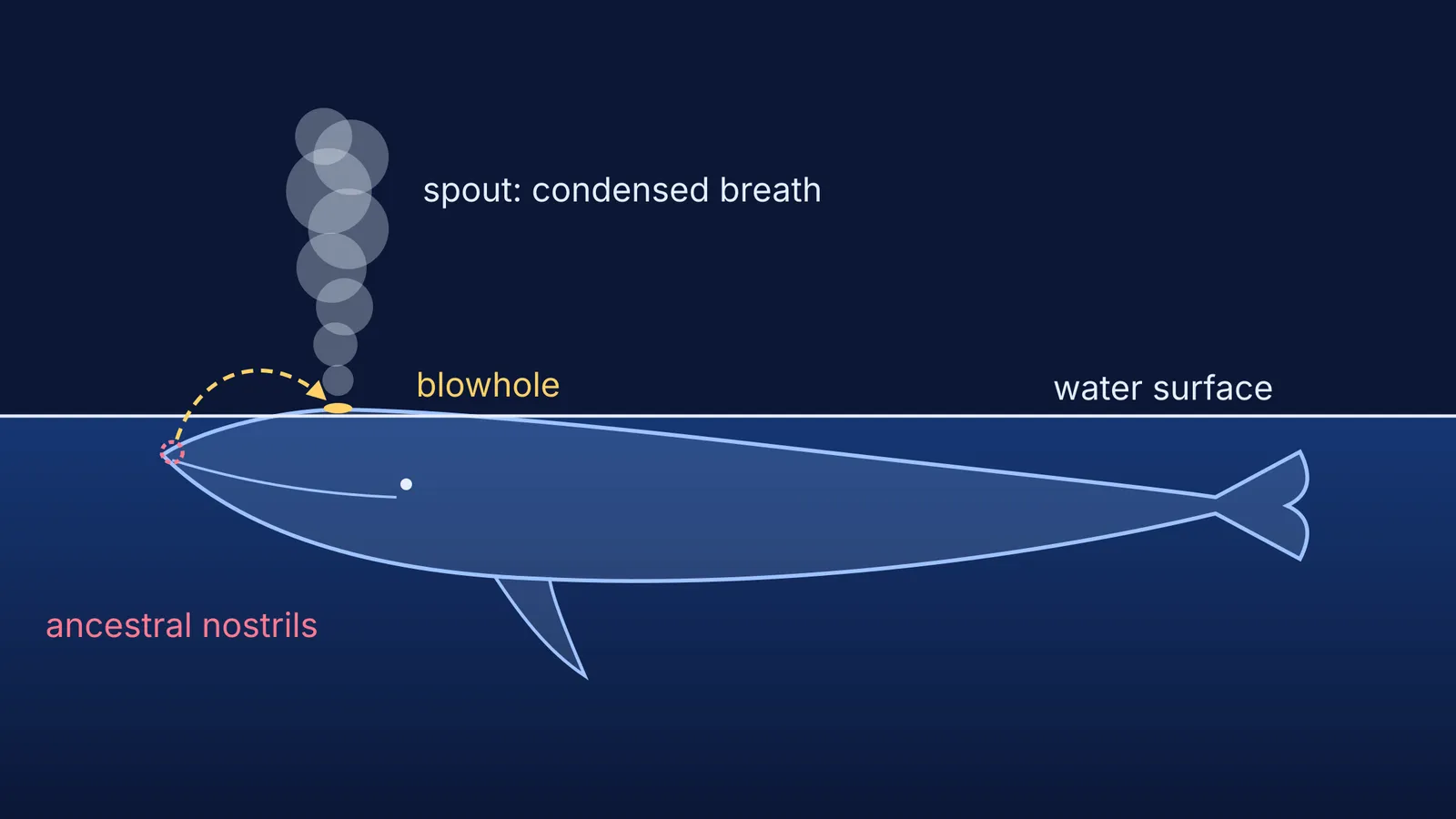
A whale's blowhole is its nostril. The whale science site Baleines en direct puts it plainly: the blowhole or blowholes of whales are their equivalent of nostrils, and their position at the top of the head makes breathing at the surface easier. Baleen whales, such as humpbacks and blue whales, have two blowholes. Toothed whales, such as dolphins and sperm whales, have one, according to the same page.
The nose did not start there. Whales evolved from four-legged land mammals, and their nostrils shifted back over time. In a 2022 study in Current Biology, Ellen Coombs and colleagues scanned the skulls of 201 whale species, living and fossil, covering about 50 million years of evolution (Natural History Museum, London; paper). Describing the early fossils, Coombs, now a postdoctoral fellow at the Smithsonian's National Museum of Natural History, said: "What you are seeing are changes in the position of the nasals, or nose, from the tip of the snout up to the top of the head as the animals are becoming more aquatic."
The museum's press release adds the pace: within eight million years, whale ancestors went from fully land-living animals, such as the four-legged, furry Pakicetus, to fully aquatic ones.
How does a blowhole let a whale breathe without lifting its head?
To breathe while swimming, you have to tip your face up or turn it sideways. A whale's nose sits on top of its head, so it only needs to break the surface with the top of its head while the rest of its body stays in the water.
The blowhole is also built to stay shut. When its muscles are relaxed, fibrous plugs close the blowhole and keep water out, so the whale must contract muscles to open it. That makes breathing a conscious act for a whale, unlike in land mammals. The same source notes that a whale's airway and digestive system are not connected, so it cannot breathe through its mouth. It also says whales renew about 90% of the air in their lungs with each breath, against 10 to 15% in humans.
Each breath is fast. Using drone footage of North Atlantic right whales and humpbacks, researchers working with the Woods Hole Oceanographic Institution timed complete breaths (an exhale followed by an inhale). The average was 3.07 seconds for right whales and 2.85 seconds for humpbacks (Iruzun Martins and colleagues, Marine Mammal Science, 2020).
Is the whale spout water?
No. The spout, or blow, is the whale's breath. As National Geographic explains, warm air from the lungs meets cooler outside air and condenses into a cloud, the same thing you see when you breathe out on a cold Delhi or Shimla morning. The cloud also carries mucus and droplets of seawater that were covering the blowhole when the whale exhaled.
That seawater is more common than scientists assumed. The same 2020 study saw seawater covering an open blowhole in 20% of right whale breaths and 90% of humpback breaths, which the authors say challenges the general view that water does not enter a baleen whale's airway. As Science News Explores reported, this matters for whales caught in oil spills and for researchers who collect blow samples with drones to study whale health.
One breath at the surface, step by step
Use this sequence for a "describe" question:
The whale rises with its body roughly level and its head just under the surface.
The top of its head, where the blowhole sits, breaks the surface first.
Muscles pull the blowhole open against its plugs.
Air rushes out; the warm, moist breath condenses into the visible spout.
The whale breathes in, refilling most of its lungs at once. In the 2020 drone study, the exhale and inhale together took about three seconds on average.
The muscles relax, the plugs close the blowhole, and the whale slips under.
Check yourself
Why is a blowhole called homologous to a human nostril? (Same origin, different position.)
Why is a spout easier to see on a cold morning? (Cooler air makes more of the warm breath condense.)
Why can't a whale gasp through its mouth? (Its airway and digestive system are not connected.)
If homology or gas exchange still feels shaky, the Fermi Concept Library has every concept in biology, each with its own lesson and its place in a map of related ideas. To go further, read why a whale is a mammal and not a fish, compare homologous and analogous organs, and find out why you can see your breath in winter.


