

On this page
This set follows our first waves and sound practice set for JEE Main and tests what set 1 left out: gases with different γ, particle speed, superposition, writing a wave equation, pressure in a pipe, beats with changing tension, a hanging rope and a joined string. Q8 is a numerical-value question.
How should you use set 2?
NTA's Syllabus for JEE (Main) - 2027 puts waves in Unit 10, Oscillations and Waves, from wave speed and the progressive-wave equation to superposition, standing waves in strings and pipes, and beats. Every question stays inside that list and NCERT Class 11 Physics Chapter 14, Waves (Reprint 2026-27).
Take 25 minutes, on paper, without a calculator.
Write what depends on what (v on γ and M, f on √T) before any numbers.
Read every trap line, even where you were right.
New to the chapter? Start with our guide on how to prepare waves and sound for JEE Main.
Easy: sound in gases, particle speed and superposition
Q1 (easy). Helium (γ = 5/3, M = 4 g/mol) and nitrogen (γ = 7/5, M = 28 g/mol) are ideal gases at the same temperature. What is the ratio of the speed of sound in helium to that in nitrogen?
(A) 0.35 (B) 2.65 (C) 2.89 (D) 8.33
Answer: (C). With the Laplace correction, v = √(γP/ρ), and for an ideal gas P/ρ = RT/M, so v = √(γRT/M). The ratio is √[(5/3)/(7/5) × 28/4] = √(25/3) ≈ 2.89.
Trap: (B) is √7, which drops γ.
Q2 (easy). A transverse wave on a string is y = 0.005 sin(8πx − 160πt), in SI units. What is the ratio of the maximum speed of a particle of the string to the speed of the wave?
(A) 0.020 (B) 0.126 (C) 2.51 (D) 7.96
Answer: (B). The maximum particle speed is Aω = 0.005 × 160π ≈ 2.51 m/s. The wave speed is ω/k = 160π/8π = 20 m/s. The ratio is Ak = 0.04π ≈ 0.126.
Trap: (C) is the particle's top speed in m/s, not the ratio.
Q3 (easy). Two waves of equal frequency and amplitude travel the same way along a string. In phase, the resultant amplitude is 8 mm. What is the resultant amplitude when their phase difference is 90°?
(A) 0 mm (B) 4.0 mm (C) 5.7 mm (D) 8.0 mm
Answer: (C). In phase, 2a = 8 mm, so a = 4 mm. The resultant amplitude is 2a cos(φ/2) = 8 cos 45° ≈ 5.7 mm.
Trap: (A) uses cos φ, not cos(φ/2).
Medium: writing the wave, pressure in a pipe, beats
Q4 (medium). A wave of amplitude 3 cm, frequency 50 Hz and speed 20 m/s travels along −x. At t = 0, the particle at x = 0 is at y = 0 and moving towards −y. Which equation describes the wave, with y in cm and x in m?
(A) y = 3 sin(5πx − 100πt) (B) y = −3 sin(5πx + 100πt) (C) y = 3 sin(5πx + 100πt) (D) y = −3 sin(2.5πx + 100πt)
Answer: (B). ω = 2π × 50 = 100π rad/s and k = ω/v = 5π rad/m. Travel along −x needs the same sign on kx and ωt. At x = 0, (B) gives y = −3 sin(100πt), which starts at zero and moves down.
Trap: (A) also starts at zero moving down, but its opposite signs send the wave along +x.
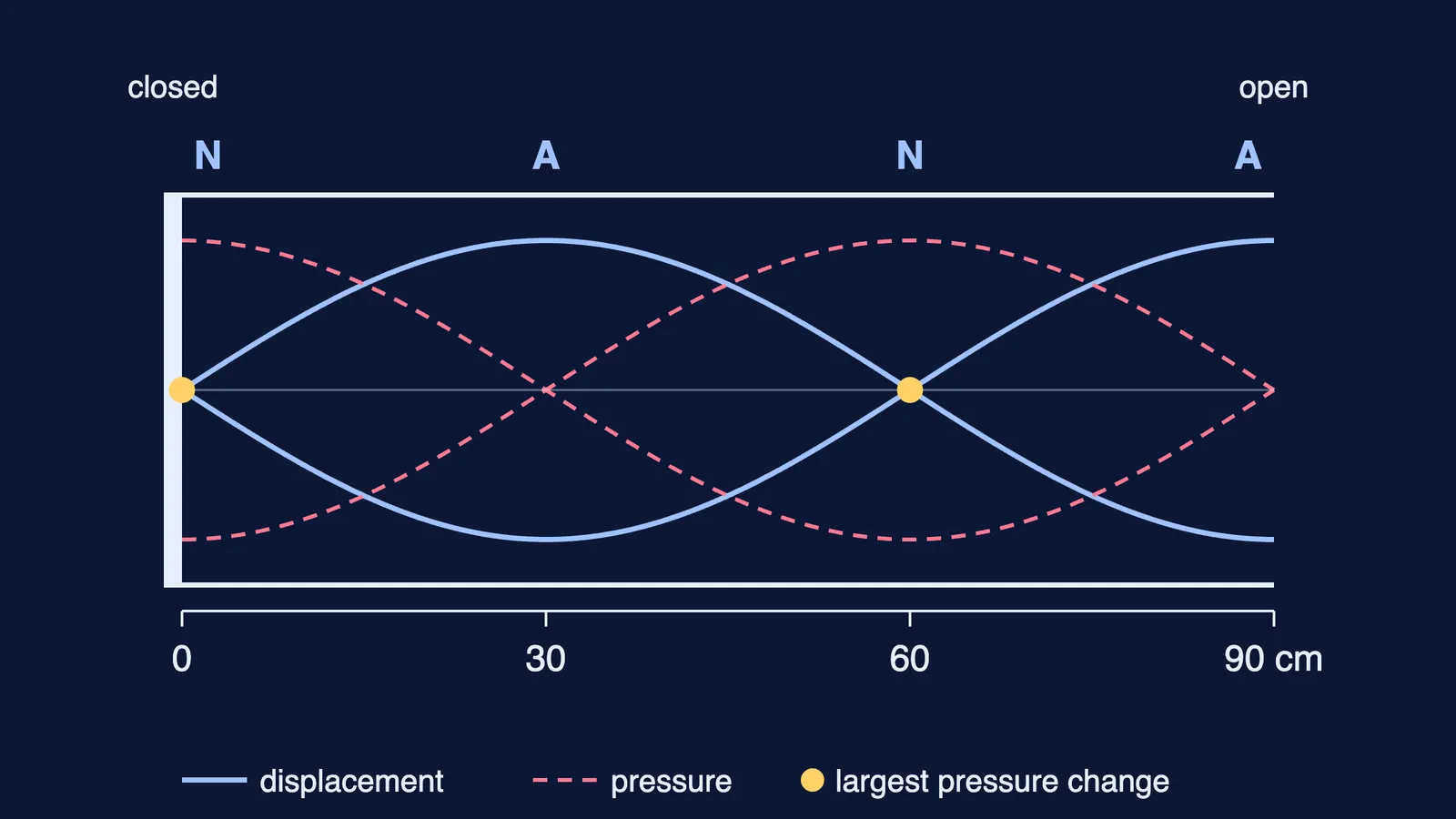
Q5 (medium). A pipe 90 cm long, closed at one end, sounds its third harmonic. Apart from the closed end itself, at what distance from the open end is the pressure variation largest?
(A) 0 cm (B) 30 cm (C) 45 cm (D) 60 cm
Answer: (B). For the third harmonic, L = 3λ/4, so λ = 120 cm. Displacement nodes sit at the closed end and λ/2 = 60 cm from it, which is 30 cm from the open end. A displacement node is a pressure antinode.
Trap: (D) marks the displacement antinode 30 cm from the closed end, where the pressure hardly changes.
Q6 (medium). A stretched string sounding its fundamental gives 5 beats per second with a 440 Hz tuning fork. When the tension is raised slightly, the beats drop to 3 per second. What was the string's original frequency?
(A) 435 Hz (B) 437 Hz (C) 443 Hz (D) 445 Hz
Answer: (A). The string was at 435 or 445 Hz. More tension raises f (f ∝ √T), and the beats fall only if f moves towards 440 Hz, so it started at 435 Hz and rose to 437 Hz.
Trap: (D) ignores direction; from 445 Hz the beats would rise to 7.
Hard: a hanging rope and a joined string
Q7 (hard). A uniform rope 4.9 m long hangs from a ceiling. A small transverse pulse starts at the bottom end. Take g = 9.8 m/s². How long does the pulse take to reach the top?
(A) 0.71 s (B) 1.00 s (C) 1.41 s (D) 2.83 s
Answer: (C). At height y, the tension supports the rope below, so T = μgy and v = √(gy). The time is ∫dy/√(gy) from 0 to L, which is 2√(L/g) = 2√0.5 ≈ 1.41 s.
Trap: (A) uses the top speed √(gL) for the whole rope. The pulse is slower lower down.
Q8 (hard, numerical). Two wires, A (40 cm long, 2.5 g/m) and B (90 cm long, 10 g/m), are joined end to end and fixed at both outer ends under a tension of 36 N. The joint stays a node. Find the lowest frequency, in hertz, at which the whole wire can vibrate.
Answer: 300. Wave speeds are √(36/0.0025) = 120 m/s in A and √(36/0.01) = 60 m/s in B. Allowed frequencies are 150n Hz for A and 33.3m Hz for B, and both must match. The smallest common value is 300 Hz: the 2nd harmonic of A and the 9th of B.
Trap: 150, A's fundamental, where B cannot fit whole loops.
What should you do after checking your answers?
Sort each miss: wrong formula (Q1, Q2, Q3, Q7), wrong sign or direction (Q4, Q6) or wrong mode picture (Q5, Q8). Redo misses the next day without solutions.
If a solution still puzzles you, the Fermi Problem Library has worked problems with a step-by-step solver that explains the reasoning rather than printing an answer.


