

On this page
A water strider does not float like a boat. It stands on the water, held up by surface tension, with legs kept dry by tiny air-trapping hairs. Only about 1,200 insect species, roughly 0.1%, can walk on water, according to John Bush and David Hu in Physics Today. Below, we work out the numbers with Class 11 physics, then suggest what to look for at a pond.
How do water striders walk on water?
Surface tension is the pull along a liquid's surface that makes it behave like a stretched skin; for water it is about 0.070 N/m (70 dynes per cm), the value given in Physics Today.
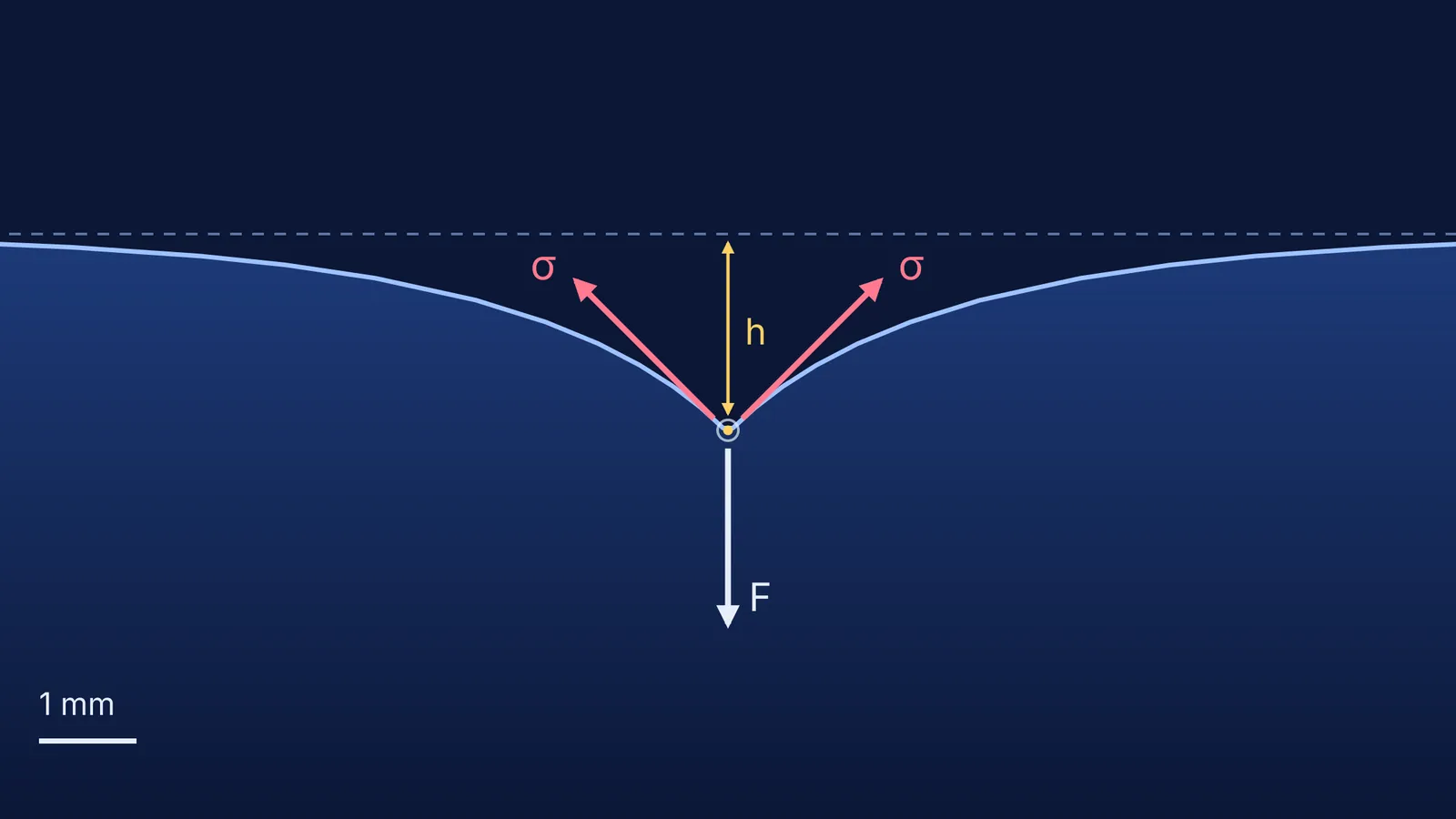
A strider's leg presses the surface into a dimple. The water on each side pulls along its own slope, so the deeper the dimple, the more of that pull points upward, all along the leg.
This only works for small animals: surface tension beats gravity below the capillary length, about 2.6 mm according to the same article.
How much weight can surface tension hold?
One water strider leg can push down with about 1.52 mN before breaking through the surface, roughly 15 times the insect's body weight, according to a 2020 review in Zoological Research of measurements by Xuefeng Gao and Lei Jiang and others.
Body weight: 1.52 mN / 15 = about 0.10 mN, or 0.00010 N.
Mass: m = W/g = 0.00010 / 9.8 = about 10 mg. That fits: a 2024 study in Proceedings of the Royal Society B found strider body masses from under 5 mg to about 500 mg.
Largest upward pull per metre of leg: the surface pulls on both sides, so at most 2σ = 2 x 0.070 = 0.14 N/m, when both sides point straight up.
Contact needed to stand still: L = W / 2σ = 0.00010 / 0.14 = about 0.0007 m, just 0.7 mm shared across all its legs.
Check the breaking point: 0.00152 / 0.14 = about 0.011 m, so one leg lying along roughly a centimetre of water could supply the measured 1.52 mN.
A resting strider uses only a small share of what surface tension could give it; Hu and Bush note that water walkers have a high margin of safety in the Journal of Fluid Mechanics.
Our post on the surface tension force on a wire frame uses the same factor of two for a soap film's two surfaces. If resolving vertically is where you slip, the Fermi Problem Library has worked problems with a step-by-step solver that explains the reasoning rather than printing an answer.
Why are water strider legs hairy?
Surface tension only helps if the leg stays dry. If the legs get wet, the strider sinks through the surface.
Gao and Jiang showed in Nature in 2004 that the legs are covered by large numbers of oriented tiny hairs (microsetae) with fine nanogrooves, and that this structure matters more for water repellency than the insect's wax. Hu and Bush's 2010 paper brings the numbers together:
The waxy material on its own has a contact angle of about 105 degrees.
Gao and Jiang measured about 168 degrees on the hairy strider leg, above the 150 degrees that counts as superhydrophobic.
Strider leg hairs are 20 to 40 micrometres long, packed at 1.2 to 1.6 million per square centimetre.
Each hair carries grooves about 400 nanometres wide running along its length.
In their experiments the leg never broke into the surface; a thin air layer stayed trapped among the hairs. Adding detergent made striders sink, the paper reports, not mainly because soap lowers surface tension but because it destroys the legs' water repellency. Lotus leaves repel water with a similar rough, waxy surface; see why water beads on lotus leaves.
What can you see at a pond?
You do not need a microscope. Hu and Bush tracked dimples by their shadows: dips in the surface bend light outward and show up as dark spots on the tank bottom (Journal of Fluid Mechanics). A sunny pond edge does the same.
Choose a calm, sunny day and a shallow edge with a light-coloured bottom. Stay on firm ground; younger children should go with an adult.
Look at the bottom under a strider, not at the insect. Each foot resting on the water makes a dark spot.
Count the shadows and compare their size with the leg that makes them.
Watch it push off and see how the shadows under the driving legs change as they press down.
Our post on why a paper clip floats on water explains that bowl. If surface tension, contact angle or capillary length still feel shaky, the Fermi Concept Library gives each concept its own lesson and its place in the map.


