

On this page
Physiotherapists teach people with a painful hip to hold the walking stick in the hand on the other side. It feels backwards, but the reason is torque. On one leg, a small muscle with a short lever balances your whole upper body, and the hip joint carries both. A stick in the opposite hand works on a long lever and takes over most of that job. This post works the numbers with the moment equation from JEE and NEET statics. It explains physics only; whether someone needs a walking aid, and how to use it, is for a doctor or physiotherapist to advise.
Why does standing on one leg load the hip so much?
Stand on your right leg. Seen from the front, your pelvis is a beam on one pivot, the right hip.
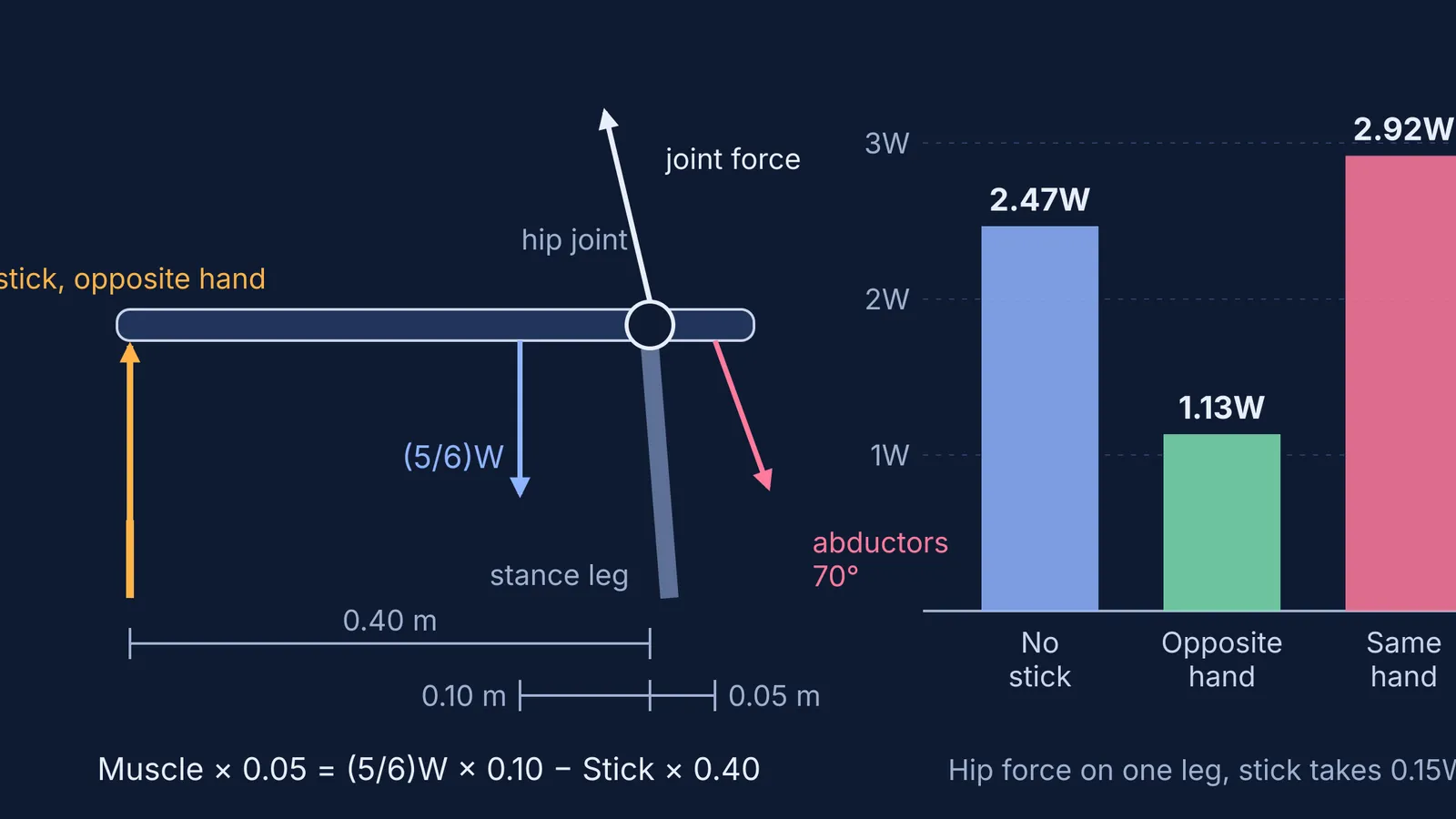
The load. Everything above the stance leg presses down: trunk, head, arms and the lifted leg. The stance leg is below the hip, so it does not count. That is roughly 5/6 of body weight W, acting about 0.10 m inside (medial to) the right hip.
The effort. That weight would tip the pelvis down towards the lifted leg. The hip abductor muscles (mainly gluteus medius), running from the side of the pelvis to the top of the thigh bone, stop it. Their line of pull is only about 0.05 m outside (lateral to) the hip.
The pivot. The femur head pushes up on the pelvis.
The effort arm is half the load arm, so the muscle pulls with about twice the load: a first-class lever with mechanical advantage below 1, as in classes of lever and their examples. The joint carries the weight and the muscle pull together.
How do you calculate the hip joint force?
Use the textbook model; the numbers are typical, not exact for anyone.
Load: (5/6)W acting 0.10 m medial to the hip.
Abductor force F_m acting 0.05 m lateral to the hip (taken as its perpendicular distance), directed at 70° to the horizontal.
Joint force J at the hip, unknown in size and direction.
Take moments about the hip, so J drops out:
F_m × 0.05 = (5/6)W × 0.10, so F_m = 1.67W.
Now add forces. Horizontally, the joint balances F_m cos 70° = 0.57W. Vertically, J balances the load plus the muscle's downward part: (5/6)W + F_m sin 70° = 0.83W + 1.57W = 2.40W.
J = √(0.57² + 2.40²) W ≈ 2.47W, tilted about 77° from the horizontal.
A hip holding up 0.83W of body carries about 2.5 times your full weight, mostly because of the muscle.
How does a stick in the opposite hand change the torque?
Hold the stick in your left hand while you stand on the right leg. It pushes up through the arm and shoulder about 0.40 m medial to the right hip, on the same side as the body weight, so it opposes the weight's turning effect:
F_m × 0.05 = (5/6)W × 0.10 − C × 0.40
where C is the stick force. The 0.40 m arm is eight times the muscle's arm, so each newton on the stick saves eight newtons of muscle pull, and C also comes off the hip's vertical load.
In the right hand, the stick sits about 0.20 m outside the hip, on the wrong side, and adds to the turning effect:
F_m × 0.05 = (5/6)W × 0.10 + C × 0.20
In this model, a same-side stick makes the hip work harder.
Worked example: a 60 kg person on one leg
Take g = 9.8 m/s², so W = 588 N. Use the model above.
Load above the hip. (5/6) × 588 = 490 N, acting 0.10 m medial. Its moment is 490 × 0.10 = 49.0 N m.
Muscle force with no stick. F_m = 49.0 / 0.05 = 980 N, which is 1.67W.
Joint force with no stick. Horizontal: 980 cos 70° = 335 N. Vertical: 490 + 980 sin 70° = 490 + 921 = 1,411 N. J = √(335² + 1,411²) ≈ 1,450 N, or 2.47W.
Stick in the opposite hand, taking 15% of body weight. C = 0.15 × 588 = 88.2 N. Its moment is 88.2 × 0.40 = 35.3 N m. The muscle now supplies only 49.0 − 35.3 = 13.7 N m, so F_m = 13.7 / 0.05 = 274 N (0.47W).
New joint force. Horizontal: 274 cos 70° = 94 N. Vertical: 490 + 274 sin 70° − 88.2 = 660 N. J = √(94² + 660²) ≈ 666 N, or 1.13W. That is about 54% less than 1,450 N.
Same 88.2 N in the same-side hand, 0.20 m lateral. F_m = (49.0 + 17.6) / 0.05 = 1,333 N (2.27W), and J comes out at about 1,716 N, or 2.92W.
A one-handed push of about 9 kg-force removes more than half the load on the hip, but only from the correct side. A stick force of 0.21W would cancel the weight's moment completely.
Do real measurements agree with this model?
Roughly, yes. Instrumented hip implants have measured this directly. Bergmann and colleagues found that patients loaded the hip with about 238% of body weight when walking at about 4 km/h, and slightly less when standing on one leg (Bergmann et al., Journal of Biomechanics, 200100040-9)). That sits close to the 2.47W our model gives.
Neumann recorded abductor muscle activity in 24 people with hip replacements. A cane in the hand opposite the operated hip cut it by about 31%, and by about 42% with a near-maximal push. A same-side cane produced no significant change (Neumann, Physical Therapy, 1998).
So the direction matches the physics, but the size is smaller than the static model suggests. Walking is not standing still, people push less on a stick than a model assumes, and lever arms vary. Treat 1.13W and 2.92W as illustrations, not clinical figures.
Why does this matter beyond the exam?
The same lever explains why people with a sore hip lean over the stance leg as they walk: leaning shortens the load arm. It is also why hip replacements must survive several times body weight, as told in how John Charnley designed the low-friction hip replacement. And why kabaddi players crouch low for stability uses the same idea of where the weight's line of action falls.
For more torque and equilibrium problems with the body as a lever, the Fermi Problem Library has a step-by-step solver that explains the reasoning, including which pivot to choose. If you are preparing for JEE, Fermi Test Prep offers personalised preparation for JEE Main & Advanced with an AI tutor, live classes, adaptive mocks, mentorship and a study plan that updates based on mastery.
Quick checklist
On one leg, about (5/6)W acts 0.10 m medial to the hip; the abductors act about 0.05 m lateral.
Moments about the hip give F_m ≈ 1.67W; adding forces gives J ≈ 2.47W in this model.
A stick in the opposite hand pushes up on the weight's side with a 0.40 m arm, eight times the muscle's arm.
With 0.15W on that stick, J falls to about 1.13W; in the same-side hand it rises to about 2.92W.
Measurements support the direction, with a smaller effect.
Physics explains the advice; a doctor or physiotherapist decides on walking aids.


