

On this page
Ask a class which animals have gills and most students say "fish" and stop. The fuller answer is a short list of vertebrate groups, each using gills at a different stage of life.
Which vertebrates breathe through gills at some stage?
Only fish and amphibians ever breathe with gills.
Fish, all their lives. "All bony fishes use gills to breathe," with the gills sitting in chambers covered by a muscular flap called the operculum, according to the OpenStax Biology 2e chapter on fishes. Sharks and rays have exposed gill slits instead of an operculum.
Frogs and toads, as tadpoles. Tadpoles usually have gills, and during metamorphosis "the gills, tail, and lateral line system disappear" while air-breathing lungs develop, according to the OpenStax chapter on amphibians.
Salamanders, often as larvae and sometimes as adults. The same OpenStax chapter notes that aquatic salamanders breathe through external gills, and the Mexican axolotl "never leaves the larval stage, becoming sexually mature without metamorphosis." Here is why axolotls never undergo metamorphosis.
Lungfish, as hatchlings. Lungfish hatch with external gills (South American lungfish hatchlings have four pairs), and adult African and South American lungfish must breathe air or they drown, because their gills are too small to meet their oxygen needs, according to the lungfish entry at Encyclopedia.com. The Australian lungfish still breathes mainly through its gills.
A frog tadpole actually has two kinds of gills in a row. In the 1951 textbook The Frog: Its Reproduction and Development, R. Rugh describes finger-like external gills that grow first. A fold of skin, the operculum, then covers them, and internal gills with a double row of filaments form. Water comes in through the mouth and leaves through a single opening on the left side, the spiracle.
Do reptiles, birds and mammals ever have gills?
No. Their embryos do form pharyngeal arches and pouches, the building blocks of gills in fish, but these never work as gills.
In a 2012 review in EvoDevo, Anthony Graham and Jo Richardson argue that amniotes did not simply lose their gills. They write that the gills "were transformed into the parathyroid glands," and that the operculum still exists, but only as a structure in the embryo. See also whether humans have pharyngeal gill slits.
How is gill breathing different from lung breathing?
The difference starts with the medium. Air is about 20.9% oxygen, while air-saturated water at 30°C holds only 5.3 ml of oxygen per litre, about 0.5%, according to an FAO aquaculture training manual.
To get the same amount of oxygen as an air-breather, a water-breathing animal must move about thirty times as much water over its breathing surface, as this Metropolitan State University of Denver animal physiology outline explains. The same outline notes that water is denser and more viscous than air, so moving it costs more energy.
Gills are "thin tissue filaments that are highly branched and folded," according to the OpenStax chapter on gas exchange. They take oxygen from water.
Lungs are internal; in mammals, air reaches them through the nasal cavity, pharynx, larynx, trachea and bronchi, according to the same chapter.
Both depend on diffusion: oxygen moves from where it is concentrated (water or air) to where it is scarce (blood).
Some fish break the pattern by gulping air as well. See our post on how magur, climbing perch and mudskippers breathe air.
Stage-by-stage: who uses gills, and when?
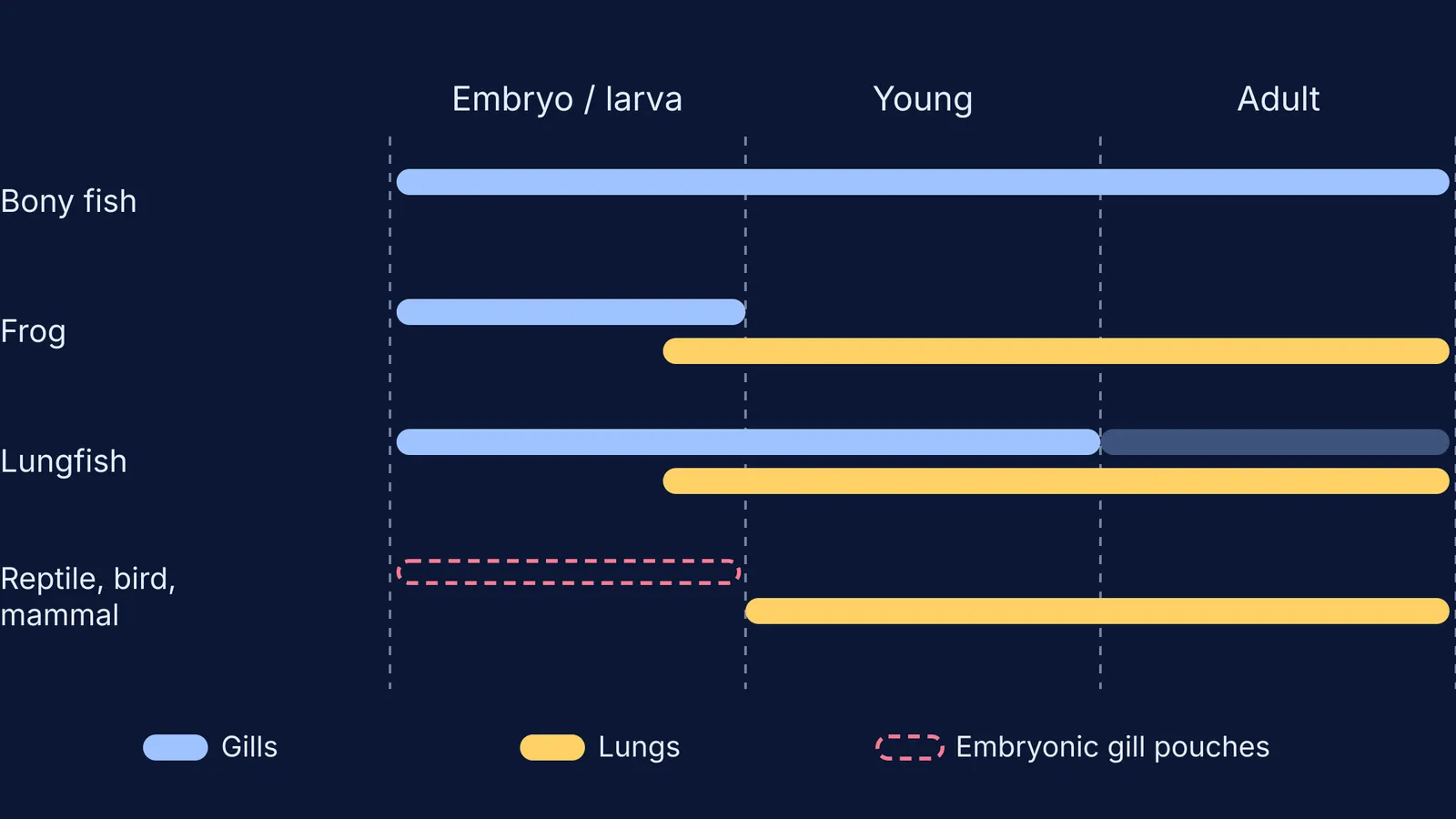
This revision chart adds the axolotl to the four rows in the diagram at the top.
Bony fish: gills as larva, gills as juvenile, gills as adult.
Frog: external then internal gills as a tadpole; lungs develop and gills disappear at metamorphosis; lungs as an adult.
Axolotl: external gills as a larva, and still external gills as a breeding adult.
African lungfish: external gills as a hatchling; must breathe air from about one month old; must breathe air as an adult.
Reptiles, birds and mammals: pharyngeal pouches in the embryo that never work as gills; lungs from hatching or birth.
How do you answer gill questions in an exam?
Run three quick checks on any option.
Is it a fish or an amphibian? If not, it never breathes with gills, even if it lives in water.
Which stage does the question mean? A frog is a gill-breather as a tadpole and a lung-breather as an adult.
Does the question say "gills" or "gill slits"? Gill pouches appear in reptile, bird and mammal embryos; working gills do not.
Worked example: which of these breathes through gills at some stage of life: crocodile, whale, frog or pigeon? Check 1 removes the crocodile (reptile), the whale (mammal) and the pigeon (bird). The answer is the frog, as a tadpole.
If the gaps are in the concepts underneath, such as metamorphosis, the chordate features or diffusion, the Fermi Concept Library has a lesson for every concept in biology, each placed in its map. For practice, the Fermi Problem Library has worked problems with a step-by-step solver that explains the reasoning rather than printing an answer.
Try it now: write the five groups from memory and mark each one's gill stage.


