

On this page
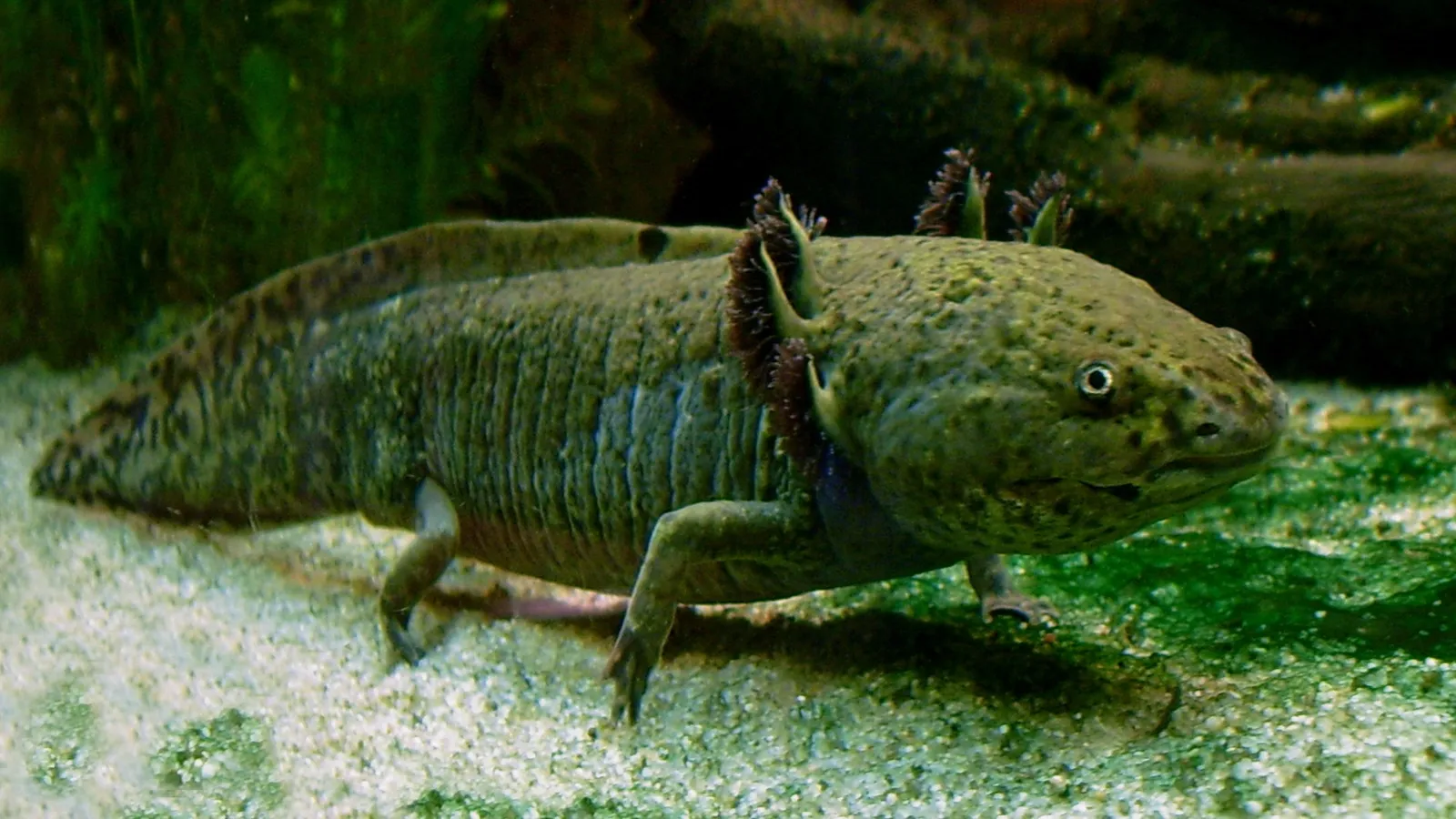
An adult axolotl looks like an overgrown tadpole. It keeps feathery gills behind its head and a fin along its tail, lives its whole life in water, and still breeds. Most amphibians grow out of that body. The axolotl does not, and the reason is a hormone you meet in Class 11 biology: thyroxine.
What is neoteny in axolotls?
The Mexican axolotl (Ambystoma mexicanum) is a salamander that does not undergo metamorphosis and keeps juvenile features in its mature, breeding stage, a condition called paedomorphosis, according to a 2018 review in General and Comparative Endocrinology. Your textbook may call the same thing neoteny. A frog tadpole loses its gills and tail; an axolotl becomes sexually mature with its larval gills and tail fin still in place.
Why does an axolotl never undergo metamorphosis?
The short answer is that the hormone signal is too weak, not that the body cannot respond.
In amphibians, metamorphosis is switched on by thyroid hormone. The chain runs like this: the hypothalamus signals the pituitary, the pituitary releases thyroid-stimulating hormone (TSH), and TSH makes the thyroid release thyroxine (T4). Researchers describe axolotl paedomorphosis as the result of low activity in this hypothalamo-pituitary-thyroid axis. Giving thyrotropin (TSH) can induce metamorphosis, which shows that everything below the pituitary works and that TSH release is what falls short, as the De Groef, Grommen and Darras review summarises.
A 2019 review in Frontiers in Endocrinology adds that thyroid hormone levels in the axolotl stay low throughout larval development and do not rise at the point when related tiger salamanders metamorphose. One mechanism researchers have proposed is a failure in the hypothalamus stimulating the pituitary cells that make TSH, though the review notes this is not yet settled.
A 2008 study by Page and colleagues adds a second factor: tissues differ in how sensitive they are to thyroid hormone.
What happened when scientists gave axolotls thyroxine?
They watched a water animal turn into a land one. In Prague, the Czech doctor Vilém Laufberger used thyroid hormone injections to turn an axolotl into a land-living adult salamander, and the English biologist Julian Huxley, unaware of this, later repeated it by feeding ground animal thyroid, as the Wikipedia entry on the axolotl records.
Huxley reported his result in Nature in 1920 under the title Metamorphosis of Axolotl caused by Thyroid-feeding. The UK charity Froglife's account of the experiment says he fed young axolotls chopped ox thyroid 2 to 3 times a week and saw signs of metamorphosis. At the time, it was becoming clear that amphibian metamorphosis is controlled by thyroid hormone.
Modern labs do the same thing with measured doses. In the Page et al. study, juvenile axolotls were reared in water containing 5 nM or 50 nM thyroxine. The 50 nM group started changing earlier and completed metamorphosis by day 28, with tail fins and gills fully resorbed. In the 5 nM group, none had finished by day 28, and the authors note that individuals at that dose complete metamorphosis after about 35 days on average.
How do you explain axolotl neoteny in an exam answer?
Examiners reward a cause-and-effect chain, not a list of facts. Use these four links:
Signal: in the axolotl, the pituitary does not release enough TSH, most likely because the signal from the hypothalamus is weak.
Hormone: with TSH low, the thyroid releases little thyroxine.
Result: thyroid hormone never reaches the level that triggers metamorphosis, so larval gills and tail fin are kept into adulthood.
Proof: adding thyroxine, or TSH, makes the axolotl metamorphose, which shows the tissues can still respond.
Test yourself, then check the answer in brackets:
What happens if you give TSH to an axolotl? (It can metamorphose, because TSH drives the thyroid.)
What changes if the thyroxine dose drops from 50 nM to 5 nM? (Metamorphosis still happens, but more slowly.)
For the other glands in this chain, see chemical coordination and integration: glands and hormones, and for thyroxine in everyday health, our explainer on why iodised salt is recommended.
If the hypothalamus–pituitary–thyroid chain still feels like something to memorise rather than understand, the Fermi Concept Library gives every biology concept its own lesson and its place in the map, so you can see where thyroxine sits.
Is the axolotl's never-grow-up body linked to its regeneration?
Not directly. Limb regrowth is a separate topic, covered in how axolotls regrow limbs, and how Hydra and Planaria differ.
In the wild, the axolotl's habitat is now limited to Lake Xochimilco near Mexico City, and the species is listed as critically endangered, as its Wikipedia entry notes.


