

On this page
Picture the heart just after the ventricles finish squeezing. They relax, their pressure drops, and blood that has been collecting in the atria pours through the open valves. The atria contract only after most of it has arrived, so they do much less of the filling than many students assume.
How much blood enters the ventricles before the atria contract?
About 70 to 80 percent of ventricular filling happens passively, before atrial systole, according to OpenStax Anatomy and Physiology 2e. The same chapter says atrial contraction, the "atrial kick", contributes the remaining 20 to 30 percent.
NCERT's Class 11 Biology chapter Body Fluids and Circulation describes the same thing from the atria's side: atrial systole "increases the flow of blood into the ventricles by about 30 per cent." That sits at the top of the OpenStax range, so for NCERT-based exams remember about 70 percent passive, 30 percent atrial.
Why does most filling happen without the atria pushing?
Fluids flow from higher to lower pressure, and OpenStax explains the cardiac cycle through these pressure gradients. In joint diastole, NCERT says, all four chambers are relaxed and the tricuspid and bicuspid valves are open, so blood from the vena cava and pulmonary veins flows through the atria into the ventricles.
Two things make this work:
The veins keep delivering blood, so atrial pressure builds while the ventricles contract with the AV valves shut.
When the ventricles relax, their pressure falls and atrial pressure pushes the tricuspid and bicuspid valves open.
What does the 0.8 second cardiac cycle look like?
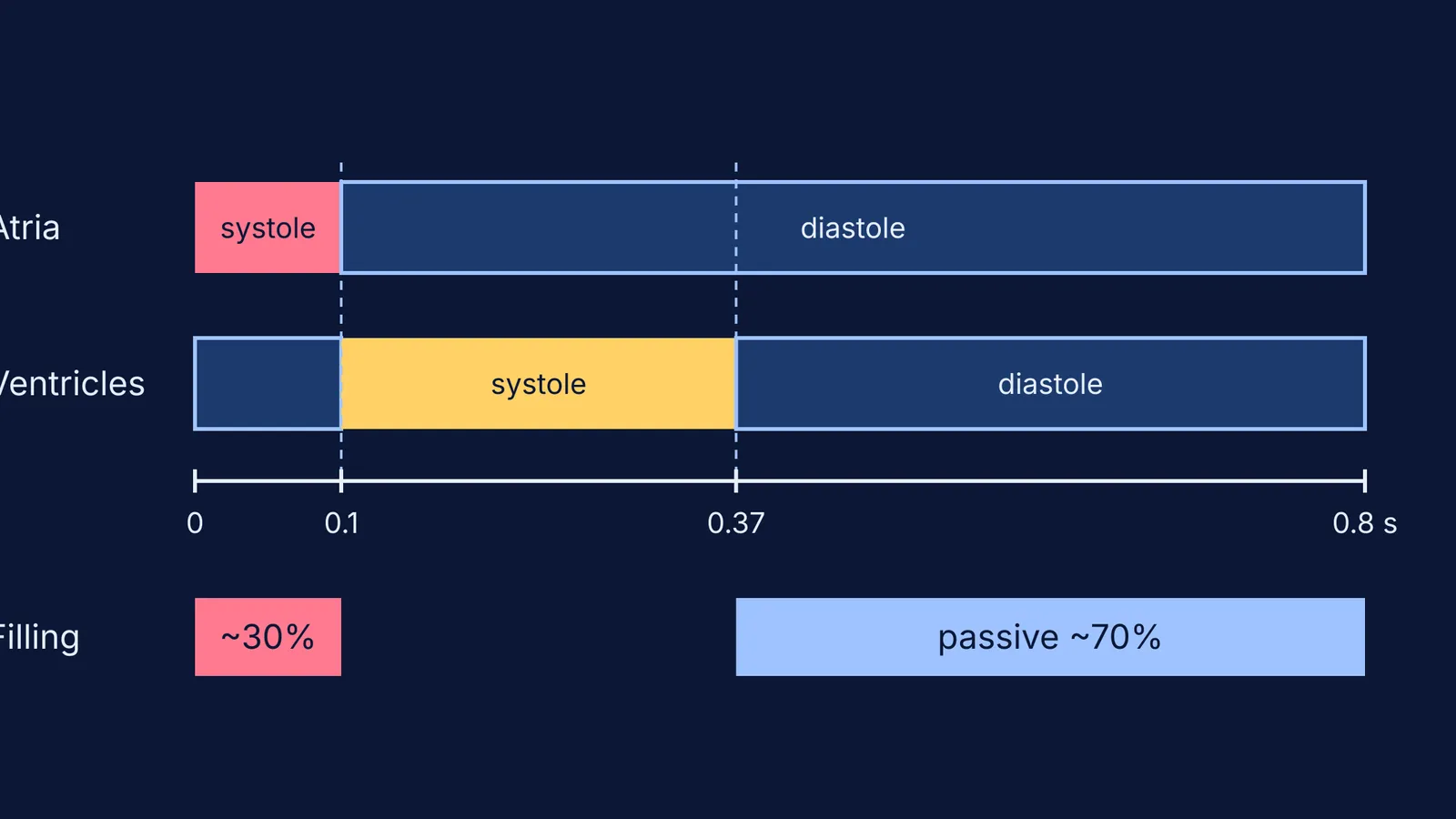
NCERT gives an average heart rate of 72 beats per minute and deduces a cycle length of 0.8 seconds (60 divided by 72 is 0.83 s, which rounds to 0.8). OpenStax splits the cycle into atrial systole of about 100 ms, ventricular systole of 270 ms and ventricular diastole of about 430 ms. Together they add up to 800 ms.
Sketch it in two rows over one time axis:
Draw a time axis from 0 to 0.8 s and mark 0, 0.1, 0.37 and 0.8 s.
Atria row: shade 0 to 0.1 s as systole and label 0.1 to 0.8 s as diastole.
Ventricles row: shade 0.1 to 0.37 s as systole and label 0.37 to 0.8 s as diastole. Leave 0 to 0.1 s relaxed too: the ventricles are still in diastole while the atria contract.
Write "passive, about 70%" over 0.37 to 0.8 s in the ventricles row, and "atrial kick, about 30%" over the 0 to 0.1 s strip.
Check the overlap: from 0.37 to 0.8 s both rows are relaxed. That joint diastole is when most filling happens.
How many millilitres is that in a real heart?
OpenStax says a resting adult's ventricle holds about 130 mL at the end of diastole, pumps out 70 to 80 mL per beat, and keeps 50 to 60 mL. So each beat it refills by roughly 75 mL, not by the full 130 mL, and the percentages apply to that refill:
Passive filling: 70 to 80 percent of about 75 mL is roughly 50 to 60 mL.
Atrial kick: 20 to 30 percent of about 75 mL is roughly 15 to 23 mL.
Cardiac output: NCERT's stroke volume of about 70 mL times 72 beats a minute is 5,040 mL, close to the 5 litres a minute that NCERT gives for a healthy person.
Does the atrial share ever change?
Yes. In a 1987 study in The American Journal of Cardiology, Kuo and colleagues90870-8) used Doppler echocardiography to measure the share of left ventricular stroke volume from atrial contraction in 41 normal subjects aged 20 to 80. The fraction rose with age, from 12% in a 20-year-old man to 46% in an 80-year-old woman. So 30 percent is a typical textbook figure, not a constant. In exams, use the textbook value; questions about a real person's heart are for a doctor.
Which exam traps should you watch for?
"The atria fill the ventricles." Mostly false, because most filling is passive.
"The AV valves open when the atria contract." False. They open earlier, when ventricular pressure falls during ventricular diastole.
"The atria and ventricles contract together." False. Atrial systole comes first, and NCERT notes that the atria relax while the ventricles contract.
Swapping the sounds. Lub is the AV valves closing and dub is the semilunar valves closing; see what causes the lub-dub heart sounds.
The ECG fits your sketch too: OpenStax notes that atrial contraction follows the P wave and ventricular diastole follows the T wave. See what the P, QRS and T waves mean, or watch the pressures change in the interactive cardiac cycle pressure graph.
If you keep mixing up the order of valve events, the Fermi Concept Library has a lesson for each concept and shows its place in the map. For practice, the Fermi Problem Library has worked problems with a step-by-step solver that explains the reasoning rather than printing an answer.
Now close this page and draw the two-row timeline from memory, marking where the 70 and the 30 go.


