

On this page
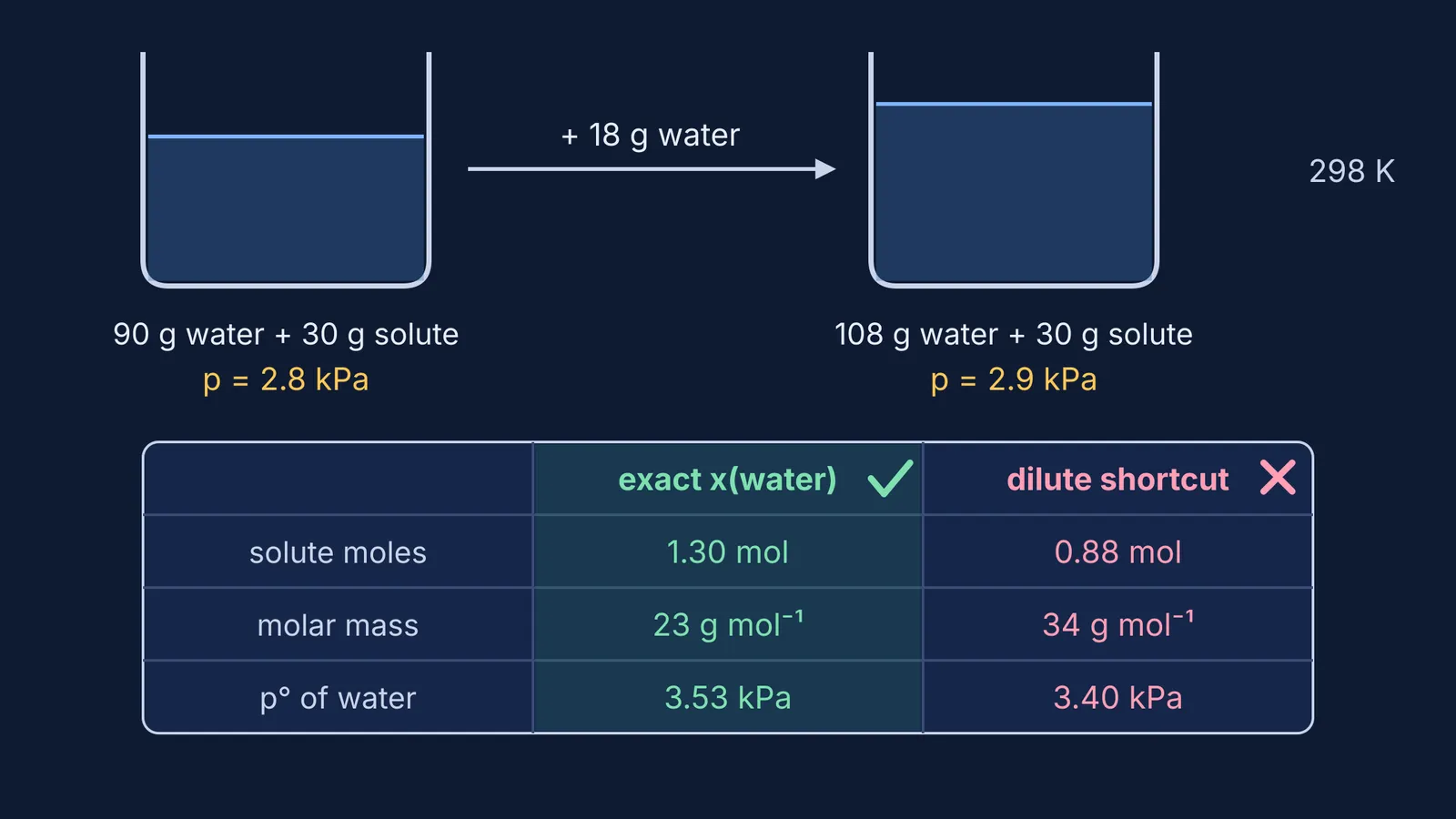
NCERT Class 12 Solutions exercise 1.19 looks like an ordinary vapour pressure question, but it has a twist. It gives you two vapour pressures and asks for two unknowns: the molar mass of the solute and the vapour pressure of pure water. Many answer keys solve it with the dilute shortcut and print 34 g mol⁻¹. The exact method gives 23 g mol⁻¹. The gap is about 50%, and seeing why is the real lesson of this problem.
What does NCERT exercise 1.19 ask?
From the NCERT Class 12 Chemistry Solutions chapter: a solution of 30 g of a non-volatile solute in 90 g of water has a vapour pressure of 2.8 kPa at 298 K. Then 18 g of water is added, and the vapour pressure becomes 2.9 kPa. Calculate (i) the molar mass of the solute and (ii) the vapour pressure of water at 298 K.
Notice what is missing. In most problems you are given p°, the vapour pressure of the pure solvent. Here you are not, so it is a second unknown. Two unknowns need two equations, and the two readings, before and after the water is added, give you exactly two.
The numbers are textbook values, not measurements. Real water at 298 K has p° of about 3.17 kPa. Treat the data as given and do not swap in the real value.
How do you set up two equations from Raoult's law?
For a non-volatile solute, only water evaporates, so Raoult's law reads:
p = p° × x(water) = p° × n(water)/(n(water) + n)
Here n is the moles of solute, which is the same in both solutions because no solute is added.
Count the water in moles, using 18 g mol⁻¹ (not 18.015, or the clean numbers drift):
First solution: n(water) = 90/18 = 5 mol
Second solution: n(water) = 108/18 = 6 mol
So the two equations are:
2.8 = p° × 5/(5 + n)
2.9 = p° × 6/(6 + n)
How do you solve them? A worked example
Step 1. Divide equation 1 by equation 2. p° cancels:
2.8/2.9 = 5(6 + n)/(6(5 + n))
Step 2. Cross-multiply. 2.8 × 6 × (5 + n) = 2.9 × 5 × (6 + n), so 16.8(5 + n) = 14.5(6 + n).
Step 3. Expand and solve for n. 84 + 16.8n = 87 + 14.5n, so 2.3n = 3 and n = 1.304 mol.
Step 4. Molar mass. M = mass/moles = 30/1.304 = 23 g mol⁻¹.
Step 5. p° of water. From equation 1: p° = 2.8 × (5 + 1.304)/5 = 2.8 × 6.304/5 = 3.53 kPa.
Step 6. Check with equation 2. 3.53 × 6/(6 + 1.304) = 3.53 × 6/7.304 = 2.90 kPa. It fits.
A neater way to see the same algebra is to flip Raoult's law: p°/p = 1 + n/n(water). That gives two straight-line equations, p°/2.8 = 1 + n/5 and p°/2.9 = 1 + n/6, which you can solve by elimination without any fractions inside fractions. You get the same n = 1.304 and p° = 3.53 kPa.
What answer does the dilute shortcut give?
The shortcut replaces the full mole fraction with (p° − p)/p° ≈ n/n(water). It is allowed when the solute is a small fraction of the solution. Apply it here:
(p° − 2.8)/p° = n/5, so n = 5 − 14/p°.
(p° − 2.9)/p° = n/6, so n = 6 − 17.4/p°.
Set them equal: 5 − 14/p° = 6 − 17.4/p°, so 3.4/p° = 1 and p° = 3.40 kPa.
n = 5 − 14/3.4 = 0.882 mol, so M = 30/0.882 = 34 g mol⁻¹.
Now put these values back into the exact law. With p° = 3.40 kPa and n = 0.882 mol, the first solution should have p = 3.40 × 5/5.882 = 2.89 kPa, not 2.8. The second should have 3.40 × 6/6.882 = 2.96 kPa, not 2.9. The shortcut answer does not reproduce the data it came from.
Why do the two methods differ by about 50%?
The shortcut assumes that adding the solute's moles to the denominator makes no difference, so n(water) + n is treated as n(water). That is fine when n is a few per cent of n(water). Here the solute is 1.304 mol against 5 mol of water in the first solution and 6 mol in the second. Its mole fraction is about 0.21 in the first and 0.18 in the second.
When you ignore n in the denominator, you undercount the solute's moles. Fewer moles for the same 30 g means a larger molar mass. In a single-reading problem with p° known, the shortcut overstates M by a factor of about 1/(1 − x), as shown in relative lowering of vapour pressure: finding molar mass. Here p° is unknown as well, and the shortcut gets it wrong too, so the two errors add up. The result is 34 against 23, a factor of about 1.48.
Two more cautions apply. Raoult's law assumes an ideal solution, and a solution this concentrated is unlikely to be fully ideal. And a solute of molar mass 23 g mol⁻¹ that is non-volatile and does not ionise is hard to name. Both are signs that this is a textbook exercise built for practice, not a real experiment.
If you want to see how vapour pressure falls as you change the mole fraction, try the Raoult's law simulation. A related problem, where water moves between two solutions until their vapour pressures match, is worked in two solutions under a bell jar.
What mistakes cost marks on this problem?
Assuming p° = 3.17 kPa (or any remembered value) instead of solving for it.
Using 108 g in the first equation. Only the second solution has 108 g of water.
Changing the moles of solute between the two solutions. The solute is the same 30 g.
Using the shortcut without checking the mole fraction.
Writing p = p° × x(solute). Raoult's law for the solvent uses x(solvent); the lowering is the one equal to x(solute).
If you keep losing track of which equation holds which numbers, the Fermi Problem Library has a step-by-step solver that explains the reasoning at each step.
Quick checklist
Two readings, two unknowns: write Raoult's law once for each solution.
n(water) = 5 mol, then 6 mol. Use M(water) = 18.
Divide the equations to remove p°, solve for n = 1.304 mol.
M = 30/1.304 = 23 g mol⁻¹; p° = 3.53 kPa.
The shortcut gives 34 g mol⁻¹ and 3.40 kPa, which do not fit the data.
Solute mole fraction near 0.2 means the exact form is required.


