

On this page
Put two open beakers of solution side by side under a sealed bell jar and leave them at one temperature. After a few days one beaker has lost water and the other has gained it. No tube connects them. The water travelled through the air in the jar, as vapour. It is a favourite JEE question, and the answer takes two lines once you see the condition.
Why does water move from one beaker to the other?
Both beakers share one vapour space. Each solution keeps the water vapour above it at its own equilibrium vapour pressure. With a non-volatile solute, Raoult's law gives p = x(water) × p°, where p° is the vapour pressure of pure water at that temperature. More solute means a smaller x(water) and so a lower p. If you want a refresher on that single-solution case, see relative lowering of vapour pressure and molar mass.
So the more dilute solution has the higher vapour pressure. The vapour in the jar settles somewhere between the two values. That pressure is above what the concentrated solution can hold in equilibrium, so water condenses into it. It is below what the dilute solution wants, so water keeps evaporating from it. The net flow is from the dilute solution to the concentrated one.
As in osmosis, the vapour space acts like a semipermeable membrane: water crosses, the solutes cannot.
The driving force is small. At 25 °C, p° ≈ 23.8 mmHg. In the example below, beaker A starts at about 23.59 mmHg and beaker B at about 23.38 mmHg, a gap of only 0.2 mmHg. That is why the transfer is slow: in a still bell jar it takes days or longer.
When does the water stop moving?
Transfer stops when the two vapour pressures are equal. Both beakers hold the same solvent at the same temperature, so they share the same p°. Equal p therefore means equal x(water), which means equal x(solute).
For n₂ mol of solute in n₁ mol of water, x(solute) = n₂/(n₁ + n₂). This is the same in both beakers exactly when the ratio n₂/n₁ is the same. And n₂/n₁ is proportional to molality (moles of solute per kg of water). So under Raoult's law, "equal solute mole fraction" and "equal molality" are the same condition, not an approximation of each other.
What the condition is not:
Not equal mass percent. Urea (M = 60 g/mol) and glucose (M = 180 g/mol) at the same mass percent have very different numbers of particles.
Not equal molarity. Molarity depends on the volume of the whole solution. It is close to molality only for dilute solutions.
Two conditions must also hold. Both beakers must be at the same temperature, otherwise their p° values differ and water simply distils from the warmer beaker to the cooler one. And the solutes must be non-volatile, so only water moves.
How much water moves? A worked example
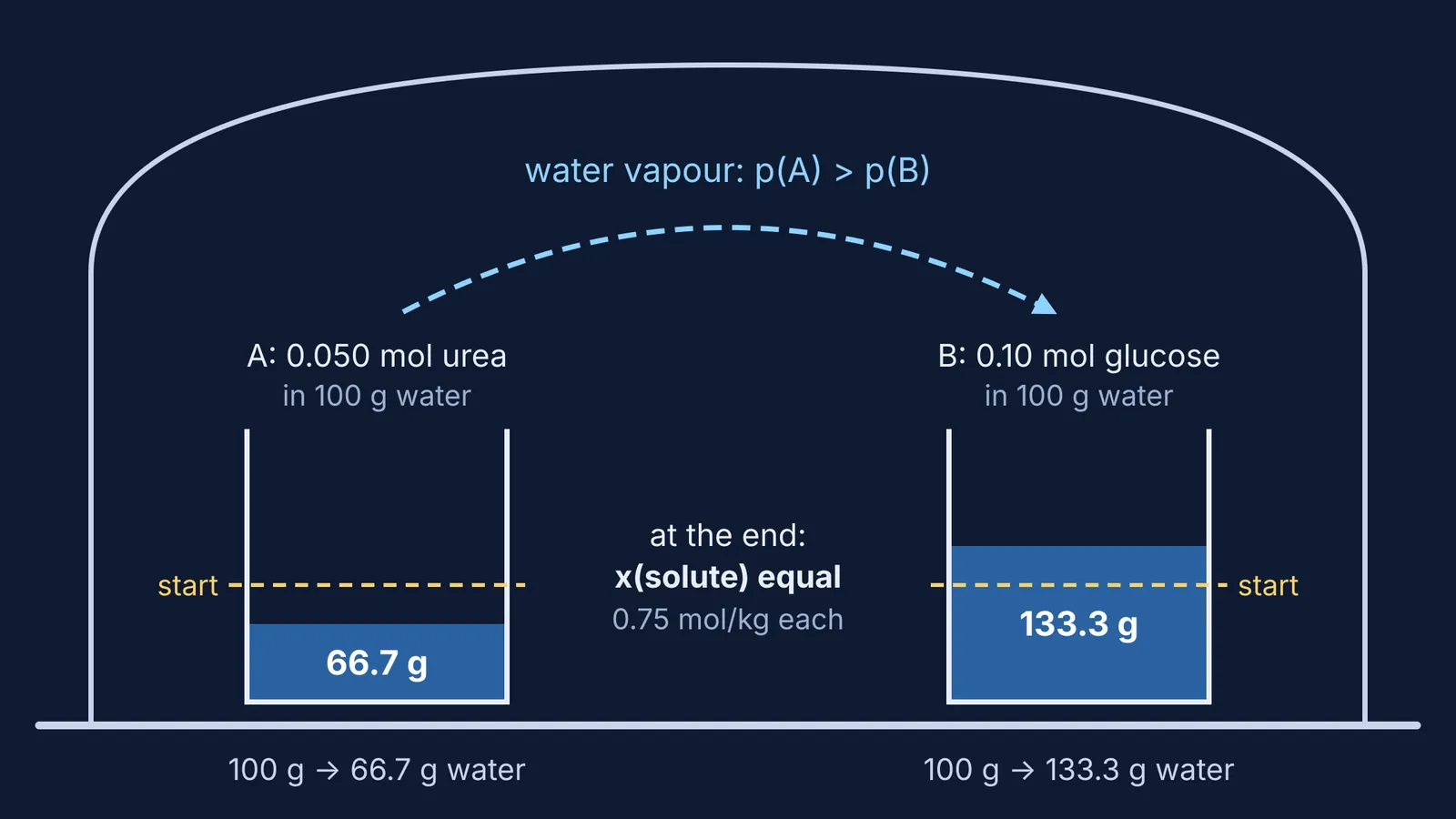
Problem. Beaker A holds 0.050 mol urea in 100 g water. Beaker B holds 0.10 mol glucose in 100 g water. Both stand under one sealed bell jar at constant temperature. Find the mass of water in each beaker at equilibrium.
Assumption. The vapour space is small, so the water held as vapour at the end is negligible. A 2 L air space at 25 °C holds about 0.0026 mol (0.05 g) of water vapour, from n = pV/RT, which is negligible. So the total liquid water stays 200 g.
Which way? A has half as much solute in the same mass of water, so it is more dilute and has the higher vapour pressure. Water goes from A to B.
Unknowns. Let the final masses of water be wA and wB grams. Their moles are wA/18 and wB/18, and wA + wB = 200.
Equal solute mole fraction. 0.050/(0.050 + wA/18) = 0.10/(0.10 + wB/18).
Cross-multiply. 0.050 × 0.10 + 0.050 × wB/18 = 0.10 × 0.050 + 0.10 × wA/18. The constant terms cancel, leaving 0.050 wB = 0.10 wA, so wB = 2wA.
Solve. wA + 2wA = 200, so wA = 66.7 g and wB = 133.3 g.
Transfer. 100 − 66.7 = 33.3 g of water moves from A to B.
Check. Molality of A = 0.050/0.0667 kg = 0.75 mol/kg. Molality of B = 0.10/0.1333 kg = 0.75 mol/kg. The final solute mole fraction is 0.0133 in both, and the common vapour pressure is about 23.48 mmHg, between the two starting values.
The molality shortcut. Since equal mole fraction means equal molality, you can write 0.050/wA = 0.10/wB straight away. Same equation, no algebra.
Does the answer depend on the starting amounts of water?
The final split does not. At equilibrium the water divides in the ratio of the solute particles: wB/wA = nB/nA. The starting amounts set only the total, and so how much has to move.
Suppose A starts with 0.050 mol urea in 50 g water (1.0 mol/kg) and B with 0.10 mol glucose in 150 g water (0.67 mol/kg). The total is still 200 g, so the final masses are still 66.7 g and 133.3 g. But now A is the more concentrated solution, so 16.7 g of water moves from B to A, the opposite way. Do not carry "33.3 g from A to B" over to a problem with different starting water.
What if one beaker holds pure water or salt solution?
Pure water in A. Pure water has vapour pressure p°, which is higher than that of any solution. No amount of extra water in B can bring its solute mole fraction down to zero, so the pressures never match while A has water left. Every drop ends up in B. Compare this with the two-beaker dynamic equilibrium activity, which uses pure water only and has no solute to drive a net flow.
Salt in B. Replace the glucose with 0.10 mol NaCl. NaCl splits into Na⁺ and Cl⁻, so with i ≈ 2 beaker B holds 0.20 mol of particles. Raoult's law counts particles.
Equal particle ratio: 0.050/wA = 0.20/wB, so wB = 4wA.
wA + 4wA = 200, so wA = 40 g and wB = 160 g.
60 g of water moves from A to B.
In a real 1 mol/kg NaCl solution the effective i is a little below 2, because the ions do not behave ideally, so slightly less water would move. Exam answers use i = 2 unless told otherwise.
This setup differs from mixtures of two volatile liquids, where both components evaporate; that case is covered in finding vapour phase composition with Raoult's and Dalton's laws. If you want to see how vapour pressure falls as solute is added, the Simulation Lab has interactive simulations for ideas that are easier to see than read.
Quick checklist
Water moves from the solution with higher vapour pressure (more dilute) to the one with lower vapour pressure.
It stops when vapour pressures are equal, which under Raoult's law means equal solute mole fraction, which is the same as equal molality.
Same temperature, non-volatile solutes, negligible water held as vapour.
Final water splits in the ratio of solute particles; starting amounts only set the total.
Count ions for electrolytes: NaCl gives about 2 particles per formula unit.
Pure water in one beaker means it all ends up in the other.


