

On this page
When two volatile liquids are mixed, the vapour sitting above them is not just a copy of the liquid below. Its composition depends on how much of each liquid is in the mixture and how easily each one evaporates.
Finding the exact makeup of that vapour is a standard problem in physical chemistry. To solve it, you need to connect what is happening in the liquid to what is happening in the gas.
What connects Raoult's and Dalton's laws?
The liquid and the vapour are governed by two different rules that meet at the surface of the solution.
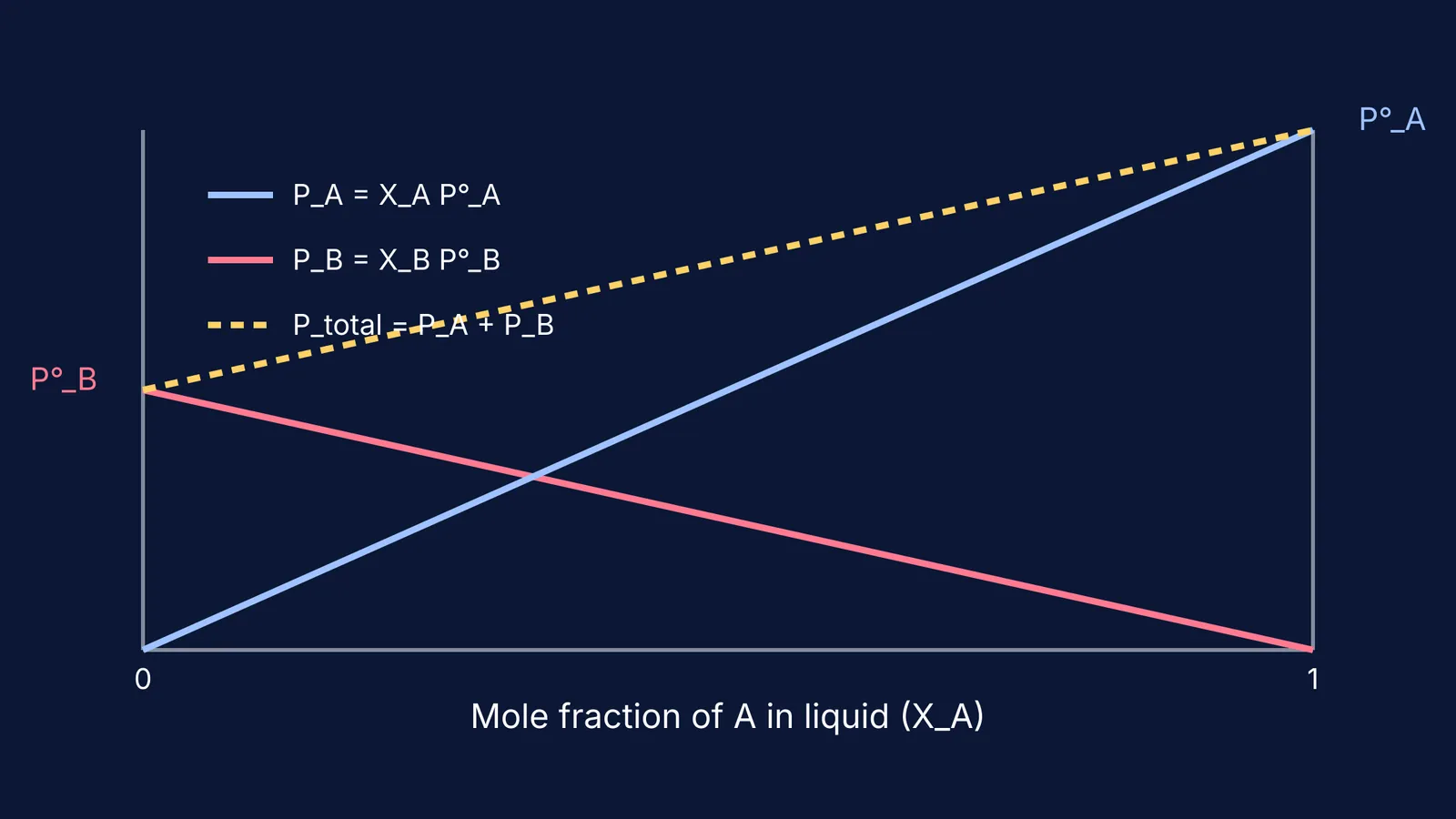
In the liquid phase, Raoult's law applies. According to OpenStax Chemistry, the partial pressure of a component in an ideal solution is equal to its pure vapour pressure multiplied by its mole fraction in the liquid. If you have a mixture of liquid A and liquid B, their partial pressures (P_A and P_B) are:
P_A = X_A × P°_A
P_B = X_B × P°_B
Here, X is the mole fraction in the liquid, and P° is the vapour pressure of the pure liquid at that temperature.
In the gas phase, Dalton's law of partial pressures takes over. It states that the total pressure of a gas mixture is the sum of the partial pressures of its components (P_total = P_A + P_B). Furthermore, the mole fraction of any gas in a mixture (Y) is simply its partial pressure divided by the total pressure (similar to the logic used when finding the average molar mass of a gas mixture).
How do you calculate mole fraction in the vapour phase?
According to OpenStax Chemistry, to find the composition of the vapour, you substitute the partial pressures from Raoult's law into the mole fraction equation from Dalton's law.
For component A, the mole fraction in the vapour phase (Y_A) is: Y_A = P_A / P_total = (X_A P°_A) / (X_A P°_A + X_B P°_B)
For component B, the equation is exactly the same, just swapped: Y_B = P_B / P_total = (X_B P°_B) / (X_A P°_A + X_B P°_B)
If you are working through these calculations and need help keeping the liquid and vapour fractions straight, the Fermi Problem Library has worked problems with a step-by-step solver that explains the reasoning rather than printing an answer.
Why is the vapour richer in the more volatile liquid?
In our example, the liquid mixture was 50% A, but the vapour above it was 71% A. This is a universal rule for ideal solutions: the vapour is always enriched in the more volatile component.
You can see why by dividing the vapour formula for A by the formula for B: Y_A / Y_B = (X_A P°_A) / (X_B P°_B)
If liquid A is more volatile than liquid B, its pure vapour pressure is higher (P°_A > P°_B). This means the ratio P°_A / P°_B is greater than 1. When you multiply the liquid ratio (X_A / X_B) by a number greater than 1, the vapour ratio (Y_A / Y_B) must be larger than the liquid ratio.
This enrichment is the physical basis for fractional distillation. By repeatedly boiling a liquid mixture and condensing the vapour—which is now richer in the more volatile component—you can eventually separate the two liquids completely. If you are struggling to picture how these equilibrium compositions shift, or how they differ from heterogeneous equilibria, the Fermi Concept Library has every concept in physics, chemistry, biology, mathematics and computing, each with its own lesson and its place in the map.


