

On this page
Your heart does not wait for the brain to tell it to beat. Each beat starts in the SA node, a patch of specialised muscle in the right atrium. What the nervous system controls is how fast that pacemaker fires, and it does so from one small region at the base of the brain.
Does the brain make the heart beat?
No. NCERT's Class 11 chapter on body fluids and circulation says normal heart activity is "auto regulated by specialised muscles (nodal tissue), hence the heart is called myogenic." Our post on how the SA node, AV node and Purkinje fibres time the heartbeat traces the electrical path.
In the absence of nerve or hormone input, the SA node would pace the heart at about 100 beats per minute, according to a review of autonomic and endocrine control of cardiovascular function by Gordan, Gwathmey and Xie in the World Journal of Cardiology (2015).
The same review notes that during rest, sleep or calm, the parasympathetic system predominates and holds the heart at 60 to 75 beats per minute. So your resting heart rate is lower than the SA node's own rate because the brain keeps a light brake on. The 70 to 75 per minute that NCERT's chapter summary gives for the SA node is the rate it sets in a living body, with that brake in place.
How does the nervous system change heart rate?
NCERT puts it in one line: "A special neural centre in the medulla oblongata can moderate the cardiac function through autonomic nervous system (ANS)" (NCERT, section 15.5). That centre works through two sets of nerves that pull in opposite directions.
Sympathetic nerves speed the heart up. Most sympathetic endings release noradrenaline (norepinephrine), and β1 receptors, found in the SA node among other places, raise the heart rate when activated, the Gordan review reports. NCERT adds that sympathetic signals also raise the strength of ventricular contraction.
The vagus nerve slows it down. The vagus "directly innervates the sinoatrial node; when activated, it serves to lower the heart rate", and acetylcholine binding to M2 receptors is what slows the rate (same review).
Hormones join in. NCERT notes that adrenal medullary hormones can also increase cardiac output. Our explainer on why your heart races when you're scared covers the adrenaline side.
For the history of how scientists showed that a nerve works by releasing a chemical, read about Otto Loewi's frog heart experiment.
What happens step by step, from stimulus to new heart rate?
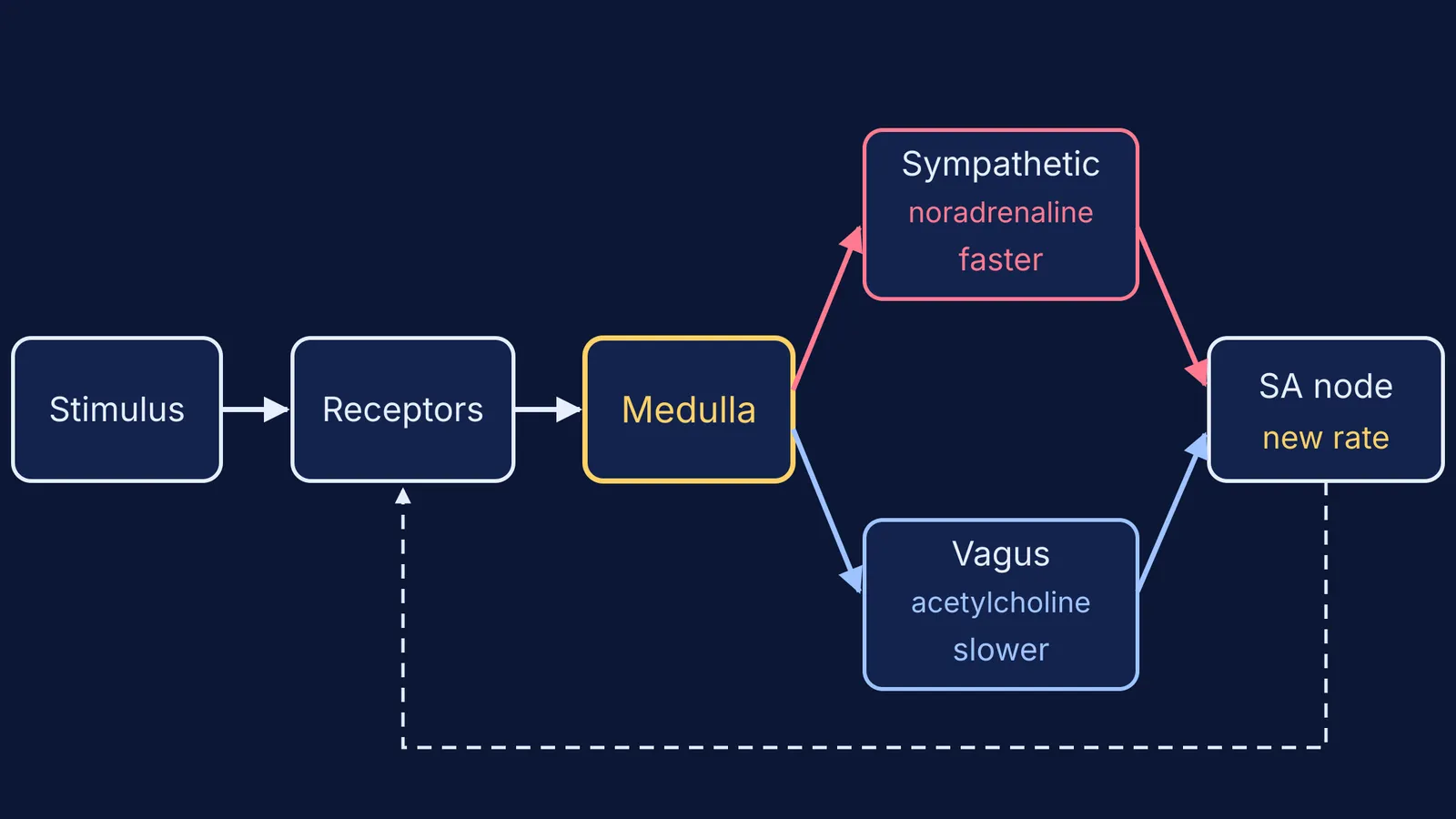
Here is the flowchart in the image above, written as a chain you can reproduce in an exam answer. The worked example is a sudden rise in blood pressure, using the baroreceptor reflex described in the Gordan review.
Stimulus: blood pressure rises and stretches the walls of the aortic arch and carotid sinuses.
Receptors: baroreceptors there are stretch sensors that send action potentials to the medulla oblongata when distended.
Control centre: the medulla takes in this signal and shifts the balance of autonomic output.
Effectors: parasympathetic (vagal) activity to the heart goes up and sympathetic drive to the blood vessels goes down.
SA node: more acetylcholine on M2 receptors means the pacemaker fires less often.
New heart rate: the heart slows, cardiac output falls, and blood pressure comes back towards normal.
Feedback: with pressure lower, the baroreceptors are stretched less, so the push towards slowing eases. This is negative feedback, the dashed loop in the diagram.
Now run it the other way for exercise or fear. The review notes that the sympathetic system is activated during exercise and emotional excitement, so the arrows flip: more sympathetic output, more noradrenaline on β1 receptors, a faster SA node and a higher heart rate.
How can you check you have really understood it?
Try these without looking back. The numbers come from the Gordan review; if you can answer all four, you have the core chain this topic is built on.
Why is a resting heart rate of 60 to 75 slower than the SA node's intrinsic rate? (A constant vagal brake.)
Which nerve and which chemical slow the heart? (The vagus, acetylcholine.)
If all nerve and hormone inputs were removed, what would the heart rate be near? (About 100 beats per minute.)
In the baroreceptor reflex, name the receptor, the centre and the effectors. (Baroreceptors; the medulla; the vagus and sympathetic nerves.)
If one link in the chain still feels shaky, the Fermi Concept Library gives every biology concept its own lesson and its place in the map, so you can see how the medulla, the autonomic nervous system and the SA node connect. If you would rather work through it aloud, Fermi's AI tutor draws the figure and checks your understanding as it goes.
Draw the seven-step chain from memory once today and again in three days, and check it against the diagram at the top.


