

On this page
Protochordate questions often come down to one idea: where is the notochord, and does it stay? Everything below is checked against the Animal Kingdom chapter of the NCERT Class 11 Biology textbook, plus two research papers.
What is the difference between Urochordata and Cephalochordata?
NCERT divides Phylum Chordata into three subphyla: Urochordata (also called Tunicata), Cephalochordata and Vertebrata, according to the Animal Kingdom chapter. The same page says Urochordata and Cephalochordata are often called protochordates and are exclusively marine.
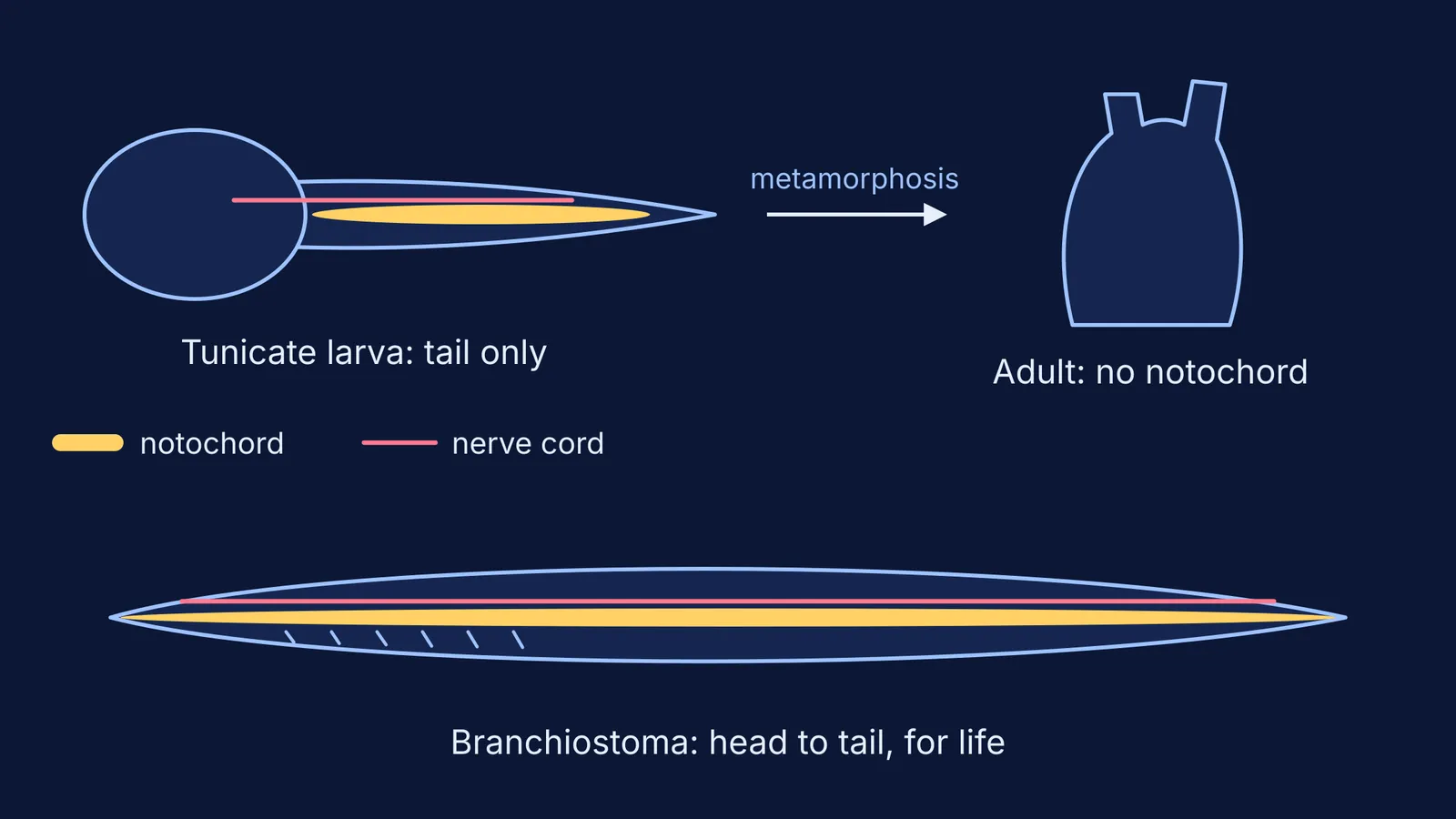
The difference NCERT gives you is the notochord. In Urochordata, the notochord is present only in the larval tail. In Cephalochordata, it extends from head to tail and is persistent throughout life.
The names carry the answer. "Uro" comes from the Ancient Greek word for tail, as Wiktionary's etymology of Urochordata records, and "cephalo" comes from the Greek word for head, per the entry for Cephalochordata. Tail-cord versus head-cord: the name tells you where to look.
Where does the notochord sit in a tunicate, and for how long?
A tunicate starts life as a small swimming larva shaped like a tadpole. A 2020 review in Frontiers in Cell and Developmental Biology by Peng, Qiao and Dong puts it plainly: in ascidians, the notochord only exists in the tail of the swimming larva and disappears after metamorphosis.
That larval notochord is small. In Ciona, a widely studied ascidian, the notochord consists of only 40 cells that line up in a single-file column, according to a review by Veeman and Reeves in Genesis.
So the adult Ascidia drawn in NCERT (Figure 4.17) has no notochord. It had one as a larva, in the tail, and lost it.
Where does the notochord sit in Branchiostoma?
Branchiostoma, which NCERT also calls Amphioxus or the lancelet, keeps its notochord running the full length of the body, head to tail, for its whole life. The same Peng, Qiao and Dong review says that in amphioxus the notochord is present throughout the body during the entire lifespan and is the body's main support structure. More in our explainer on why amphioxus keeps its notochord for life.
NCERT's section on Class Chondrichthyes does say the notochord is persistent throughout life, so persistence alone does not prove you are looking at a protochordate.
Urochordata vs Cephalochordata: the five-row comparison
Every row comes from page 46 of the NCERT Animal Kingdom chapter. Read each one as "Urochordata versus Cephalochordata".
Other name: Tunicata versus Amphioxus or lancelet (for Branchiostoma).
Where the notochord sits: larval tail only versus head to tail.
How long it lasts: larva only versus throughout life.
Habitat: exclusively marine versus exclusively marine (both are protochordates).
NCERT examples: Ascidia, Salpa, Doliolum versus Branchiostoma.
Rows 1, 4 and 5 are recall. Rows 2 and 3 are the concept, and they are where it is easiest to slip.
How do protochordates compare with vertebrates?
NCERT gives vertebrates a third pattern: they have a notochord during the embryonic period, and it is replaced by a cartilaginous or bony vertebral column in the adult, as the same chapter explains. That gives you three timelines to keep apart:
Tunicates: notochord in the larval tail, then gone.
Branchiostoma: notochord head to tail, for life.
Vertebrates: notochord in the embryo, then replaced by the vertebral column.
Our post on notochord vs vertebral column covers the replacement step, and why not all chordates are vertebrates shows where the protochordates fit.
A five-minute revision plan
Read the protochordate paragraph on NCERT page 46 once, aloud.
Close the book and sketch two outlines: a tadpole-shaped larva with a line only in its tail, and a slim lancelet with a line from tip to tip.
Write the five rows above from memory, then check them.
Test yourself with three statements and mark each true or false.
The three statements: "The adult Ascidia has a notochord" (false; only the larva does). "Branchiostoma is a protochordate with a lifelong notochord" (true). "A persistent notochord is found only in Cephalochordata" (false; NCERT says the same of Chondrichthyes).
If the word notochord itself still feels hazy, the Fermi Concept Library has every concept in biology, each with its own lesson and its place in the map, so you can see how the notochord connects to the ideas around it.
Before your next mock test, say "tail, then gone; head to tail, for life" and name one example for each.


