

On this page
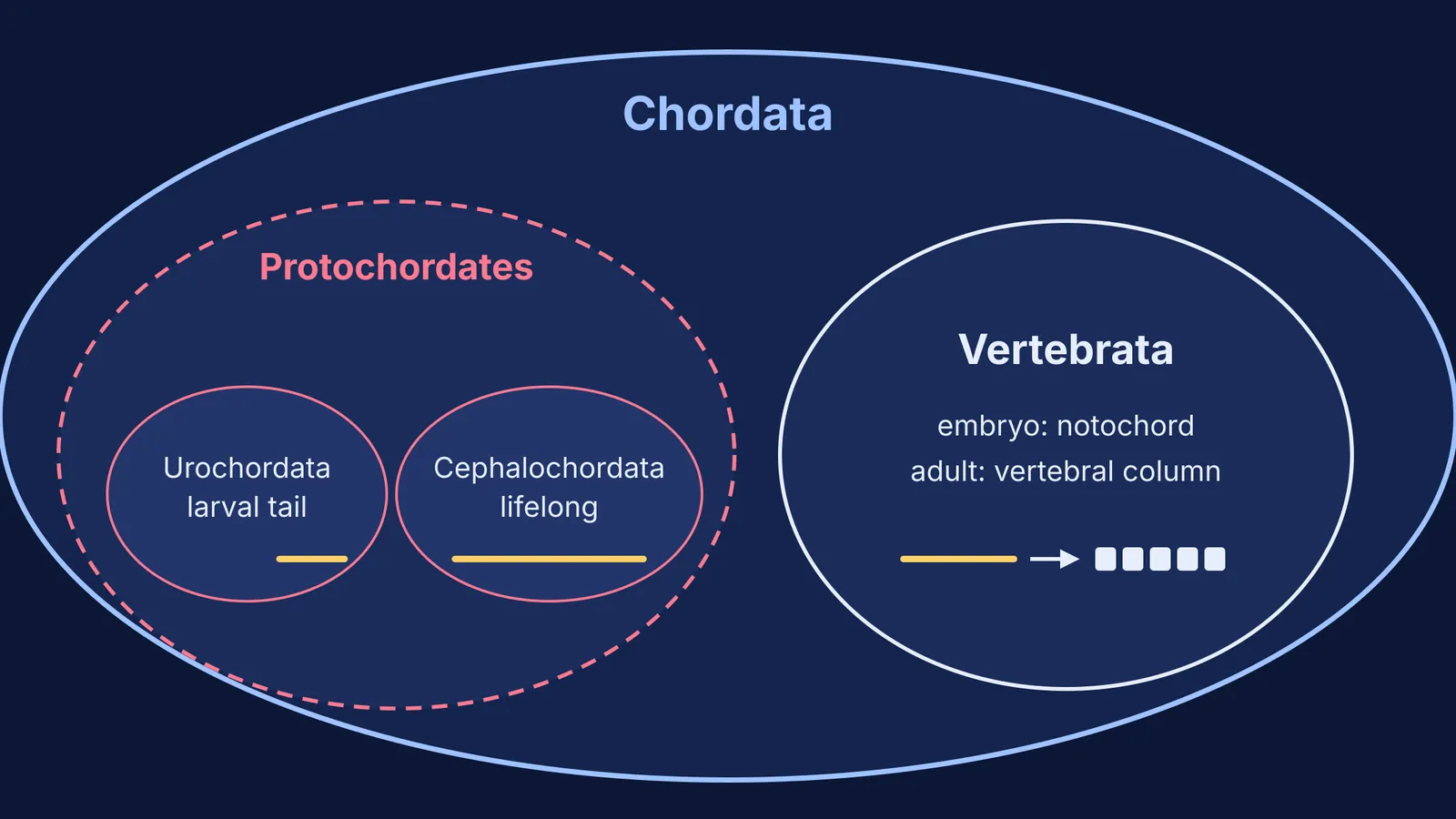
The line "All vertebrates are chordates but all chordates are not vertebrates" is Exercise 9 of Chapter 4, Animal Kingdom, in the NCERT Class 11 Biology textbook. Draw it as nested circles. Vertebrata is one circle inside the bigger Chordata circle, next to two smaller circles that NCERT groups together as protochordates.
This post builds that picture one layer at a time, names the feature at each boundary, and ends with an answer you can write in the exam.
What makes an animal a chordate?
According to NCERT, section 4.2.11, chordates are fundamentally characterised by a notochord, a dorsal hollow nerve cord and paired pharyngeal gill slits. They also have a post-anal tail and a closed circulatory system.
NCERT's Table 4.1 sets chordates against non-chordates on five points:
Notochord present, not absent.
Central nervous system dorsal, hollow and single, not ventral, solid and double.
Pharynx perforated by gill slits.
Heart ventral, not dorsal.
Post-anal tail present.
The key word is "present", not "present in the adult". NCERT's chapter summary says Chordata includes animals with a notochord "either throughout or during early embryonic life". That phrase lets vertebrates into the circle. For more on the three features, see our post on the fundamental features of chordates.
Why are not all chordates vertebrates?
NCERT divides phylum Chordata into three subphyla: Urochordata (or Tunicata), Cephalochordata and Vertebrata. Urochordata and Cephalochordata are often called protochordates, and they are exclusively marine. Here is the nested picture in words:
Chordata, the outer circle: a notochord at some stage of life.
Urochordata, a protochordate: notochord only in the larval tail. Examples: Ascidia, Salpa, Doliolum.
Cephalochordata, a protochordate: notochord from head to tail, persisting throughout life. Example: Branchiostoma (Amphioxus or lancelet).
Vertebrata: notochord in the embryo, replaced by a cartilaginous or bony vertebral column in the adult.
So the deciding feature is the vertebral column. In NCERT's account, vertebrates have one and protochordates do not: one has a notochord only in the larval tail, the other keeps it for life. Our post on Amphioxus keeping its notochord for life looks at the second case, and notochord vs vertebral column explains what replaces what.
What else do vertebrates have besides a backbone?
According to NCERT, besides the basic chordate characters, vertebrates have a ventral muscular heart with two, three or four chambers, kidneys for excretion and osmoregulation, and paired appendages that may be fins or limbs. Inside Vertebrata, NCERT splits Agnatha (no jaws, class Cyclostomata) from Gnathostomata (with jaws), which divides into Pisces (fins) and Tetrapoda (limbs).
A second trap sits just outside the outer circle. NCERT section 4.2.10 says Hemichordata was earlier considered a subphylum of Chordata but is now a separate phylum under non-chordata. Hemichordates such as Balanoglossus have a rudimentary structure in the collar region called the stomochord, which NCERT describes as similar to a notochord.
How do you write the answer to "Justify the statement"?
Here is a five-step answer built from NCERT's own wording:
Define the outer set: chordates have a notochord, a dorsal hollow nerve cord and paired pharyngeal gill slits.
Place vertebrates inside it: vertebrates have a notochord in the embryonic period, so all vertebrates are chordates.
Name the boundary: in vertebrates the notochord is replaced by a cartilaginous or bony vertebral column in the adult.
Show who stays outside: in Urochordata the notochord is only in the larval tail, and in Cephalochordata it persists throughout life. Neither has a vertebral column.
Close with examples: Ascidia and Branchiostoma are chordates but not vertebrates.
A model answer: "Chordates are animals with a notochord, a dorsal hollow nerve cord and paired pharyngeal gill slits. Vertebrates have a notochord during the embryonic stage, so they are chordates. In vertebrates the notochord is replaced by a vertebral column in the adult. Protochordates such as Ascidia (notochord only in the larval tail) and Branchiostoma (notochord throughout life) have no vertebral column. So all vertebrates are chordates, but not all chordates are vertebrates."
How do you make the nesting stick?
Draw the circles from memory before you open the chapter. Write one feature on each boundary: notochord on the Chordata line, vertebral column on the Vertebrata line. Then place six animals: Ascidia, Salpa, Branchiostoma, Petromyzon, Scoliodon and Balanoglossus. If you hesitate on one, that is the gap to fix.
If a term on the boundary feels shaky, the Fermi Concept Library covers every concept in biology, each with its own lesson and its place in the map.


