

On this page
If you have read the NCERT chapter on the animal kingdom, you have met one line that sets up a classic exam trap. Two groups of protochordates both have a notochord, but only one keeps it. That group is the cephalochordates, and its best-known member is amphioxus.
What is amphioxus, and where does it sit among chordates?
The NCERT Class 11 Biology chapter Animal Kingdom divides phylum Chordata into three subphyla: Urochordata (also called Tunicata), Cephalochordata and Vertebrata. It names Branchiostoma, also called amphioxus or the lancelet, as its example of a cephalochordate. The same chapter groups urochordates and cephalochordates together as protochordates and says they are exclusively marine.
According to that chapter, all chordates have a notochord, a dorsal hollow nerve cord, paired pharyngeal gill slits and a post-anal tail. Our explainer on the fundamental features of chordates covers each of these features. What separates the subphyla is what happens to the notochord as the animal grows.
Does amphioxus keep its notochord for its whole life?
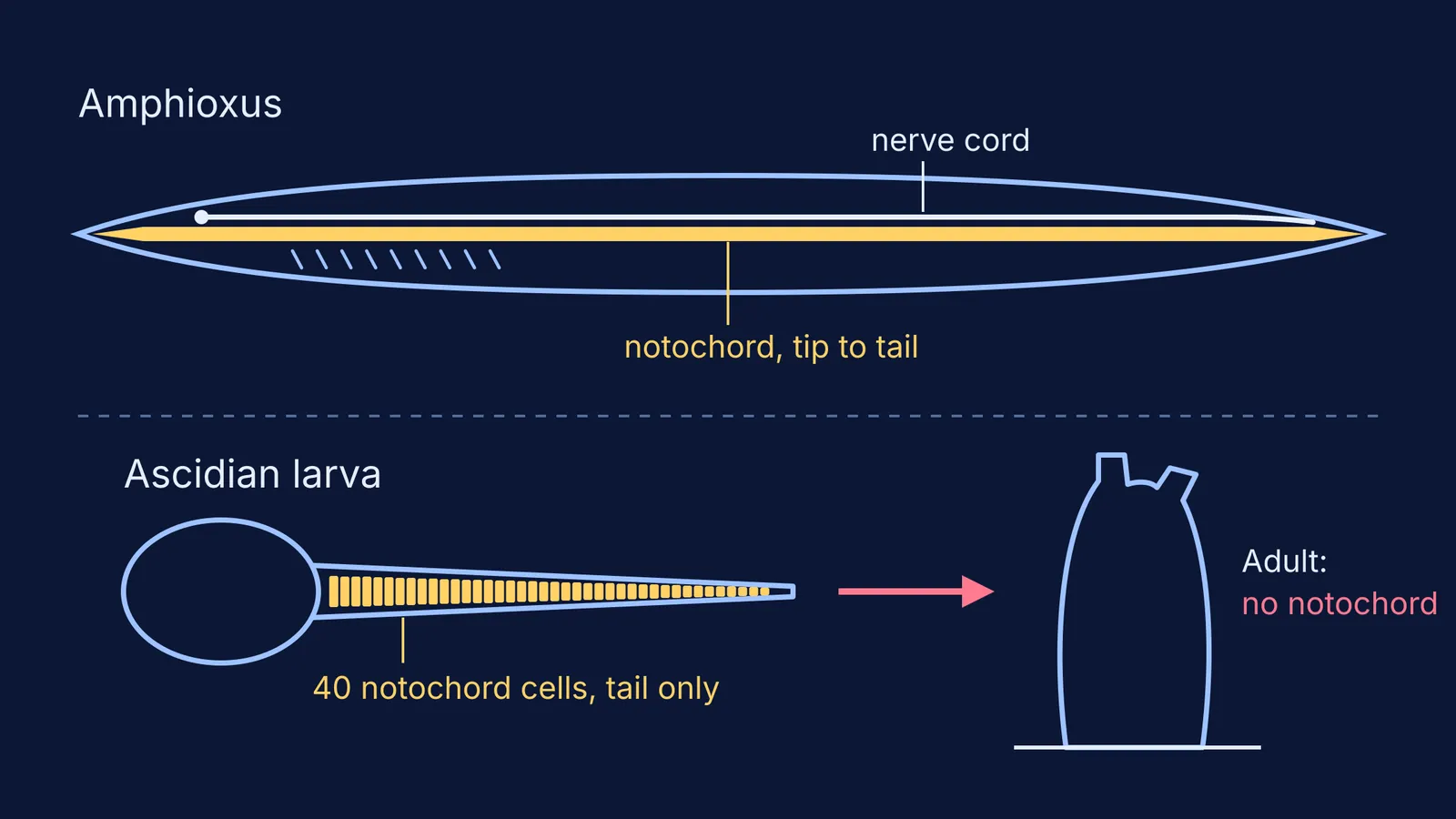
Yes. NCERT states that in Cephalochordata the notochord "extends from head to tail region and is persistent throughout their life" (NCERT Animal Kingdom chapter).
"Head to tail" is meant literally. In a 2006 review of the amphioxus nervous system in the International Journal of Biological Sciences, Èlia Benito-Gutiérrez writes that the nerve cord and notochord together run the length of the body, except at the front, where only the notochord reaches the tip. She explains that the name Cephalochordata refers to exactly this: the chord in the head.
The amphioxus notochord is also built differently from ours. A 2021 study by Noriyuki Satoh and colleagues in Frontiers in Cell and Developmental Biology describes it as having muscle-like properties and myofibrils. The authors say these muscle-like properties are not seen in urochordates or vertebrates.
How is a urochordate's notochord different?
Urochordates, or tunicates, include the sea squirts. NCERT puts the difference in one line: in Urochordata, the notochord is present only in the larval tail (NCERT Animal Kingdom chapter). Its examples are Ascidia, Salpa and Doliolum.
Research on the sea squirt Ciona shows how small that larval notochord is. A 2011 study in BMC Evolutionary Biology by Jamie Kugler and colleagues reports that the notochord of a Ciona tailbud embryo consists of just 40 cells. Those 40 cells are gradually reabsorbed at metamorphosis, so the adult sea squirt is left without one.
There is one exception beyond the textbook. The same study notes that larvaceans, a group of tunicates that includes Oikopleura, keep their notochord throughout their lifespan. NCERT does not cover larvaceans, so in a school or NEET-UG answer, stick to the textbook line: urochordates have the notochord only in the larval tail.
Is amphioxus the only chordate that keeps its notochord?
No, and this is the second trap. For vertebrates in general, the NCERT chapter says the notochord is present during the embryonic period and is replaced by a cartilaginous or bony vertebral column in the adult. Yet in its section on cartilaginous fishes (class Chondrichthyes, such as Scoliodon and Pristis), the same chapter says the notochord is persistent throughout life.
So "notochord for life" alone does not identify amphioxus. The combination does: a notochord for life, reaching the front tip of the body, in an animal that is not a vertebrate. If you are revising the jawless vertebrates next, see our guide to how lampreys and hagfish feed and spawn.
How do you answer a notochord question in an exam?
Run any animal in the question through these five checks, in order:
Is it a chordate at all? Balanoglossus has a stomochord, not a notochord; see why Balanoglossus is not a chordate.
Where is the notochord? Tail only points to a urochordate. Head to tail points to a cephalochordate.
When is it there? Larva only points to a urochordate. Whole life points to a cephalochordate, or a cartilaginous fish.
Is it replaced by a vertebral column in the adult? Then it is a vertebrate.
Does the example match NCERT? Ascidia, Salpa and Doliolum are urochordates. Branchiostoma is a cephalochordate.
Here is a worked example. Take the statement: "In Urochordata, the notochord extends from head to tail and persists throughout life." Check 2 fails at once, because NCERT places the urochordate notochord only in the larval tail. The statement is false: it describes Cephalochordata with the subphylum names swapped. Look for this kind of swap whenever two groups are described in a single sentence.
If one of the terms in this chain is shaky, such as notochord, nerve cord or metamorphosis, the Fermi Concept Library has a lesson for every concept in biology, each with its place in the map. If you are not sure where to start with the chapter, Fermi's AI tutor works out what you already know and builds a plan for the session.
Next time you revise the chapter, sketch the two animals side by side from memory and mark where the notochord runs in each.


