

On this page
You can lie flat all night and still wake up needing the toilet, so urine cannot depend on falling downhill. The ureters, the tubes joining each kidney to the bladder, are muscular pumps with a one-way valve at the end.
Doesn't urine just fall into the bladder?
No. The OpenStax anatomy chapter on the ureters, reproduced on LibreTexts, says urine "does not passively drain into the bladder but rather is propelled by waves of peristalsis". A figure caption on the same page adds that fluid pressure and gravity contribute.
Gravity can help when you stand, because the kidneys sit above the bladder. Lying down, they are no longer stacked one above the other, so gravity can do little to move urine along the tube.
Each adult ureter is 22 to 30 cm long, according to physiology notes for urology trainees hosted by the British Association of Urological Surgeons (BAUS).
How does peristalsis push urine through the ureter?
Peristalsis is a ring of muscle contraction that travels along a tube, squeezing whatever lies ahead of it.
The rhythm starts near the kidney. A 2006 review in The Journal of Physiology by Richard Lang and colleagues discusses pacemaker "atypical" smooth muscle cells in the renal pelvis, the funnel where urine collects, working with a second network of cells to drive the waves (Lang et al., 2006). The BAUS notes give the numbers:
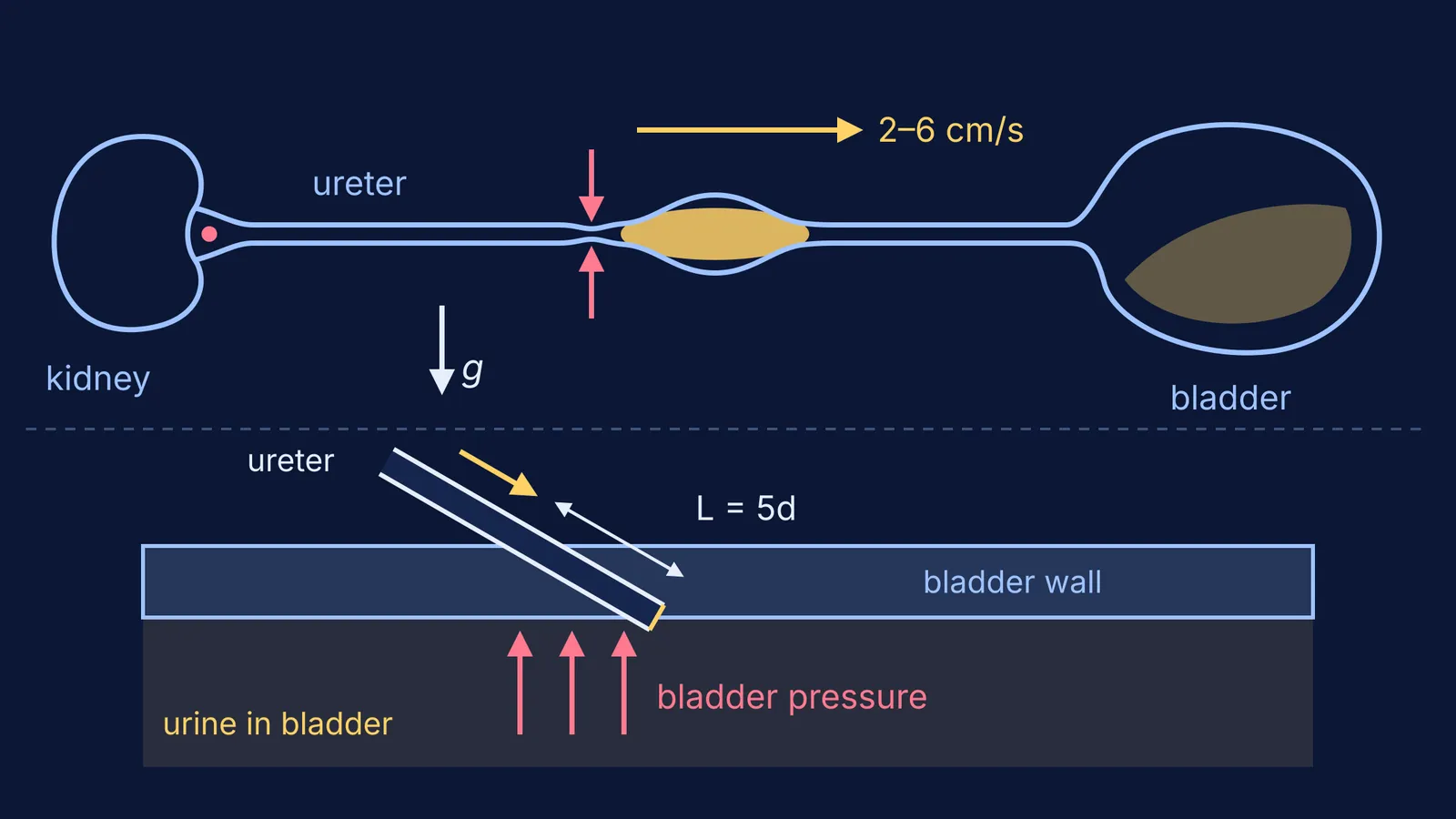
the signal spreads along the ureter at 2 to 6 cm per second
waves pass 2 to 6 times per minute
resting pressure inside the ureter is 0 to 5 cm of water
a peristaltic wave raises it to 20 to 80 cm of water
At normal flow, the waves form urine into separate packets called boluses, each pushed by the squeeze behind it; only at very high flow does it run as a continuous column (same BAUS notes).
Worked example: can a ureter push urine uphill?
A pressure of "20 cm of water" could hold up a 20 cm column of water. Urine is mostly water, so the BAUS figures above compare directly with gravity. This is a rough comparison, not a measurement:
Standing: gravity adds at most the ureter's vertical drop, under 30 cm of water.
Lying flat: the kidneys are no longer above the bladder, so gravity adds little. Each wave still delivers 20 to 80 cm of water.
Headstand: gravity now works against the flow, again by under 30 cm of water. Waves in the upper part of the 20 to 80 cm range still beat it.
Timing: at 2 to 6 cm per second, one wave crosses a 22 to 30 cm ureter in roughly 4 to 15 seconds (22 ÷ 6 ≈ 3.7 s; 30 ÷ 2 = 15 s).
Posture changes how much gravity helps or hinders, but the pump's push is about as large or larger, so lying down makes little difference. For the extreme case, see how astronauts eat and use the toilet in microgravity.
Why doesn't urine flow back up into the kidneys?
As your bladder fills, its pressure rises. The BAUS notes list ureter pressure higher than bladder pressure as a requirement for transport, and say transport decompensates when bladder pressure goes above 40 cm of water.
The fix is geometry. Near the bladder, each ureter turns and pierces the bladder wall obliquely, creating "a one-way valve (a physiological sphincter rather than an anatomical sphincter)" (LibreTexts). The slanted segment inside the wall is the intramural ureter. A review in Pediatric Nephrology by Jennifer Sung and Steven Skoog explains that the bladder wall passively compresses it during filling, which stops urine flowing backward, like a garden hose being stepped on (Sung and Skoog).
The same review cites a 1959 dissection study: in children without reflux, the tunnel was about 5 times as long as the ureter was wide, compared with 1.4 times where reflux occurred. A longer tunnel gives the bladder more ureter to squeeze shut.
When the valve fails, urine flows backward: vesicoureteral reflux. The NIDDK says it is most common in infants and young children. Some children have no symptoms; when there are symptoms, the most common is a urinary tract infection.
How should you revise this for exams?
Answer these out loud, without notes:
What moves urine down the ureter? (Peristalsis, not gravity.)
Where does the beat start? (Pacemaker cells in the renal pelvis.)
How often do waves pass? (2 to 6 times per minute.)
Why does lying down make little difference? (One sentence.)
Draw the oblique tunnel and show which way bladder pressure pushes.
What is it called when the valve fails? (Vesicoureteral reflux.)
Step 5 is the hardest, because the valve is a 3D shape. Fermi's AI tutor draws the figure as it teaches and checks your understanding as it goes. The Fermi Concept Library gives every biology concept its own lesson.
To see what happens upstream, read how the collecting duct and ADH set urine volume, then why most birds have no urinary bladder.


