

On this page
On the International Space Station, everything you let go of floats: a crumb, a grain of salt, a drop of tea. Without gravity, engineers rely on two other tools: surface tension, which holds a liquid together, and airflow from fans.
Why do astronauts eat tortillas instead of bread?
In orbit, crumbs drift into equipment instead of falling to the floor. One way NASA limits this risk is by sending tortillas instead of sliced bread, according to Space Center Houston. They do not produce many crumbs, and space tortillas stay good on the shelf for roughly 18 months.
Seasoning has the same problem. If you shook salt and pepper out in space, the grains would end up suspended in the air, so astronauts use liquid seasoning instead of shakers. NASA's food lab dissolves salt in water and pepper in oil, Popular Science reports. Liquid seasoning sticks to the food.
How do astronauts drink water in space?
In orbit, nothing keeps tea at the bottom of a cup, so drinks start out sealed. According to NASA, beverages start as a powder in a container sealed with a one-way plastic valve, and water is injected once on orbit.
You can drink from an open cup if its shape does gravity's job. A Portland State University thesis on the Capillary Beverage Experiment on the ISS describes Space Cups in which the role of gravity is replaced by "the combined effects of surface tension, wetting, and special container geometry". "Gravity isn't doing it, it's surface tension that's bringing it there," Mark Weislogel, a professor of mechanical engineering at Portland State University, told The World.
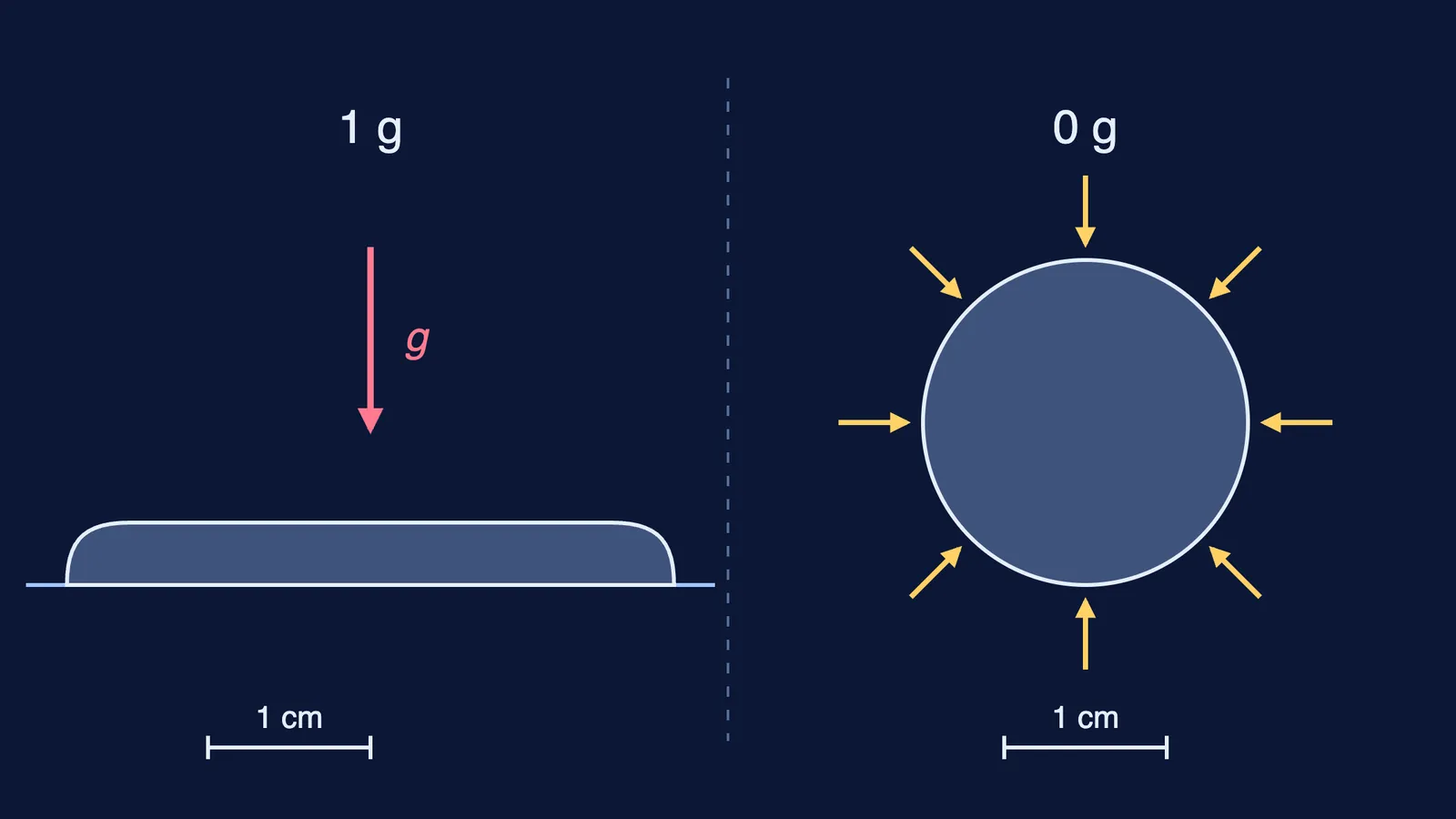
Surface tension also explains why a floating drop is round: a sphere has the smallest surface area of any shape with the same volume.
Shape 1 cm³ of water as a cube. Its surface area is 6 × 1 × 1 = 6 cm².
Shape the same 1 cm³ as a sphere. Then r = (3/(4π))^(1/3) ≈ 0.620 cm, so the area is 4πr² ≈ 4.84 cm².
The sphere has about 19% less surface. Every bit of surface costs energy, so a free drop pulls itself into a sphere.
On Earth, a drop that size sags into a puddle because gravity beats surface tension. In orbit, nothing opposes it. The same force is behind why a needle floats on water and sinks with soap, and ideas like this are easier to see than to read about, which is what the Fermi Simulation Lab is for.
How does a space toilet work without gravity?
"In the absence of gravity, space toilets use air flow to pull urine and feces away from the body," says NASA. Its Universal Waste Management System, announced in September 2020, starts the airflow automatically when the lid is lifted. It is 65% smaller and 40% lighter than the station toilet it was built to follow.
Solid waste is sealed in water-tight bags and compacted in a canister; most canisters burn up with a cargo ship on re-entry. On the station, urine is pre-treated and fed into a system that recycles water. In 2023, NASA reported that the station's life-support system had reached total water recovery of 98%, up from 93 to 94% before a brine processor was added. The station also has to make its air: see how the space station makes oxygen.
What will Gaganyaan astronauts eat?
India's planned space menu comes from the Defence Food Research Laboratory (DFRL) in Mysuru, a DRDO lab. The menu it described in 2021, reported by ThePrint, listed idli, upma or poha for breakfast, biryani or vegetable pulao for lunch, and korma and chapatis for dinner. Meals were to be mildly spiced, with an extra spice sachet, and dehydrated, so astronauts add water. Bread was left out because it tends to crumble, and a DRDO scientist described straws that pull droplets back after each sip.
Clearing food for spaceflight takes time. Indian astronaut Shubhanshu Shukla said only gajar ka halwa, moong dal ka halwa and amras completed every required test in time for his mission to the International Space Station. "They wanted to do more tests, but we did not have enough time," he said, as Business Today reported. Next, read how Gaganyaan's crew escape system works.
Can you plan a space-safe thali?
Run each dish through four checks:
Does it crumble? Roti passes. Biscuits and rusk fail.
Does it have loose grains or powder? Turn it into a paste or a liquid, as NASA does with salt and pepper.
Could the liquid escape? Dal, rasam or juice needs a sealed pouch with a valve or a straw.
Will it keep for months without a fridge? Dehydrated dishes and heat-treated food in sealed pouches pass; fresh ones need a plan.
Dry chivda fails checks 1 and 2. Halwa passes all four, because it is soft, holds together and can be sealed. Dal passes only in a sealed pouch with a straw.
To work through surface tension step by step,Fermi's AI tutor works out what you already know and builds a plan for the session.


