

On this page
NASA's station facts page says an international crew of seven lives and works on board, orbiting Earth about every 90 minutes. Their oxygen comes from a reaction you have probably seen in a school lab: passing an electric current through water.
How does the space station get oxygen to breathe?
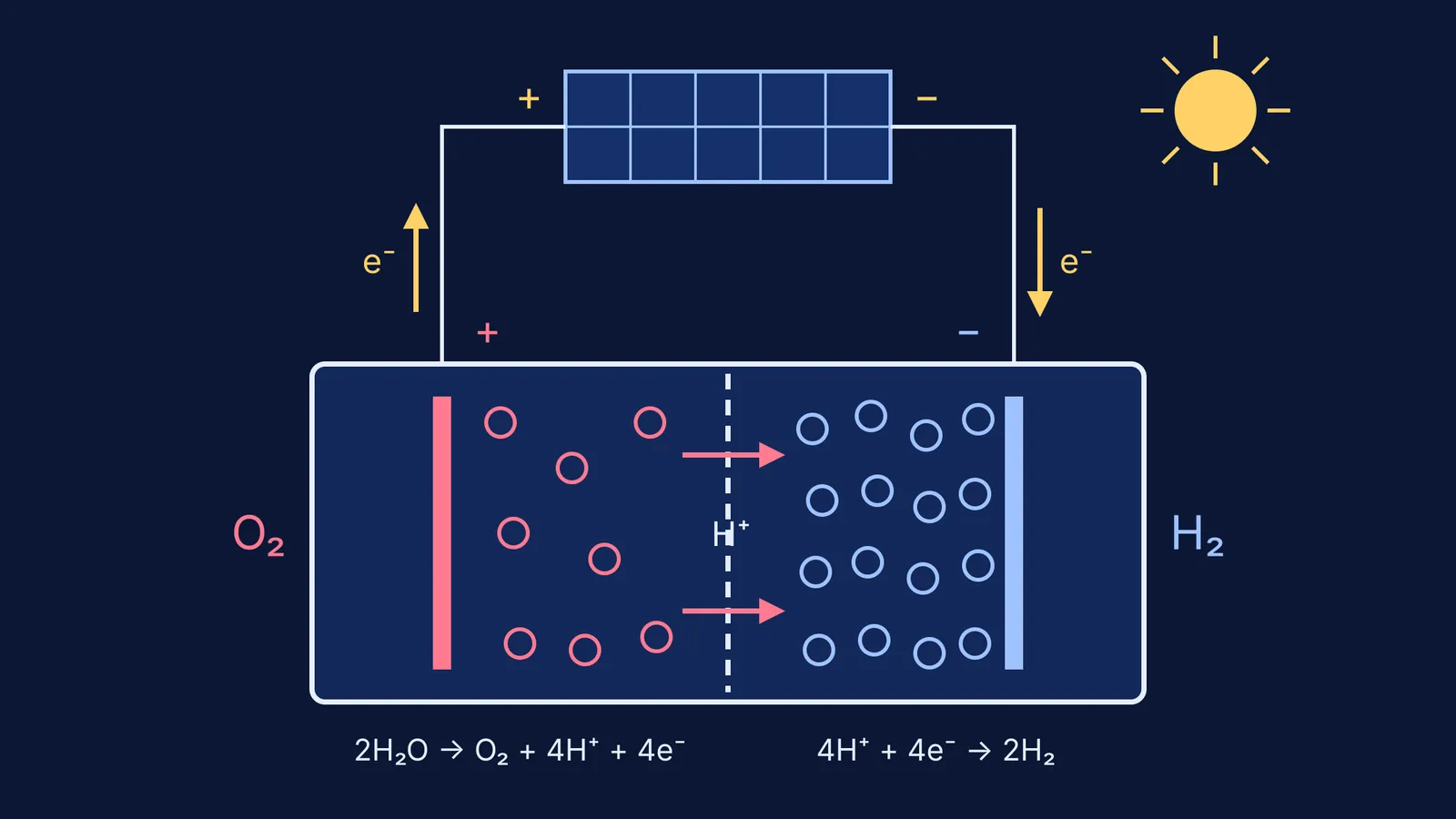
According to NASA's overview of the station's life support systems, the Oxygen Generation System produces oxygen for the crew to breathe. Its heart is a cell stack that electrolyses water supplied by the station's Water Recovery System, giving oxygen and hydrogen. The same page says the Water Recovery System recycles about 90 percent of the water on the station.
The oxygen goes into the cabin. The hydrogen is either vented into space or sent to a Sabatier reactor, where it reacts with the carbon dioxide the crew breathe out to make water (reused) and methane (released into space).
The hard numbers come from a 2024 NASA conference paper on the oxygen generator by Kevin Takada and colleagues:
The station's Oxygen Generation Assembly makes up to 9.25 kg of oxygen a day at a current of 46.9 A.
That is enough for 10.88 people, assuming each person uses 0.85 kg of oxygen a day.
Since it was first switched on in 2007, it had made 13,288 kg of oxygen and 1,661 kg of hydrogen by 13 May 2024.
Where does the electricity come from?
From the Sun. NASA's facts page says 8 solar arrays provide 75 to 90 kilowatts of power, and the station passes through 16 sunrises and sunsets every 24 hours. In the NASA paper, a power supply module inside the oxygen generator takes that station power and feeds current to the cell stack.
Is this the same electrolysis of water you do in Class 10?
Yes. Activity 1.7 in NCERT Class 10 Science, Chapter 1 puts carbon electrodes in water with a few drops of dilute sulphuric acid, connects a 6 volt battery, and asks whether the volume of gas in both test tubes is the same. It is not. The overall reaction is 2H₂O → 2H₂ + O₂, so the cathode gives twice the volume of hydrogen as the anode gives oxygen. We go through that in why electrolysis of water gives a 2:1 volume ratio.
By mass, the same equation predicts 4 g of hydrogen for every 32 g of oxygen, a ratio of 8 to 1. The station's own totals from the NASA paper match it.
How much electricity does one astronaut's oxygen need?
This is where Class 12 Electrochemistry comes in. NCERT Class 12 Chemistry, Unit 2 gives the anode reaction 2H₂O → O₂ + 4H⁺ + 4e⁻ with E° = 1.23 V, and Faraday's constant as 96487 C per mole of electrons. Work it through for one person's 0.85 kg a day, the figure the NASA paper assumes:
Moles of oxygen: 850 g ÷ 32 g/mol = 26.6 mol of O₂.
Electrons: 4 per O₂ molecule, so 4 × 26.6 = 106 mol of electrons.
Charge: 106 mol × 96487 C/mol ≈ 1.03 × 10⁷ C.
Current through a single cell for a whole day: 1.03 × 10⁷ C ÷ 86,400 s ≈ 119 A.
Water used: 2 H₂O per O₂, so 53.1 mol × 18 g/mol ≈ 956 g, just under a litre.
Minimum energy: 1.03 × 10⁷ C × 1.23 V ≈ 1.26 × 10⁷ J, about 3.5 kWh.
First, the paper says the station's assembly runs at no more than 46.9 A, yet makes 9.25 kg a day. One cell at 46.9 A would make only about 336 g a day, so the same current must pass through at least 28 cells' worth of stack, each making its own oxygen. That is our estimate from Faraday's law, not a NASA figure.
Second, 1.23 V is only the minimum. The NCERT chapter explains that some electrode reactions are so slow that extra voltage, called overpotential, has to be applied, so the true energy bill is higher. For more practice, see Faraday's laws of electrolysis with solved examples.
How can you revise this in 20 minutes?
Five minutes: redraw Activity 1.7 from memory, labelling anode, cathode and which gas collects where.
Five minutes: add the two half-reactions to get 2H₂O → 2H₂ + O₂, checking that the electrons cancel.
Five minutes: redo the worked example for the crew of seven on NASA's facts page. You should get 5.95 kg of oxygen and about 6.7 litres of water a day.
Five minutes: explain to someone at home why the station sometimes sends the hydrogen to the Sabatier reactor.
If bubbles forming at electrodes and ions moving through a cell are hard to picture, the Fermi Simulation Lab has interactive simulations for ideas that are easier to see than to read. If a Faraday's law numerical keeps going wrong at the same step, the Fermi Problem Library has worked problems with a step-by-step solver that explains the reasoning.
Then go outside and spot the ISS from India.


