

On this page
It moves faster than a passenger jet and shines brighter than most stars in the night sky, yet many people never notice it. The International Space Station (ISS) is the third brightest object in the sky, and spotting it from India requires nothing more than a clear sky and knowing exactly when to look.
Here is the science behind why it is visible, and how you can catch it on its next pass.
Why is the ISS visible from Earth?
The ISS does not have giant floodlights pointing down at us. Instead, it relies entirely on reflected sunlight. The station orbits at an altitude of approximately 400 to 420 kilometres above the Earth NASA. At this impressive height, it catches the Sun's rays long after the Sun has set for people standing on the ground.
Because the station is covered in massive solar arrays—spanning about 73 metres across—and its overall size rivals that of a football field, it acts like a giant mirror in low Earth orbit. When the geometry is right, it reflects that sunlight down to Earth, making it appear as a brilliant, steady white light Wikipedia. Unlike an aeroplane navigating the airways, it will not blink or flash red and green lights. It simply shines with a steady, unblinking intensity.
When are the best twilight hours to look?
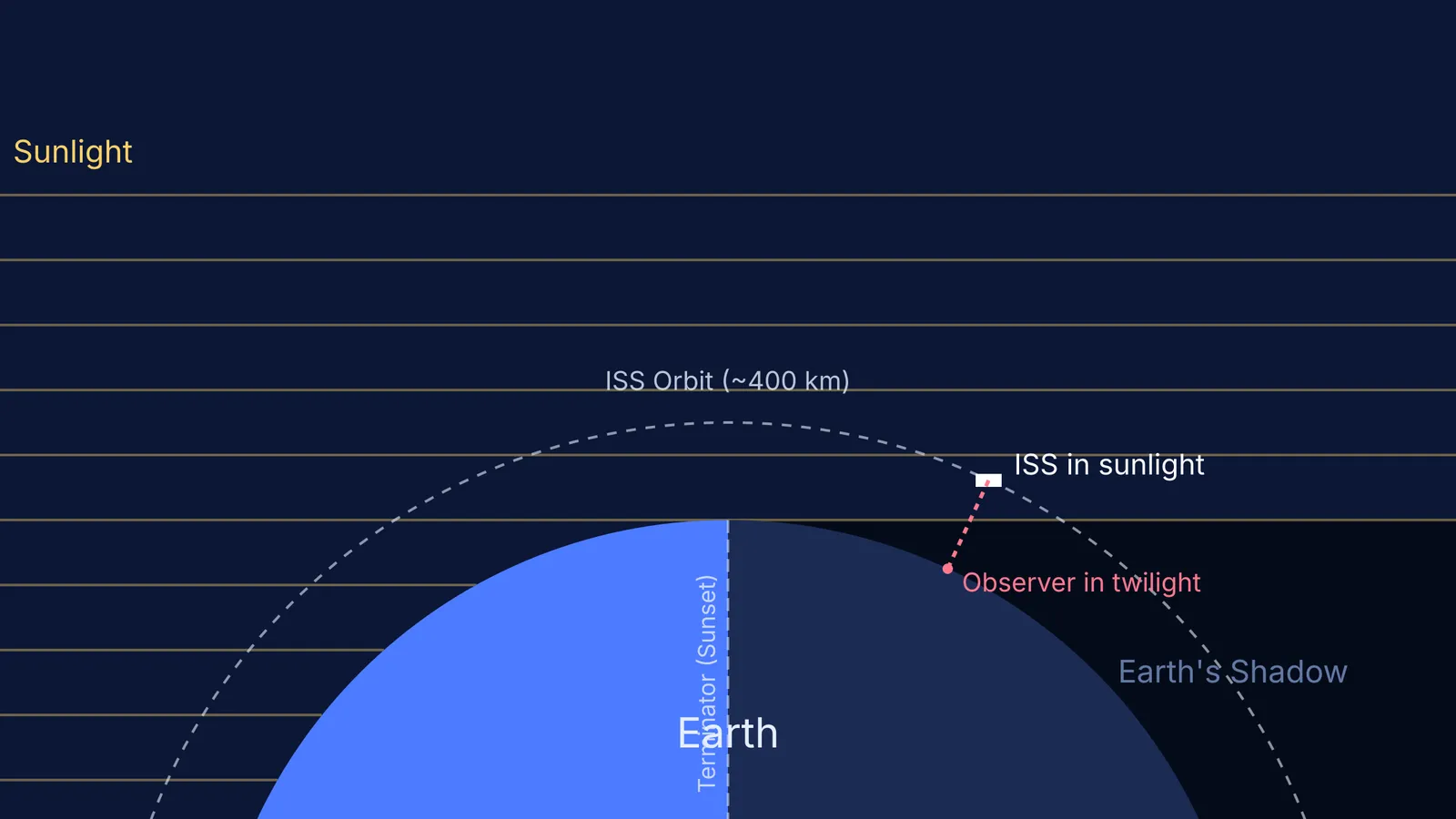
To see the space station, you must be standing in the dark, but the station must be bathed in sunlight. This means the ISS is only visible to the naked eye during twilight hours, typically one to two hours before sunrise or after sunset ISS OnLive.
The Earth casts a massive shadow out into space. If you look up in the middle of the day, the sky is too bright and blue to see the station's reflection. If you look up in the middle of the night, the station is passing deeply through the Earth's shadow, meaning there is absolutely no sunlight for it to reflect down to you.
Visualising an orbit and these specific sunlight angles is notoriously hard to do from a textbook diagram. The Fermi Simulation Lab provides interactive simulations for the ideas that are easier to see than to read. By changing the tilt of the Earth in a simulation, it helps you see exactly when the station slips behind the terminator line and into the shadow.
What does an orbital pass look like?
When you spot a good pass, the station will usually appear near the western horizon. Because it orbits the Earth in the same direction the Earth rotates, it generally moves from west to east.
It will rise silently, looking like a bright star that has detached itself from the constellations. It does not leave a glowing trail like a meteor, and it does not hum like a high-altitude aircraft. It moves with a smooth, relentless glide across the sky. At its peak brightness, it can outshine the brightest stars and occasionally rival the planet Venus.
How can we see the space station from India with naked eyes?
The station travels at a staggering speed of about 27,600 km/h, completing a full orbit of the Earth every 93 minutes Wikipedia. Because of this tremendous speed, a visible pass usually lasts only two to six minutes from start to finish.
Here is a practical checklist to plan your viewing NASA:
Find your local pass time: Visit NASA's official tracking website to get a list of upcoming passes for your specific city.
Check the maximum height: Passes are measured in degrees above the horizon. A pass of 10° is very low and will likely be blocked by trees or buildings. Look for passes that reach above 40° for the clearest view.
Know the direction: The tracking data will tell you exactly which compass direction the station will appear from and where it will disappear.
Find a dark spot: While the station is bright enough to see from light-polluted city centres like Delhi or Bengaluru, finding a spot away from direct streetlights makes the contrast much sharper.
Connecting orbital mechanics to what you see in the actual sky is a great way to study physics. If you want to understand the mathematical rules that keep the station flying, reviewing Kepler's second law and areal velocity is a solid next step, along with exploring atmospheric refraction to understand why the background stars twinkle while the station does not.
Next time you have a clear evening, step outside and look up. Knowing that a functioning laboratory is flying overhead—often carrying a crew of international astronauts conducting science in zero gravity—turns a simple point of moving light into a remarkable sight.


