

On this page
Exams usually ask about four fish scales: placoid, ganoid, cycloid and ctenoid. Learn each by shape, material and the fish that carry it, then use the sketch guide and identification steps below.
What are the four types of fish scales?
The Australian Museum sorts scales into placoid (sharks and rays), cosmoid (lungfishes and some fossil fishes), ganoid (bichirs, bowfin, paddlefishes, gars and sturgeons), and cycloid and ctenoid (most bony fishes). Cosmoid scales are mostly a fossil story, so school syllabi stick to the other four. The definitions below follow the fish scale entry on Wikipedia.
Placoid scales are small, tooth-like scales, also called dermal denticles, found on sharks and rays.
Ganoid scales are shiny, diamond-shaped scales that fit together like a jigsaw, joined by peg-and-socket joints, instead of overlapping.
Cycloid scales are thin, round scales with a smooth rear edge, common on salmon and carp.
Ctenoid scales are like cycloid scales but carry tiny teeth, called ctenii, along the rear edge; perch-like fishes have them.
Cycloid and ctenoid scales are grouped together as leptoid scales, the scales of teleosts, the modern bony fishes.
What are fish scales made of?
A 2009 review in the Journal of Anatomy by Sire, Donoghue and Vickaryous compares how each type is built.
Placoid scales are built like teeth: a cap of enameloid, a layer of dentine below it and a pulp cavity in the middle. In living sharks and rays they develop from odontogenic papillae, the same kind of tissue that forms teeth (Sire and colleagues, 2009).
Ganoid scales are covered in ganoine, a shiny, hypermineralised tissue that the same review compares to enamel, lying over a layer of dentine.
A 2008 study in Nature Materials found four layers in each scale of the bichir *Polypterus senegalus*: ganoine about 10 µm thick, dentine about 50 µm, isopedine about 40 µm and a bone base about 300 µm. The whole scale, MIT News reported, is about 500 millionths of a metre thick.
Cycloid and ctenoid scales are elasmoid scales, made of elasmodine: stacked layers of collagen fibrils laid down like plywood (Sire and colleagues, 2009). They are thin and bendable, and they overlap like roof tiles.
One detail is still argued over. The Australian Museum lists lungfishes under cosmoid scales, but the 2009 review describes cosmoid scales as entirely extinct. If an exam asks about cosmoid scales, go with your textbook.
How do you identify a fish scale?
Use this as your identification key, stopping at the first match.
Is the skin rough, with no separate flat scales you could peel off? The scales are placoid: tooth-like, made of dentine and enameloid, found on sharks and rays.
Are the scales glossy and diamond-shaped, fitting edge to edge? They are ganoid: rhombic, coated in ganoine, found on gars, bichirs, sturgeons and paddlefishes.
Are they thin, overlapping and smooth along the rear edge? They are cycloid: round, collagen-based, found on salmon and carp.
Are they thin and overlapping, with a fringe of tiny teeth on the rear edge? They are ctenoid: comb-edged, collagen-based, found on perch-like fishes.
How do you draw each type of fish scale?
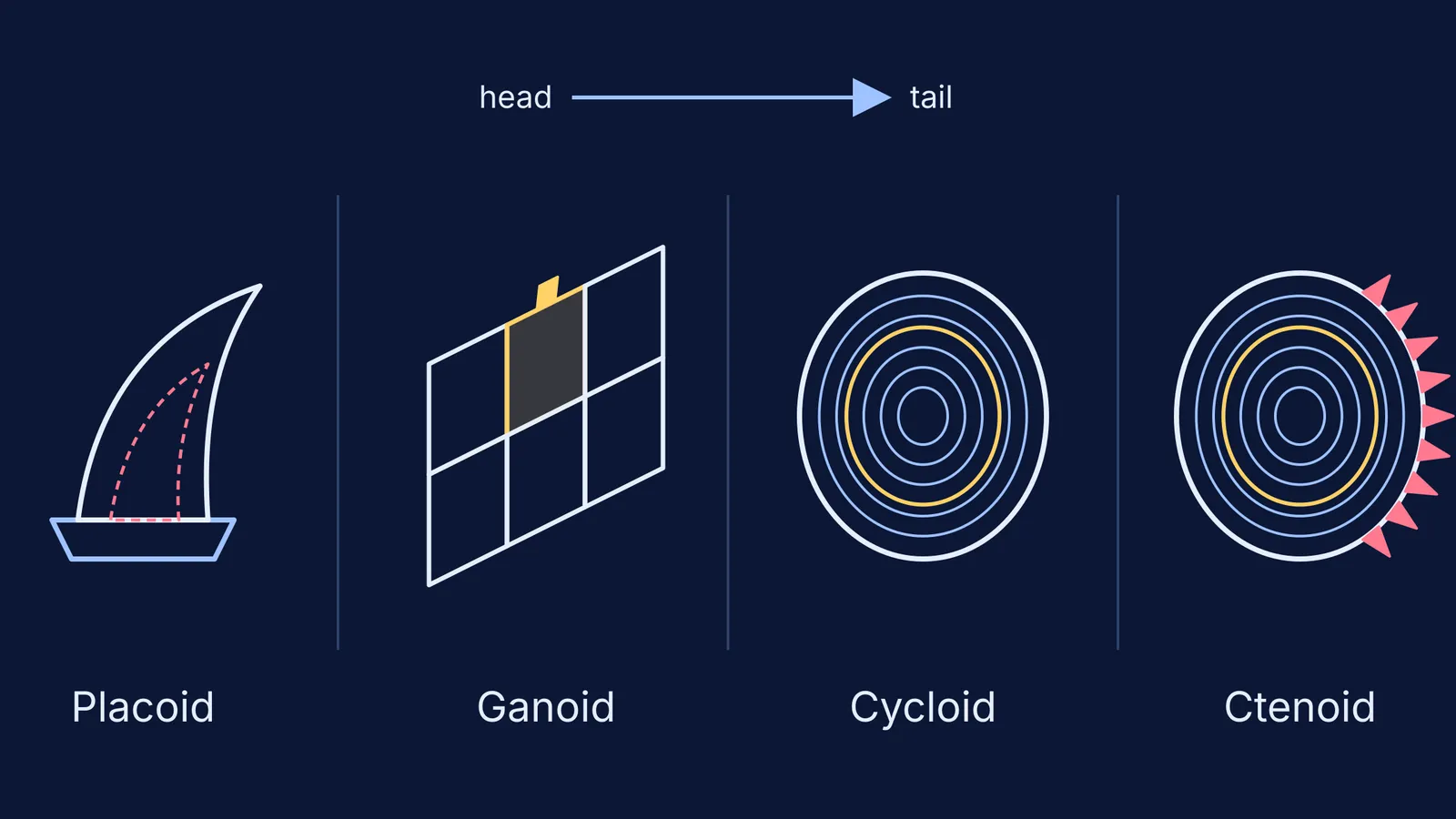
The diagram at the top follows these steps, head to the left, tail to the right. Each sketch takes about 30 seconds.
Placoid: draw a flat base plate, then a curved spine rising from it and pointing back towards the tail. Add a dotted pulp cavity inside.
Ganoid: draw a row of slanted diamonds touching edge to edge, with a small peg on the top edge of one.
Cycloid: draw an oval and fill it with nested growth rings. Keep the back edge smooth.
Ctenoid: draw the same oval, then add small teeth all along the back edge, the side nearest the tail.
Can you tell a fish's age from its scales?
For cycloid and ctenoid scales, often yes. The Australian Museum explains that growth rings called circuli appear as these scales grow, and slower growth in winter bunches them into bands called annuli. Counting the annuli estimates the fish's age, like counting tree rings. The same page notes two oddities: in some flatfish species, males have ctenoid scales while females have cycloid ones, and the Indian mahseer has scales that can reach over 10 cm long.
Which mistakes cost marks on fish-scale questions?
Giving sharks cycloid scales. Placoid scales belong to cartilaginous fishes; our explainer on cartilaginous vs bony fish sets the two groups side by side.
Putting the ctenii on the front edge. They sit on the rear edge, the part that shows.
Calling placoid scales "bony". They are made of dentine and enameloid; see how shark skin denticles cut drag.
Drawing ganoid scales overlapping. They meet edge to edge.
If skin, teeth and bone keep blurring together, the Fermi Concept Library gives every concept in biology its own lesson and its place in the map. To practise, the Fermi Problem Library has worked problems with a step-by-step solver that explains the reasoning rather than just printing an answer.


