

On this page
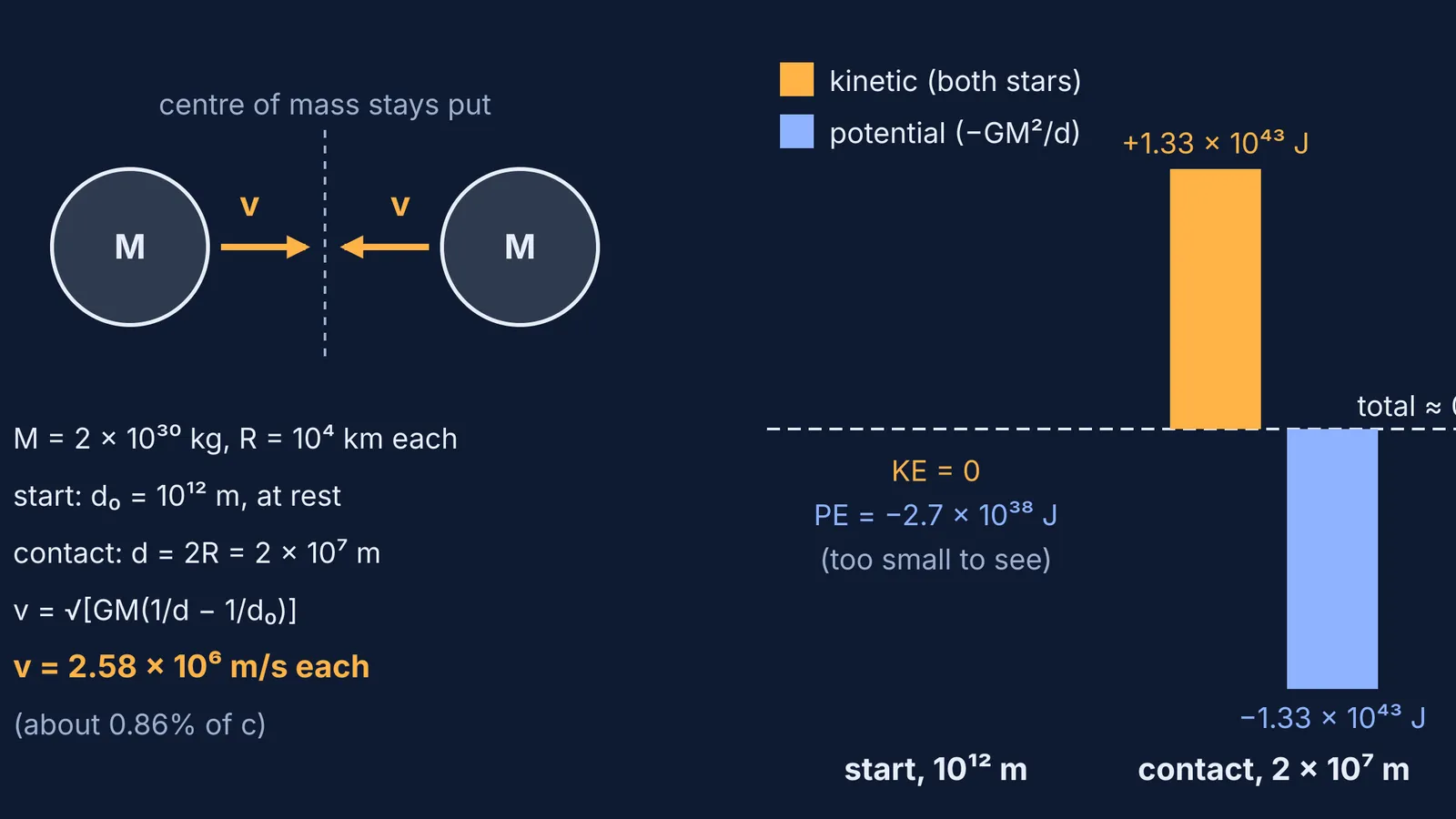
Two stars, each with the mass of the Sun (2 × 10³⁰ kg) and a radius of 10⁴ km, start essentially at rest 10⁹ km apart. Gravity pulls them straight towards each other. How fast is each star moving when they collide? This is a standard Class 11 gravitation problem. You need two conservation laws working together: momentum tells you how the speed is shared, and energy tells you how much speed there is. The answer comes out at about 2.6 × 10⁶ m/s for each star.
Why do both stars end up with the same speed?
The only forces are the stars' pulls on each other. They are equal and opposite (Newton's third law), so the total momentum of the pair cannot change. It starts at zero, because both stars start at rest, so it stays zero:
M v₁ + M v₂ = 0, so v₁ = −v₂.
The stars have equal masses, so they move with equal speeds in opposite directions at every instant. The centre of mass, halfway between them, never moves. They meet there.
If the masses were different, the speeds would be in the inverse ratio of the masses, but momentum would still be zero. The same momentum-plus-energy method, run in reverse for two charges that repel and fly apart, is worked in the speeds of two charges released from rest.
How does energy conservation give the impact speed?
There is no friction and no other force, so the total mechanical energy is conserved. The gravitational potential energy of the pair, with centres a distance d apart, is −GM²/d. It belongs to the pair, not to either star alone, so you count it once.
Start. Kinetic energy is zero. Potential energy is −GM²/d₀.
At contact. Each star has kinetic energy ½Mv², so the total is 2 × ½Mv² = Mv². Potential energy is −GM²/d.
Setting the totals equal:
−GM²/d₀ = Mv² − GM²/d, so v² = GM(1/d − 1/d₀).
The separation d at contact is the distance between the centres, which is R + R = 2R, not R.
This differs from a body launched from a fixed planet, where only one object moves and gets all the kinetic energy. That one-body version is covered in the maximum height reached when projected below escape velocity. Here both stars move, so the energy released is split between them.
Worked example: speed of each star at impact
Problem. Two stars, each of mass 2 × 10³⁰ kg and radius 10⁴ km, start at rest with their centres 10⁹ km apart. Find the speed of each star just before they collide. Take G = 6.67 × 10⁻¹¹ N m² kg⁻².
Convert units. d₀ = 10⁹ km = 10¹² m. R = 10⁴ km = 10⁷ m, so d = 2R = 2 × 10⁷ m.
Momentum. Total momentum is zero, so both stars have the same speed v.
Energy. v² = GM(1/d − 1/d₀).
The bracket. 1/d = 1/(2 × 10⁷) = 5 × 10⁻⁸ m⁻¹. 1/d₀ = 10⁻¹² m⁻¹. The difference is 4.9999 × 10⁻⁸ m⁻¹.
GM. 6.674 × 10⁻¹¹ × 2 × 10³⁰ = 1.335 × 10²⁰ m³ s⁻².
Square and root. v² = 1.335 × 10²⁰ × 5.0 × 10⁻⁸ = 6.67 × 10¹² m² s⁻², so v = 2.58 × 10⁶ m/s.
Units check. GM has units m³ s⁻², and 1/d has units m⁻¹, so v² is in m² s⁻². Good.
Closing speed. The stars approach each other at 2v = 5.17 × 10⁶ m/s.
The kinetic energy at contact is Mv² = 1.33 × 10⁴³ J, all of it drawn from the drop in potential energy.
Can you ignore the starting separation?
Yes, and you should say why. The two terms in the bracket are 5 × 10⁻⁸ m⁻¹ and 10⁻¹² m⁻¹. The second is only 2 × 10⁻⁵ of the first, so dropping it changes v by about one part in 100,000. The stars gain almost all of their speed in the last part of the fall, when they are close together, because potential energy varies as 1/d.
This also explains why the problem says the stars start "essentially at rest". Starting from 10¹² m or from infinitely far away gives the same answer to three significant figures. In that limit, v = √(GM/2R), which looks like an escape-speed formula with the numbers shared between two bodies.
How does reduced mass give the same answer?
You can also work in terms of the separation alone. The relative motion of two bodies behaves like one body of reduced mass μ = M·M/(M + M) = M/2 moving at the relative speed u. Energy conservation then reads ½ × (M/2) × u² = GM²(1/d − 1/d₀), which gives u = 2√(GM(1/d − 1/d₀)) = 5.17 × 10⁶ m/s, exactly twice the speed of each star. Reduced mass is introduced for circular orbits in binary stars and two-body orbits; this head-on fall is the same idea along a straight line.
If you want to revise how gravitational potential energy and reduced mass fit together, the Concept Library covers each idea on its own page.
Are these real stars, and is Newtonian physics good enough?
Check the speed against light: 2.58 × 10⁶ ÷ 3.00 × 10⁸ = 0.0086, so each star moves at about 0.86% of the speed of light. Relativistic corrections at that speed are tiny, so Newtonian mechanics is fine.
The stars themselves are not Sun-like. The Sun's radius is about 7 × 10⁵ km. A star with the Sun's mass squeezed into a radius of 10⁴ km, a little larger than the Earth, is a white dwarf. The problem also treats the stars as rigid, undistorted spheres. Real stars this close would be stretched by each other's tidal pull in the final moments, so the "contact" is an idealisation.
From rest at 10¹² m, the fall itself takes roughly two years. Almost all of that time is spent far apart, moving slowly.
Quick checklist
Total momentum is zero, so equal masses get equal and opposite speeds.
Potential energy of the pair, −GM²/d, is counted once.
Kinetic energy at contact is 2 × ½Mv², not ½Mv².
Contact separation is 2R = 2 × 10⁷ m, not R.
1/d₀ is negligible next to 1/d; say why.
v = 2.58 × 10⁶ m/s each, closing speed 5.17 × 10⁶ m/s, about 0.86% of c.


