

On this page
Two small charged spheres sit a short distance apart on a frictionless surface. You let go of both at the same instant. They push each other away, speed up, and settle towards steady speeds as the gap grows. The question asks for those final speeds, and the trap is that the masses are different, so the two particles do not share the energy equally.
This is a two-equation problem. Energy alone gives you one equation with two unknowns. Momentum gives you the second.
Which two laws give the final speeds?
The first is conservation of momentum. OpenStax University Physics states that the total momentum of a closed system is conserved, provided the system's mass stays constant and the net external force on it is zero. The Coulomb forces between the two charges are internal, equal and opposite, so they cannot change the total. Both particles start at rest, so the total momentum is zero at the start and stays zero.
The second is conservation of energy. The electric potential energy of two point charges is U = kq₁q₂/r, measured from zero at infinite separation. OpenStax uses k = 8.99 × 10⁹ N·m²/C². That matches the CODATA value of the vacuum permittivity published by NIST, 8.8541878188 × 10⁻¹² F/m, since k = 1/(4πε₀). When the charges are "far apart", r is effectively infinite, so all of the starting U has become kinetic energy.
If the idea of U = 0 at infinity feels shaky, read our explainer on what the sign of the potential energy of two charges tells you first.
How do you find each speed when the masses differ?
Call the masses m₁ and m₂, the charges q₁ and q₂ (same sign), and the starting separation r₀.
Momentum: 0 = m₁v₁ − m₂v₂, so v₂ = m₁v₁ / m₂. The particles move in opposite directions with equal-sized momenta.
Energy: kq₁q₂/r₀ = ½m₁v₁² + ½m₂v₂².
Substitute v₂: U = ½m₁v₁²(1 + m₁/m₂).
Rearrange: v₁ = √(2U·m₂ / (m₁(m₁ + m₂))), and then v₂ = m₁v₁ / m₂.
There is a quicker way to see the energy split. Kinetic energy can be written p²/2m. Both particles carry momentum of the same size p, so each one's kinetic energy goes as 1/m. The lighter particle takes the bigger share: KE₁ : KE₂ = m₂ : m₁.
Worked example: what are the speeds of 1 g and 2 g charges?
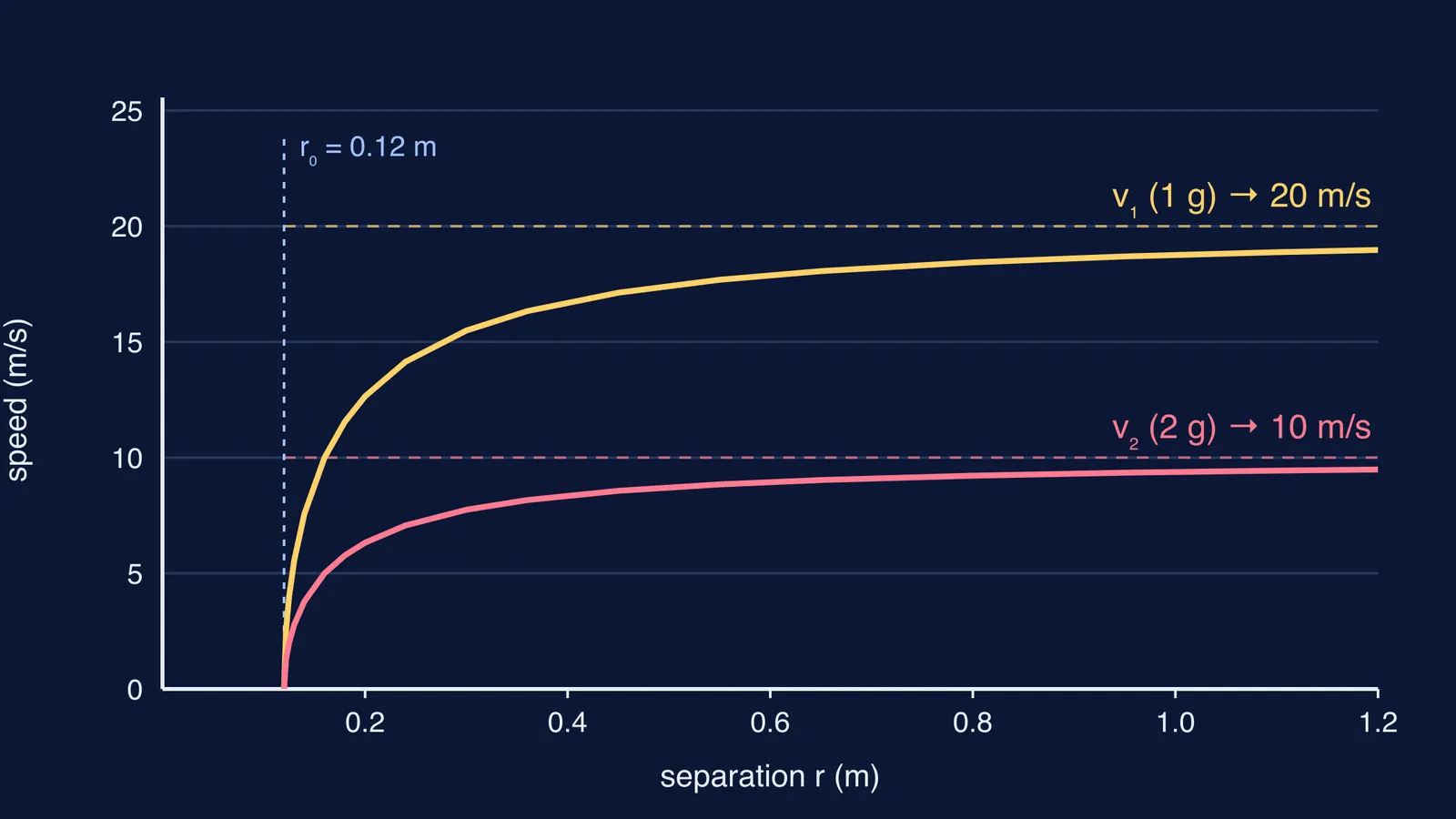
Two spheres each carry +2 μC. Sphere A has mass 1 g, sphere B has mass 2 g. They are released from rest 12 cm apart. Ignore gravity and friction. Find each speed when they are far apart.
Starting energy: U = (9 × 10⁹)(2 × 10⁻⁶)(2 × 10⁻⁶) / 0.12 = 0.30 J. We rounded k to 9 × 10⁹ to keep the arithmetic clean.
Speed of A: v₁² = 2(0.30)(0.002) / ((0.001)(0.003)) = 400, so v₁ = 20 m/s.
Speed of B: v₂ = (0.001)(20) / 0.002 = 10 m/s, in the opposite direction.
Check: ½(0.001)(20)² = 0.20 J and ½(0.002)(10)² = 0.10 J. Together they make 0.30 J, split 2 : 1 in favour of the lighter sphere.
If the question asks for speeds at some finite separation r instead, only part of U has been released: kq₁q₂(1/r₀ − 1/r). Each speed then becomes its far-apart value times √(1 − r₀/r). At r = 24 cm, double the starting gap, A is moving at 20 × √0.5 ≈ 14.1 m/s.
The same momentum-then-energy pattern runs through recoil problems too, such as a spring gun firing a ball on a frictionless floor and the recoil of the daughter nucleus in alpha decay.
What mistakes cost marks on this problem?
Treating one charge as fixed. If you hold B still and give all 0.30 J to A, you get v₁ = √600 ≈ 24.5 m/s. That is wrong whenever both particles are free to move.
Splitting the energy equally. Equal shares happen only when the masses are equal.
Forgetting the direction. The speeds are positive, but the velocities point opposite ways.
Using opposite charges. Unlike charges attract, so released from rest they move towards each other and never get far apart.
Missing hidden external forces. If one sphere is tied to a wall or sits on a rough table, momentum of the pair is no longer conserved, and the method changes.
If you keep reaching for energy alone and getting stuck, practise a few of these until writing the momentum line first becomes automatic. The Fermi Problem Library has worked problems with a step-by-step solver that explains the reasoning rather than printing an answer, so you can see where the second equation comes from. For the ideas underneath, the Fermi Concept Library gives conservation of momentum and electric potential energy each their own lesson.


