On this page
You put a spring gun on a smooth floor, compress the spring and let go. The ball flies one way and the gun slides the other. Exam questions then ask for both speeds, and the usual trap is giving all of the spring's energy to the ball. Here is how momentum decides the split.
Why does the gun recoil on a frictionless floor?
Before release the ball and gun are at rest, so their total momentum is zero. The spring force is internal: it pushes the ball forward and the gun backward with equal force. Gravity and the floor's normal force cancel vertically, and with no friction nothing acts horizontally from outside.
The total momentum of a closed system is conserved when its mass stays constant and the net external force on it is zero (OpenStax University Physics, section 9.3). So after release:
m v = M V
Here m and v are the ball's mass and speed, and M and V are the gun's. The two momenta are equal in size and opposite in direction. If the gun were clamped to a table, the table and the Earth would take the recoil, and the ball would get practically all of the energy. That all-energy-to-the-ball case is the one used in our post on the range of a ball fired from a spring gun.
How is the spring energy shared between ball and gun?
A spring compressed by x stores elastic potential energy U = ½kx², taking zero at its natural length (OpenStax University Physics, section 8.1). With no friction, all of U becomes kinetic energy:
½mv² + ½MV² = U
Kinetic energy can also be written as K = p²/2m (OpenStax University Physics, section 7.2). Ball and gun have the same momentum magnitude p, so each one's kinetic energy is inversely proportional to its mass. That gives the sharing rule:
Ball's share: K(ball) = U × M/(m + M)
Gun's share: K(gun) = U × m/(m + M)
The lighter body takes the bigger share. A heavy gun barely moves and leaves almost all the energy to the ball; two equal masses split it half and half. Our explainer on kinetic energy and momentum using p²/2m has more problems built on this idea.
Worked example: how fast do the ball and gun move?
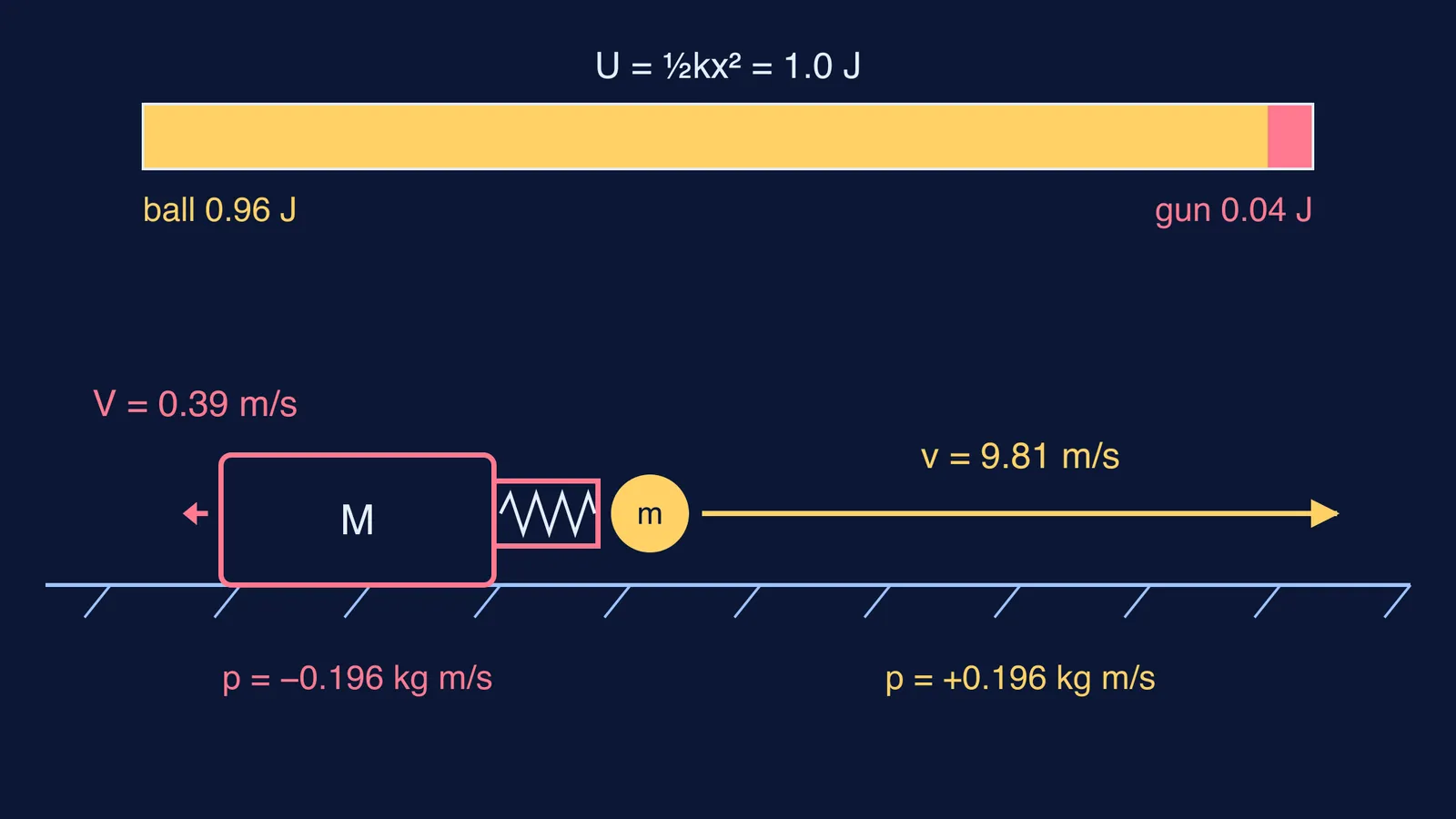
A 500 g spring gun rests on a frictionless floor. Its spring, with k = 800 N/m, is compressed by 5.0 cm and fires a 20 g ball horizontally. Find the ball's speed and the gun's recoil speed.
Spring energy: U = ½ × 800 × (0.05)² = 1.0 J.
Ball's share: K(ball) = 1.0 × 0.50/0.52 ≈ 0.962 J, so v = √(2 × 0.962/0.020) ≈ 9.81 m/s.
Gun's share: K(gun) = 1.0 × 0.020/0.52 ≈ 0.038 J, so V = √(2 × 0.038/0.50) ≈ 0.39 m/s.
Check momentum, which must be conserved (OpenStax University Physics, section 9.3): 0.020 × 9.81 ≈ 0.196 kg m/s and 0.50 × 0.392 ≈ 0.196 kg m/s, in opposite directions.
If the gun were clamped, the ball would take the full 1.0 J and leave at √(2 × 1.0/0.020) = 10 m/s. Letting the gun recoil costs the ball only about 2% of its speed here, because the gun is 25 times heavier. Make the gun 20 g as well and each body gets 0.5 J, so the ball leaves at only about 7.1 m/s.
You can also skip the share step and use the closed forms:
v = √(2UM / (m(m + M)))
V = √(2Um / (M(m + M)))
What mistakes do students make with spring-gun recoil?
Writing ½mv² = ½kx². That treats the gun as fixed, which it is not on a frictionless floor.
Using energy alone. One equation cannot give two unknowns; you need momentum as well.
Dropping the direction. Take the ball's direction as positive and the gun's velocity comes out negative.
Mixing stages. Momentum and energy conservation cover the firing. What the ball does next, such as flying as a projectile, is a separate step.
The same reasoning sits behind every gun recoil calculation using momentum conservation; the spring version simply tells you how much energy there is to share.
How can you check your answer quickly?
Run these four checks before you move on:
The two momenta have equal size.
The two kinetic energies add up to ½kx².
The speed ratio v/V equals the mass ratio M/m.
The lighter body is the faster one.
If you want more practice, the Fermi Problem Library has worked problems with a step-by-step solver that explains the reasoning rather than printing an answer, so you can see exactly where the momentum equation enters. And if two bodies pushing apart is hard to picture, the Fermi Simulation Lab has interactive simulations for ideas that are easier to see than to read.
Next time a question says "frictionless floor", write m v = M V before you write anything about energy.