

On this page
You fire a rifle and it kicks back into your shoulder. You throw a ball while standing on a frozen pond and you slide backwards. Both follow one rule, and it turns recoil questions into a two-line calculation.
What is the formula for recoil velocity of a gun?
NCERT's Class 11 Physics chapter on laws of motion (Section 4.7) uses this exact case to introduce conservation of momentum. While the bullet is in the barrel, the gun pushes the bullet with a force F and, by Newton's third law, the bullet pushes the gun with −F for the same short time. Since both started at rest, NCERT writes the result as p_gun = −p_bullet: the total momentum of the bullet-plus-gun system stays zero.
Written with masses and speeds, that becomes:
m × v + M × V = 0
V = −m × v / M
Here m and v are the bullet's mass and velocity, M is the gun's mass and V is the recoil velocity. The minus sign says the gun moves opposite to the bullet.
The condition matters. OpenStax's University Physics, Section 9.3 states that the total momentum of a closed system is conserved, where closed means constant mass and zero net external force. During firing, the forces between gun and bullet are internal, so they cannot change the system's total momentum.
How do you calculate recoil step by step?
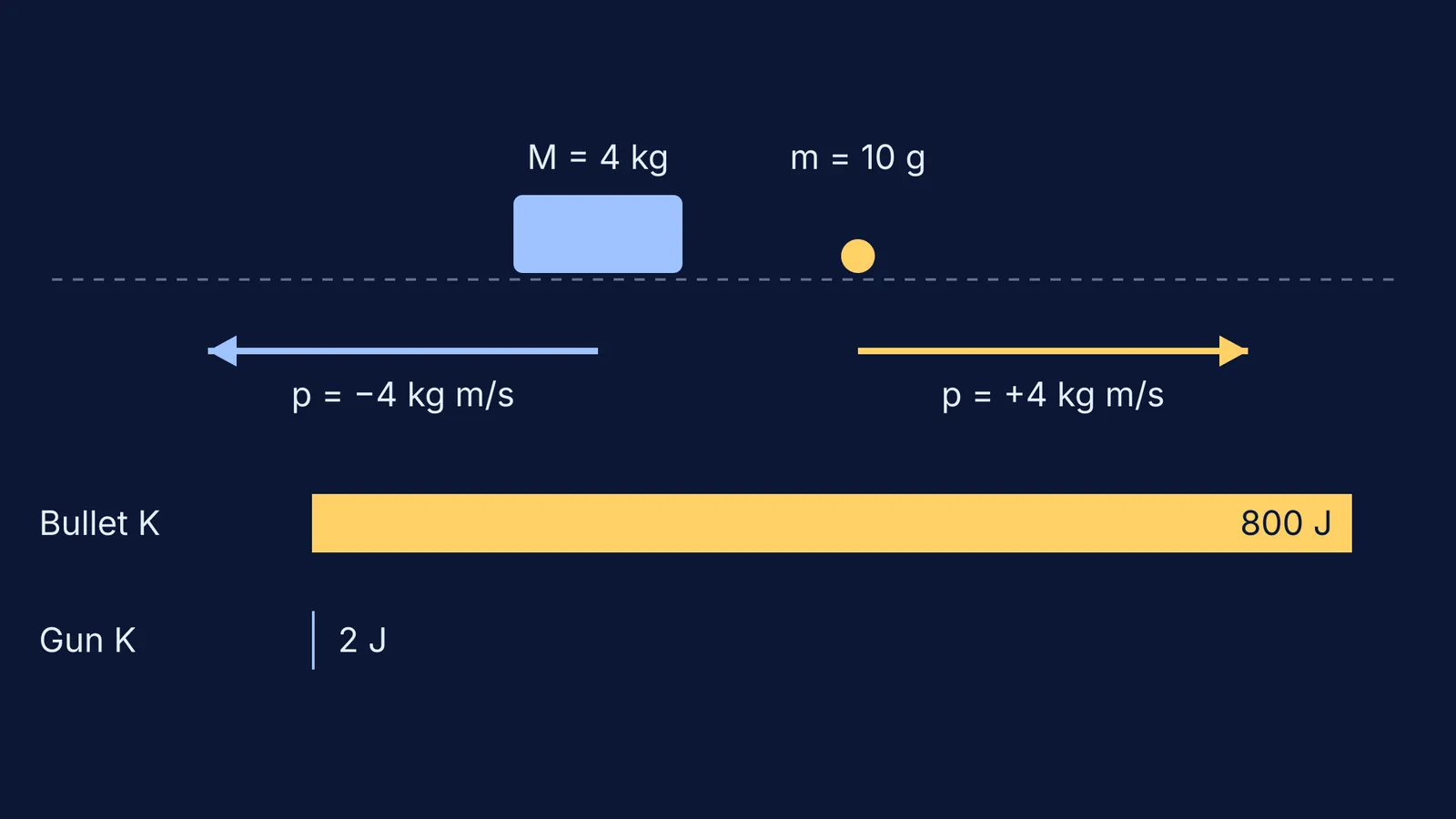
Using the relation from the NCERT chapter, take made-up but realistic exam numbers: a 4 kg rifle fires a 10 g bullet at 400 m/s.
Convert units first: 10 g = 0.010 kg.
Bullet momentum: 0.010 × 400 = 4 kg m/s.
Total momentum before firing is zero, so the gun's momentum is −4 kg m/s.
Recoil velocity: V = −4 / 4 = −1 m/s. The gun moves back at 1 m/s.
Now the person on ice. A 60 kg student standing on smooth ice throws a 0.5 kg ball forward at 10 m/s. Ice gives almost no friction, so horizontal momentum is conserved.
Ball momentum: 0.5 × 10 = 5 kg m/s.
Student momentum: −5 kg m/s.
Student velocity: −5 / 60 ≈ −0.083 m/s, a slow glide backwards.
Why does the bullet get almost all the kinetic energy?
Momentum is shared equally and oppositely. Kinetic energy is not. OpenStax's section on explosions notes that the system has no kinetic energy before firing and a great deal after: chemical potential energy in the gunpowder becomes kinetic energy of the bullet and of the recoiling gun.
To see how it splits, write kinetic energy in terms of momentum: K = p²/2m. Both objects carry the same size of momentum p, so the one with the smaller mass gets the larger kinetic energy. The ratio is simply:
K_bullet / K_gun = M / m
For the rifle, K_bullet = ½ × 0.010 × 400² = 800 J and K_gun = ½ × 4 × 1² = 2 J. That is a ratio of 400, exactly 4 kg ÷ 0.010 kg, so the bullet takes about 99.75% of the 802 J of kinetic energy shared between bullet and gun.
For the student on ice, the ball gets ½ × 0.5 × 10² = 25 J, while the student gets ½ × 60 × (0.083)² ≈ 0.21 J. The ratio is 60 ÷ 0.5 = 120.
This is also why a heavier gun kicks less, and why holding a rifle firmly against your shoulder helps: you and the gun recoil together as one larger mass.
What mistakes cost marks in recoil questions?
Leaving grams as grams. Convert to kilograms before you substitute.
Dropping the minus sign and losing the direction.
Assuming kinetic energy is conserved. It is not: it comes from stored chemical energy, or on the ice, from your muscles.
Using momentum conservation when an external force acts, such as friction on rough ground. Then apply it only along a direction with no external force.
Mixing up muzzle speed and ground speed (see the trap above).
The same reasoning appears whenever something at rest splits in two. Our explainer on a shell exploding midair adds fragments and gravity, the guide to collisions and momentum problems covers elastic and inelastic cases, and using p squared over 2m in problems shows more uses of the energy formula from this post.
If you keep getting the sign or the frame wrong, the Fermi Problem Library has worked problems with a step-by-step solver that explains the reasoning rather than printing an answer. For the idea itself, the Fermi Concept Library covers every concept in physics, each with its own lesson and its place in the map.


