

On this page
A spring gun problem is a classic physics challenge because it forces you to combine two entirely different branches of mechanics into one calculation. Inside the barrel, you have to use the conservation of energy to find out how fast the ball is moving. However, once the ball leaves the barrel, the spring is entirely forgotten, and the system becomes a pure two-dimensional kinematics problem.
Breaking the scenario into these two independent stages is the secret to solving it without confusion. If you try to mix forces and times too early, the algebra can quickly become overwhelming.
How do you find the launch speed of a spring gun?
Before you can calculate where the ball will land, you need to know exactly how fast it leaves the gun. We do this by assuming that all the energy stored in the compressed spring is perfectly transferred to the ball, with no energy lost to friction or heat.
The elastic potential energy stored in a spring is given by ½kx² (LibreTexts/Book%3A_University_Physics_I_-_Mechanics_Sound_Oscillations_and_Waves_(OpenStax)/08%3A_Potential_Energy_and_Conservation_of_Energy/8.02%3A_Potential_Energy_of_a_System)). Here, k is the spring constant (which measures how stiff the spring is) and x is the exact distance the spring is compressed from its natural resting position.
When the spring releases, this stored potential energy turns instantly into the kinetic energy (½mv²) of the ball. Setting these two energy states equal gives us our starting point:
½kx² = ½mv²
You can cancel out the ½ fraction on both sides of the equation to isolate the velocity squared:
v² = kx² / m
We can leave the velocity in its squared form, because the kinematic formula for range will require v² anyway. This saves you from having to calculate an unnecessary square root during an exam.
What is the range formula for a projectile on level ground?
As soon as the ball leaves the gun, gravity becomes the only force acting on it. If we assume the gun fires from ground level and the ball lands on that same flat, level surface, we can completely bypass solving for time and use the standard range equation.
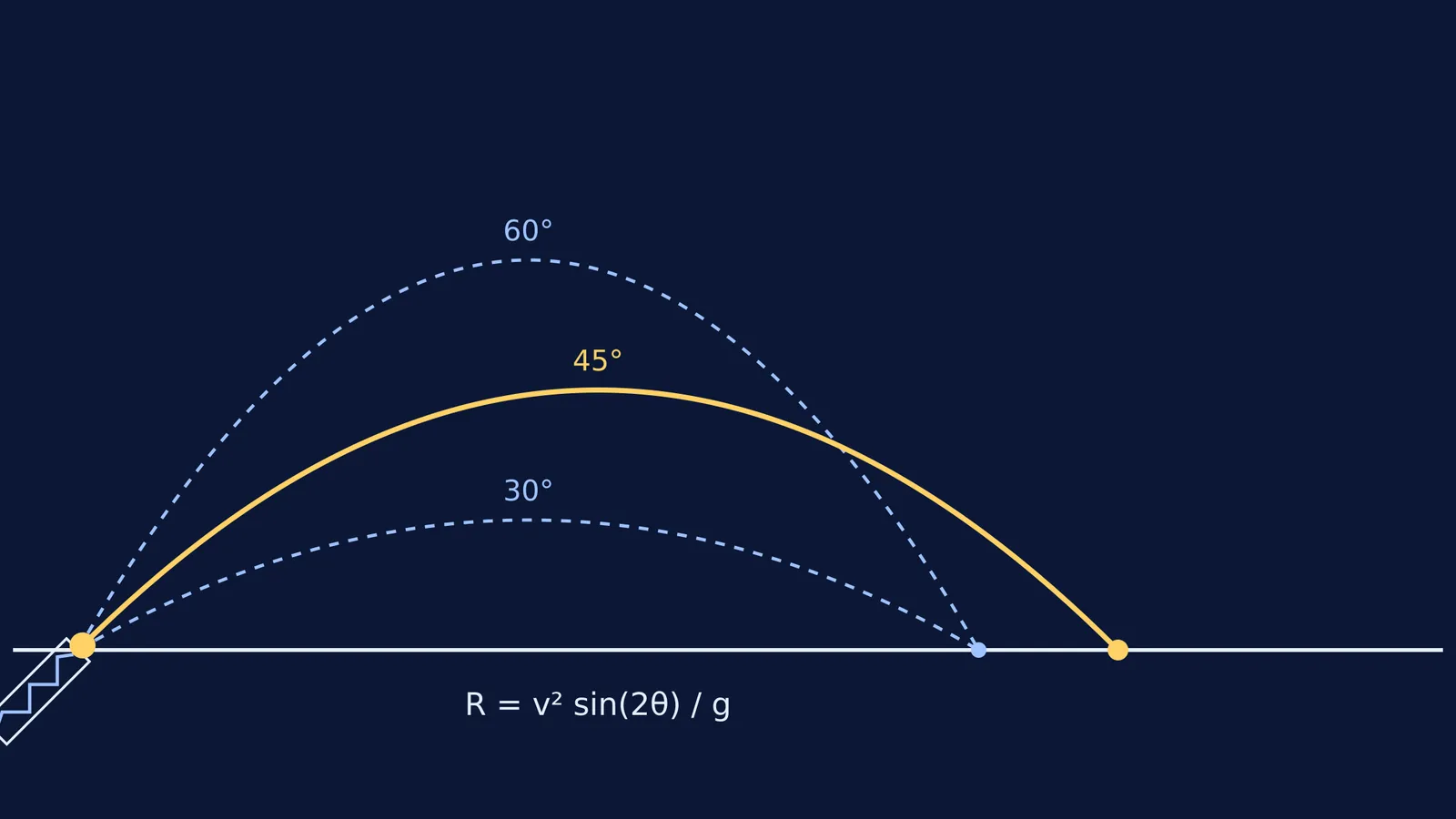
The range of a projectile on level ground is v² sin(2θ) / g, reaching its maximum at a launch angle of 45° (LibreTexts/Book%3A_University_Physics_I_-_Mechanics_Sound_Oscillations_and_Waves_(OpenStax)/04%3A_Motion_in_Two_and_Three_Dimensions/4.04%3A_Projectile_Motion)). In this formula, v is the launch speed, θ is the angle of the barrel relative to the ground, and g is the constant acceleration due to Earth's gravity.
Because the trigonometric sine function peaks when its internal argument is exactly 90°, the maximum physical distance happens when 2θ = 90°, which simplifies to θ = 45°. Firing the spring gun at this specific angle perfectly balances the horizontal speed (carrying the ball forward) and the vertical speed (keeping the ball in the air).
Furthermore, complementary angles will always produce the exact same horizontal range. A ball fired at 30° will travel the exact same distance as a ball fired at 60°, even though the 60° shot will spend significantly more time in the air and reach a much greater maximum height.
How does the combined spring gun range formula work?
To find the final, unified formula for the spring gun's range, we simply substitute our earlier expression for v² directly into the kinematic range equation.
Replacing the generic v² term with kx² / m, we get:
R = (kx² sin(2θ)) / (mg)
This combined equation tells you everything about how the physical system behaves under different conditions:
Stiffer springs and larger compressions: Increasing k and x (which sit in the numerator) will predictably increase the range. Since x is squared, pulling the spring back twice as far will multiply the range by four.
Heavier balls: Increasing the mass m (which sits in the denominator) reduces the range, simply because the spring cannot accelerate a heavier object to as high a launch speed.
The launch angle: The angle still completely controls the flight path geometry independent of the spring. Whether the spring is weak or strong, 45° remains the optimal choice for maximum horizontal distance.
When working through complex exam papers, missing a transition step in these multi-part problems can cost you crucial marks. If you often know the underlying concepts but struggle to string them together mathematically, the Fermi Problem Library has worked problems with a step-by-step solver that explains the reasoning rather than printing an answer.
For more practice with related kinematics, review the Equation of trajectory of a projectile: finding u and θ from it. To see how potential energy is calculated and applied in other mechanical systems, explore Elastic potential energy in a stretched wire, worked through.


