

On this page
When solving electrostatics problems for exams like JEE Main and NEET-UG, signs can determine your score. While Coulomb force and electric field require vector addition, electric potential energy is a scalar. Yet students frequently drop the negative sign or struggle to interpret what a minus sign means physically. Electrostatic potential energy's algebraic sign is not arbitrary; it indicates whether a system is bound or repulsive, and dictates the work required to assemble or separate charges.
Why is the potential energy of two charges positive or negative?
The electrostatic potential energy U of two point charges q₁ and q₂ separated by distance r in vacuum is U = (1 / (4πε₀)) × (q₁q₂ / r), where ε₀ is the permittivity of free space. As detailed in the NCERT Class 12 Physics Part I curriculum and OpenStax University Physics Volume 2, potential energy is defined as the external work required to bring charges from infinite separation to distance r without acceleration.
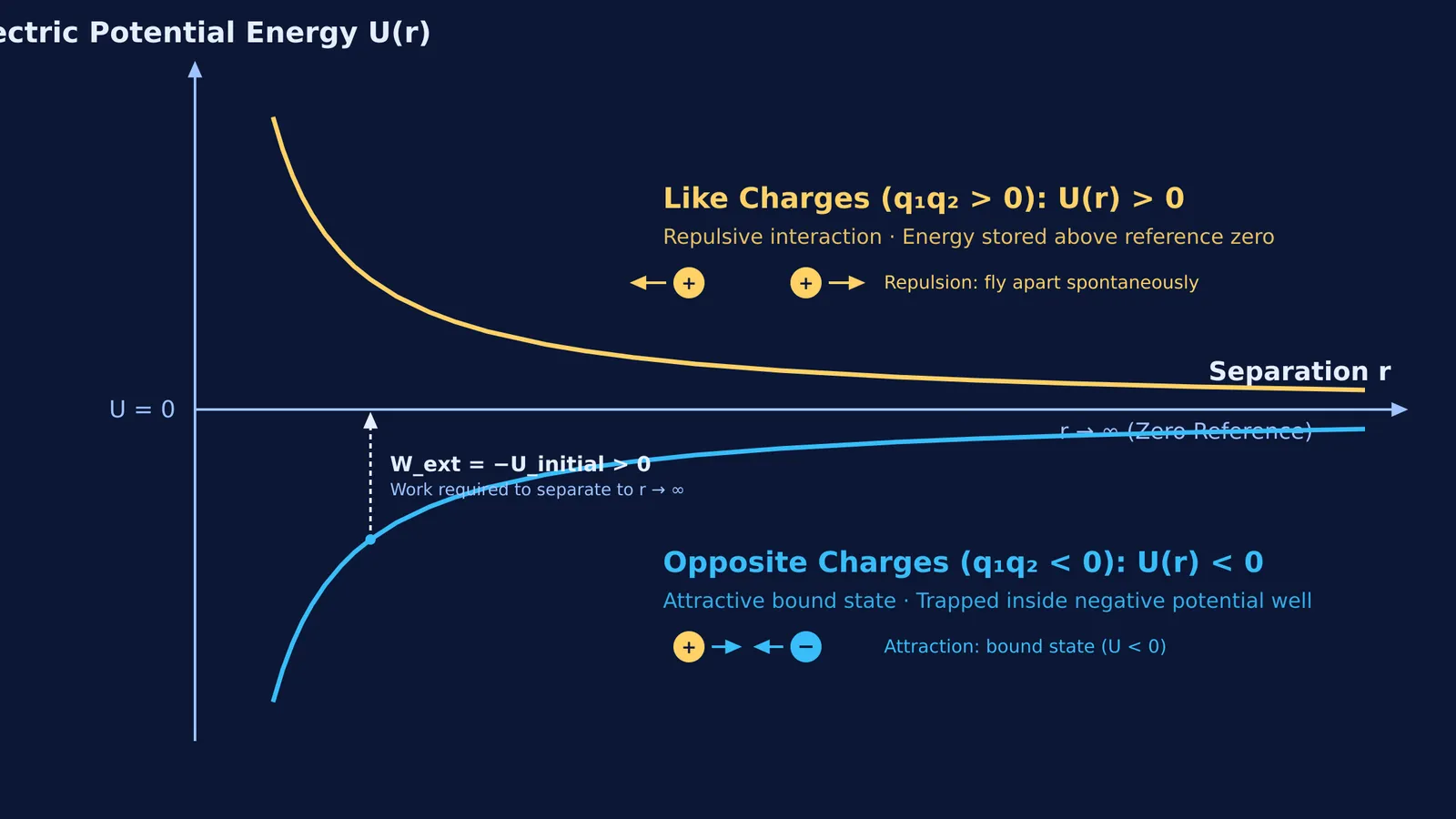
By convention, potential energy is zero at infinite separation: U(∞) = 0. When both charges share the same sign, their product q₁q₂ is positive, giving U > 0. Because like charges repel, an external force must push against this repulsion to bring them closer from infinity. The external agent does positive work, storing potential energy in the system much like compressing a mechanical spring.
When charges have opposite signs, their product q₁q₂ is negative, giving U < 0. Opposite charges attract naturally and would accelerate toward each other if released. To bring them together slowly at constant speed, an external agent must exert an outward force to hold them back, doing negative work on the system. You can explore how pairwise interactions combine across multiple charges in our guide on the work to assemble point charges.
Why do students struggle with negative potential energy?
Negative potential energy represents a well-documented conceptual obstacle in physics education. In a 2014 study in Physical Review Special Topics - Physics Education Research, Beth A. Lindsey investigated how university physics students reason about potential energy (Lindsey, 2014). The findings revealed a sharp asymmetry: while 70% to 95% of students (84% on average) correctly predicted that potential energy increases when like charges are pushed together, only 36% on average realized that potential energy also increases when opposite charges are separated. In fact, 55% of students stated that potential energy decreases as opposite charges move apart.
Lindsey found that nearly half of incorrect respondents relied on a flawed distance heuristic: assuming that because greater distance weakens electrostatic force, potential energy must also decrease. This mistake conflates force magnitude with scalar energy. For two opposite charges, increasing separation from 10 cm to 20 cm shifts U from −10 J to −5 J. Because −5 is greater than −10, potential energy has increased by +5 J. Students focusing only on absolute values see 10 dropping to 5 and mistakenly conclude energy decreased.
How much work is needed to separate two charges?
Under the work-energy relation in OpenStax University Physics Volume 2, external work moving particles without kinetic change is W_ext = ΔU = U_final − U_initial. To separate two charges completely to infinity, the final state is U_final = U(∞) = 0.
This yields the separation work formula: W_ext = 0 − U_initial = −U_initial.
For like charges (U_initial > 0): W_ext = −U_initial < 0. Because like charges repel, the electric field pushes them apart. An external agent does not supply energy; the charges separate spontaneously if released.
For opposite charges (U_initial < 0): W_ext = −(−|U_initial|) = +|U_initial| > 0. Because opposite charges attract, an external agent must do positive work to pull them out of their potential well.
Consider a worked example: a charge of +2.0 μC and a charge of −3.0 μC are held 10 cm (0.10 m) apart in air. Using Coulomb's constant k ≈ 9.0 × 10⁹ N m² / C²:
U_initial = (9.0 × 10⁹) × (+2.0 × 10⁻⁶) × (−3.0 × 10⁻⁶) / 0.10 = −0.54 J.
To separate this pair to infinity, the external work required is W_ext = −(−0.54 J) = +0.54 J. You must supply 0.54 joules of work to pull these particles apart. To connect this with field gradients and zero points, review finding electric field from a potential gradient and locating points of zero potential near two charges.
How to determine signs without memorising formulas?
Instead of relying on rote sign rules, you can apply a three-step physical check:
Identify natural motion: Do the particles naturally attract or repel?
Compare displacement: Does motion go with the electric force or against it? Moving against the electrostatic force always increases potential energy (positive ΔU).
Check the reference ceiling: If charges attract, they sit in a potential well below zero (U < 0). Pulling them apart raises energy toward zero. If charges repel, holding them together stores positive energy (U > 0) above zero.
When practicing electrostatics problems, the Fermi Problem Library provides worked problems with a step-by-step solver that explains the reasoning rather than printing an answer. For a structured overview across fields and potentials, the Fermi Concept Library covers every concept in physics, chemistry, biology, mathematics and computing, each with its own lesson and its place in the map. For ideas that are easier to see than to read, the Fermi Simulation Lab provides interactive simulations for the ideas that are easier to see than to read.


