

On this page
Old box televisions drew their picture with an electron beam fired from the back of a glass tube onto a glowing screen. Earth's magnetic field runs through every room, so it pushes on that beam too. A Class 12 NCERT exercise in the Magnetism and Matter chapter asks how far: an 18 keV beam travels 30 cm horizontally through a horizontal field of 0.04 G. The calculation is short, but the answer often quoted does not match the 0.04 G printed in the question. Here is the full working, the reason for the mismatch, and what the real field would do.
How do you find the deflection of an electron beam in a magnetic field?
You need two results and one geometric shortcut.
Speed from the gun. An electron accelerated through 18 kV gains kinetic energy K = 18 keV. Non-relativistically, K = ½mv², so v = √(2K/m).
Radius of the path. The magnetic force evB acts at right angles to the velocity, so the electron moves on a circle: evB = mv²/r, giving r = mv/(eB). If r = mv/qB is new to you, see how to predict the radius of a charged particle's circle in a magnetic field.
The sagitta. After travelling a distance d along its first direction, a particle on a circle of radius r has moved sideways by y = r − √(r² − d²). When d is much smaller than r, this becomes y ≈ d²/2r. Use the shortcut only when d ≪ r; otherwise use the exact form.
What answer does 0.04 G actually give?
Question. An electron beam of energy 18 keV moves horizontally through a horizontal magnetic field of 0.04 G, normal to the beam. Find the up or down deflection over 30 cm.
Convert units. 1 G = 10⁻⁴ T, so B = 0.04 G = 4 × 10⁻⁶ T. K = 18 × 10³ × 1.602 × 10⁻¹⁹ J = 2.884 × 10⁻¹⁵ J. Take m = 9.109 × 10⁻³¹ kg and d = 0.30 m.
Find the speed. v = √(2 × 2.884 × 10⁻¹⁵ / 9.109 × 10⁻³¹) = 7.96 × 10⁷ m/s.
Find the radius. r = mv/(eB) = (9.109 × 10⁻³¹ × 7.96 × 10⁷)/(1.602 × 10⁻¹⁹ × 4 × 10⁻⁶) = 113 m. Units: kg·(m/s)/(C·T), and 1 T = 1 kg/(C·s), so the result is in metres.
Check the shortcut is allowed. d/r = 0.30/113 = 0.0027, far below 1.
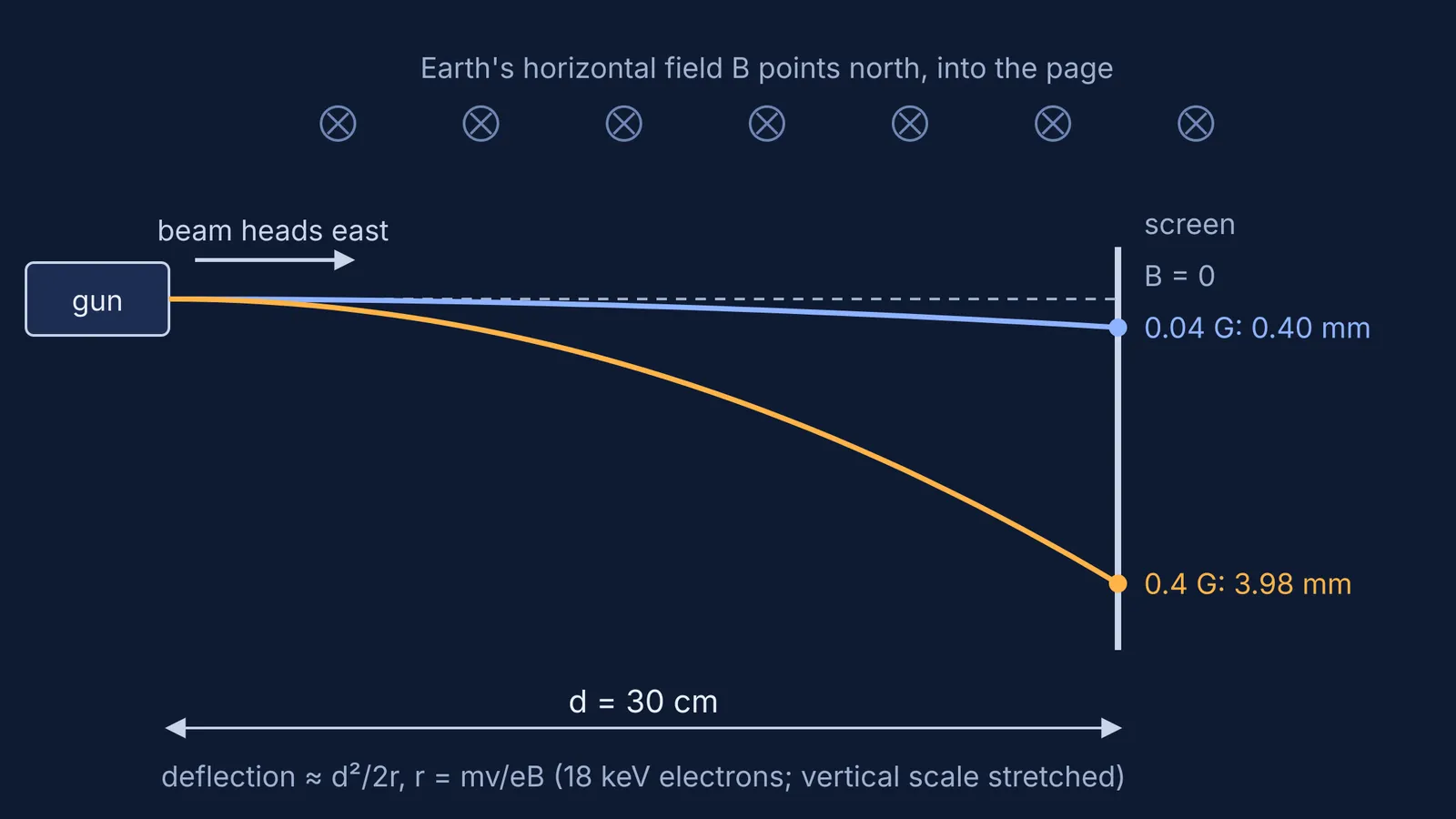
Find the deflection. y ≈ d²/2r = 0.09/(2 × 113) = 3.98 × 10⁻⁴ m = 0.40 mm. The exact form r − √(r² − d²) agrees to better than 0.001%.
So with the field printed in the question, the beam moves sideways by less than half a millimetre over the whole tube.
Why do many keys give 11.3 m and about 4 mm?
The answer often quoted is r = 11.3 m and a deflection of about 3.9 to 4 mm. Run the same steps with B = 0.4 G = 4 × 10⁻⁵ T and you get exactly that: r = 11.3 m and y = 0.09/(2 × 11.3) = 3.98 mm. The radius scales as 1/B and the deflection as B, so a field ten times larger gives a deflection ten times larger.
That means the quoted answer belongs to 0.4 G, not 0.04 G. Either the field in the question or the field used in the key is off by a factor of ten. Which one is physically sensible? The NOAA geomagnetism FAQ gives Earth's surface field as roughly 25,000 to 65,000 nT, that is 0.25 to 0.65 G. A horizontal component of 0.4 G sits inside that range. A field of 0.04 G is several times weaker than the field anywhere on Earth's surface.
What to do in an exam: work with the number printed in your paper and show the unit conversion clearly. If you get 0.40 mm for 0.04 G, your physics is right. How the horizontal component relates to the total field and the angle of dip is covered in angle of dip, declination and the horizontal component of Earth's field.
Does relativity change the answer for an 18 keV electron?
Only slightly. The electron's rest energy is 511 keV, so γ = 1 + 18/511 = 1.035 and v/c is about 0.26. The radius depends on momentum, r = p/(eB), and the relativistic momentum is about 0.9% larger than mv computed classically. The radius grows by 0.9% and the deflection drops by the same fraction: 0.394 mm instead of 0.398 mm for 0.04 G, and 3.94 mm instead of 3.98 mm for 0.4 G. To two significant figures nothing changes, which is why the non-relativistic method is accepted at this energy.
Which way does the beam bend, up or down?
The force on an electron is F = −e(v × B), opposite to the direction given by the right-hand rule for a positive charge. Take a beam heading east with the horizontal field pointing north.
v × B for east × north points up.
The electron carries negative charge, so the force points down.
Turn the tube to face west and the beam bends up. Point it north or south, along the horizontal field, and the horizontal component exerts no force at all.
Earth's field also has a vertical component. In the northern hemisphere it points downward, and for an eastward beam it pushes the electrons sideways, towards the south. So a real tube sees an up or down shift from the horizontal component and a left or right shift from the vertical one, and both change when you rotate the set.
Why did old TV sets need degaussing?
Cathode ray tube sets are now obsolete, but the numbers explain a real design problem of their time. Take an illustrative colour tube at 25 kV in a 0.5 G (50 µT) field with 30 cm of travel: r ≈ 10.8 m and the shift is about 4.2 mm. That is large compared with the fine dot pattern a colour tube had to hit. The field also magnetised the steel parts around the tube, which shifted the beams and discoloured patches of the screen. Sets had degaussing coils that demagnetised those parts when switched on. The history of the tube itself is told in Karl Ferdinand Braun and the cathode ray tube.
If you want to see how the circle tightens as you raise B or lower the speed, the Simulation Lab has interactive simulations for ideas easier to see than read. For more problems like this one, the Fermi Problem Library has a step-by-step solver that explains the reasoning.
Quick checklist
Convert gauss to tesla first: 1 G = 10⁻⁴ T.
v = √(2K/m) for a beam accelerated through a known voltage.
r = mv/(eB); check that d ≪ r before using y ≈ d²/2r.
0.04 G gives r = 113 m and 0.40 mm; 0.4 G gives 11.3 m and about 4 mm.
At 18 keV, relativity changes the result by under 1%.
The force on an electron is opposite to v × B; an eastward beam under a northward field bends down.


