

On this page
A current that changes thousands of times a second is invisible. A meter needle cannot keep up, so how do you see its shape? In 1897 Karl Ferdinand Braun answered with a beam of electrons. Electrons have so little mass that they can follow very fast changes, and where they hit a coated screen it glows. This post covers Braun's life and work, how a cathode ray tube steers its beam, a worked example on the deflection, and what a student can learn from him.
Who was Karl Ferdinand Braun?
Braun was born on 6 June 1850 in Fulda, Germany, according to his Nobel Prize biography. He studied at Marburg and Berlin, where he earned his doctorate in 1872 for work on the oscillations of elastic strings. He worked at Würzburg and Leipzig, then held posts at Marburg, Strasbourg, Karlsruhe and Tübingen, before returning to Strasbourg in 1895 to lead its Physics Institute.
His early papers already touched materials that matter today. One, recorded by its publisher as Ueber die Stromleitung durch Schwefelmetalle (on current conduction through metal sulphides), studied the kind of crystals we now call semiconductors. NCERT's Class 12 semiconductor chapter notes that a crystal of galena, lead sulphide, with a metal point contact was used early on as a detector of radio waves.
What did Braun build in 1897?
The Nobel biography says he invented "a cathode-ray oscillograph, constructed in 1897". His paper that year in Annalen der Physik has a title that explains its purpose: a method for demonstrating and studying the time variation of variable currents. A beam of cathode rays, now known to be electrons, strikes a fluorescent screen. The signal being studied steers the beam, so the spot moves as the signal changes, drawing its shape in light.
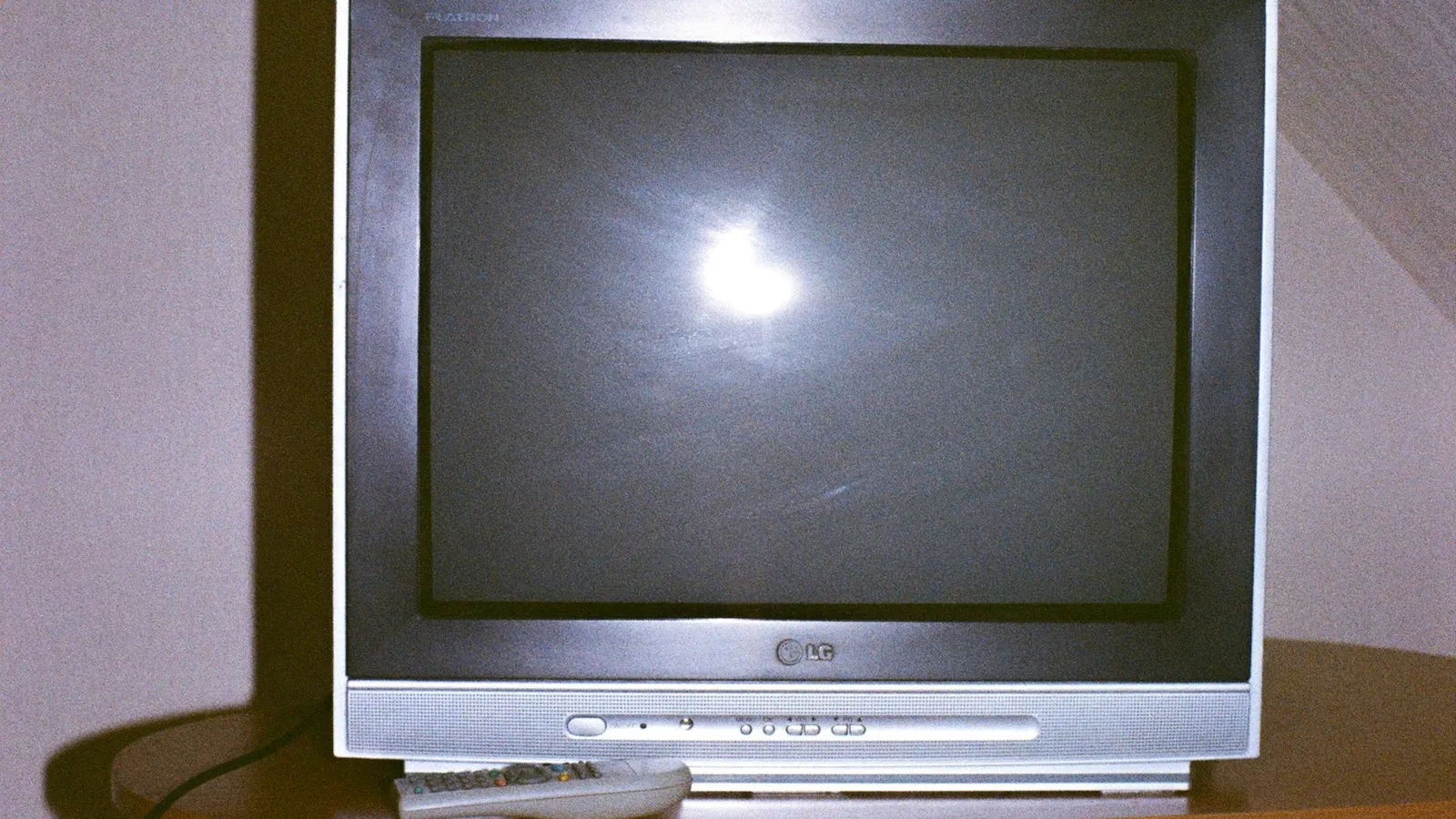
NCERT's Class 11 chemistry chapter on the structure of the atom points out that television picture tubes were cathode ray tubes, with the picture produced by fluorescence on a coated screen. The Class 12 semiconductor chapter adds that these tubes have now largely given way to LCD screens.
Worked example: how far does the spot move?
This example uses electric deflecting plates, the design found in many later oscilloscopes. It is not a description of Braun's original tube, and all values are sample numbers.
An electron is accelerated through Va = 1,000 V, then passes between plates of length L = 2.0 cm with 100 V across a 1.0 cm gap. The screen is D = 20 cm beyond the plates.
Speed: eVa = ½mv², so v = √(2eVa/m) = √(2 x 1.602 x 10^-19 x 1,000 / 9.109 x 10^-31) ≈ 1.88 x 10^7 m/s.
Field between the plates: E = V/d = 100 / 0.010 = 1.0 x 10^4 V/m.
Sideways shift inside the plates: y = eEL² / (2mv²). Since mv² = 2eVa, this becomes y = EL² / (4Va) = 1.0 x 10^4 x (0.020)² / 4,000 = 1.0 x 10^-3 m = 1.0 mm.
Angle on leaving: tan θ = EL / (2Va) = 1.0 x 10^4 x 0.020 / 2,000 = 0.10.
Spot on the screen: Y = y + D tan θ = 0.0010 + 0.20 x 0.10 = 0.021 m = 2.1 cm.
Notice that e and m cancelled in steps 3 and 4. For a beam made by a given accelerating voltage, the deflection depends only on the voltages and the geometry. That is part of why a CRT makes a good measuring instrument.
Common mistakes to avoid:
Using the plate voltage as the field. E is volts per metre: 100 V across 1 cm is 10,000 V/m, not 100.
Stopping at the plates. Most of the 2.1 cm comes from the straight flight after the plates.
Mixing the two voltages. Va speeds the electron up; the plate voltage pushes it sideways.
For more on this motion, see our guide to electron deflection in an electric field.
Why did Braun win a Nobel Prize?
From 1898 Braun worked on wireless telegraphy. The Nobel biography says he introduced the closed oscillation circuit into wireless telegraphy and was one of the first to send electric waves in chosen directions. The 1909 presentation speech credits him with a change to the transmitting circuit that made it possible "to produce intense waves with very little damping". He shared the 1909 Nobel Prize in Physics with Guglielmo Marconi "in recognition of their contributions to the development of wireless telegraphy". Our post on Marconi and radio tells the other half of that story.
The Nobel Prize's own summary adds that, like many researchers of his era, Braun did not patent his inventions, arguing that just as he had benefited from others' work, others should benefit from his. During the First World War he travelled to New York as a witness in a patent case, fell ill and could not return to his laboratory. He died in Brooklyn on 20 April 1918.
What can a student take from how Braun worked?
Make the invisible visible. His tube turned a fast, unseen change into a picture anyone could study.
Use the right tool for the speed. A needle has too much inertia; an electron beam has almost none.
Move between theory and devices. He went from vibrating strings to crystals, tubes and transmitters.
If you can follow the derivation but freeze on a new deflection problem, the Fermi Problem Library has a step-by-step solver that explains the reasoning behind each step.
Next step: redo the worked example with an accelerating voltage of 2,000 V and check that the spot moves half as far, 1.05 cm.


