On this page
Can a class be split into pairs of friends with nobody left over? Graph theory calls that a perfect matching, and Tutte's theorem answers the question completely.
What does Tutte's theorem say?
A graph is a set of vertices (dots) joined by edges. A matching is a set of edges where no two share a vertex. A perfect matching is a matching that touches every vertex, so every vertex gets exactly one partner.
An odd component is a connected piece of a graph with an odd number of vertices. For a set S of vertices, write odd(G − S) for the number of odd components left after you delete S and every edge touching it.
Tutte's theorem: a graph G has a perfect matching if and only if odd(G − S) ≤ |S| for every set S of vertices. W. T. Tutte proved it in The Factorization of Linear Graphs, Journal of the London Mathematical Society, 1947, and the Wikipedia article on Tutte's theorem on perfect matchings gives a modern proof.
One direction is easy. An odd component cannot pair up all of its own vertices, so at least one of them must partner a vertex in S, and each vertex of S takes only one partner. The hard part is the converse: if no S fails, a perfect matching exists.
How do you prove a graph has no perfect matching?
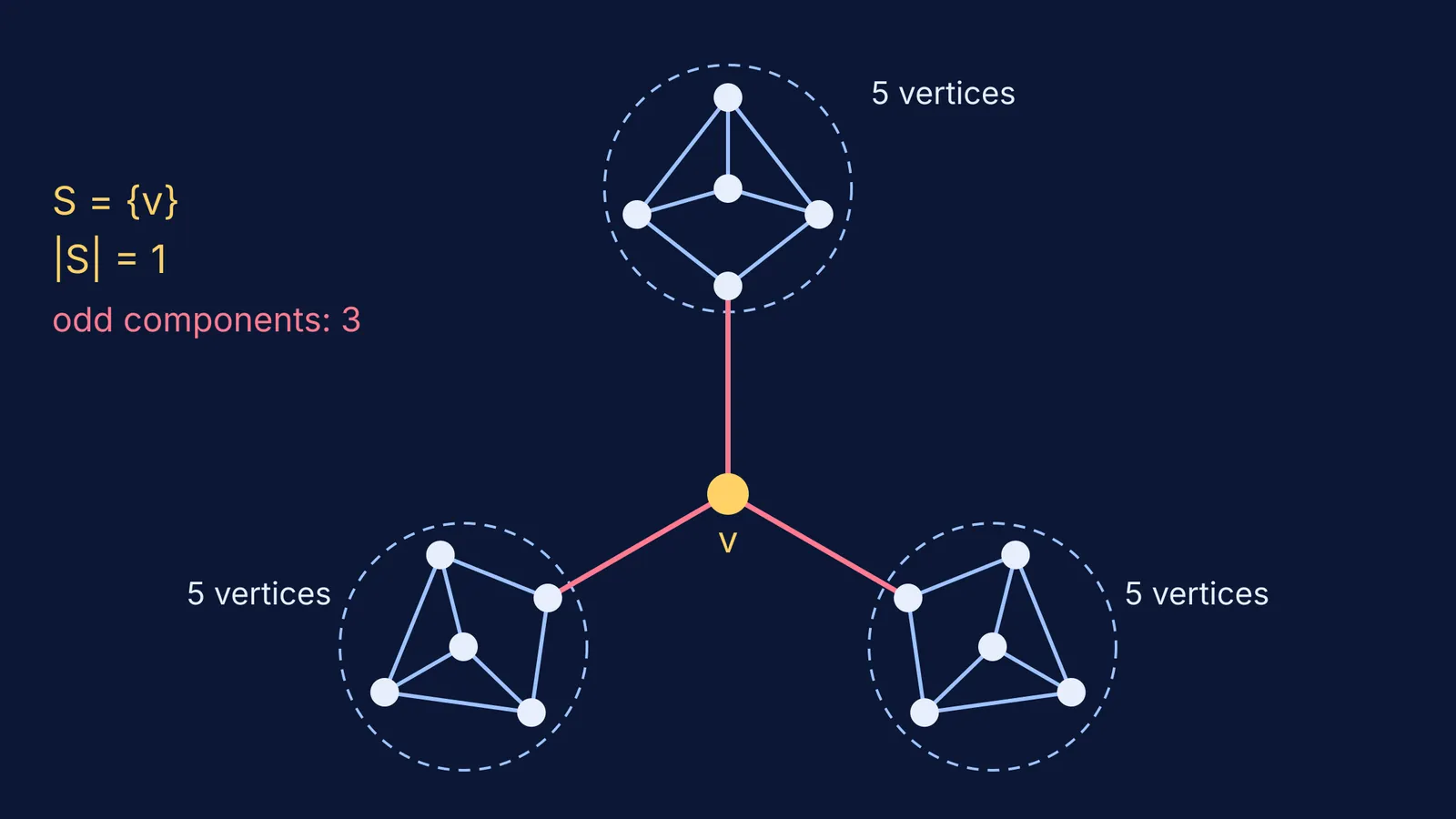
Here is a worked example, drawn above. Take one vertex v and three identical blobs of 5 vertices each, 16 vertices in all. In each blob, call the vertices a, b, c, d, e and join a–b, a–c, b–d, b–e, c–d, c–e and d–e. Then join v to the vertex a of each blob.
Every vertex now has exactly 3 neighbours, and 16 is even, so nothing looks wrong yet.
Take S = {v}. Deleting v leaves three blobs of 5 vertices each, so odd(G − S) = 3 while |S| = 1. Since 3 > 1, this graph has no perfect matching: each blob must send a vertex to v, but v takes only one partner.
The same steps work on any graph:
Count the vertices. If the number is odd, S = ∅ already fails.
Try a cut vertex, or one end of a bridge, as S.
Delete S and count the odd components.
If that count beats |S|, you have a proof. If no bad S turns up, look for an actual matching.
How does Tutte's theorem imply Hall's theorem?
Hall's theorem (P. Hall, 1935) covers bipartite graphs, whose vertices split into two sides X and Y with every edge going from one side to the other. With |X| = |Y|, there is a perfect matching exactly when every set A in X has at least |A| neighbours in Y. This is the version stated in the Wikipedia article on Hall's marriage theorem.
To get Hall from Tutte, add every edge inside Y. That changes nothing, because each X vertex still needs a Y partner, which uses up all of Y. Now delete any S. Y − S becomes one piece, joined by every X vertex with a neighbour in it. The other components are lonely X vertices whose neighbours all lie in S; call them A. By Hall's condition, |A| ≤ |S|.
So there are at most |A| + 1 odd components. The only risky case is |A| = |S|. Then S lies inside Y, and the big piece has 2(|Y| − |S|) vertices, which is even. Either way, odd(G − S) ≤ |S|, so Tutte's theorem gives a perfect matching.
Why does every cubic bridgeless graph have a perfect matching?
Julius Petersen proved in 1891 that every cubic graph without a bridge has a perfect matching. A cubic graph has three edges at every vertex. A bridge is an edge whose removal disconnects the graph. As the Wikipedia article on Petersen's theorem shows, the proof is a short parity argument using Tutte's condition.
Take any S and an odd component C of G − S. The degrees inside C add up to 3 times an odd number, which is odd. Each edge inside C counts twice, so the number of edges from C to S must be odd. It cannot be 1, because that edge would be a bridge, so it is at least 3. The vertices of S touch at most 3|S| edges in all, so 3 × odd(G − S) ≤ 3|S|, which is Tutte's condition.
In the worked example, each blob meets v through a single bridge, exactly the case this argument rules out. So "bridgeless" cannot be dropped.
How should you practise matching problems?
Hunt for a bad S first; reach for Tutte or Hall to prove a matching exists only when that search fails. To revise the ideas behind these proofs one at a time, the Fermi Concept Library gives every concept in mathematics its own lesson. For more practice, the Fermi Problem Library has worked problems with a step-by-step solver that explains the reasoning rather than printing an answer.