

On this page
You can look up the moment of inertia of a uniform disc or ring in a table. You cannot look up the moment of inertia of a gear wheel, a fan hub or a cricket bat. Engineers measure those, and one of the simplest ways needs only a flat platform, three equal threads and a stopwatch. It is called a trifilar suspension, and it turns a rotation problem into a timing problem.
What is a trifilar suspension?
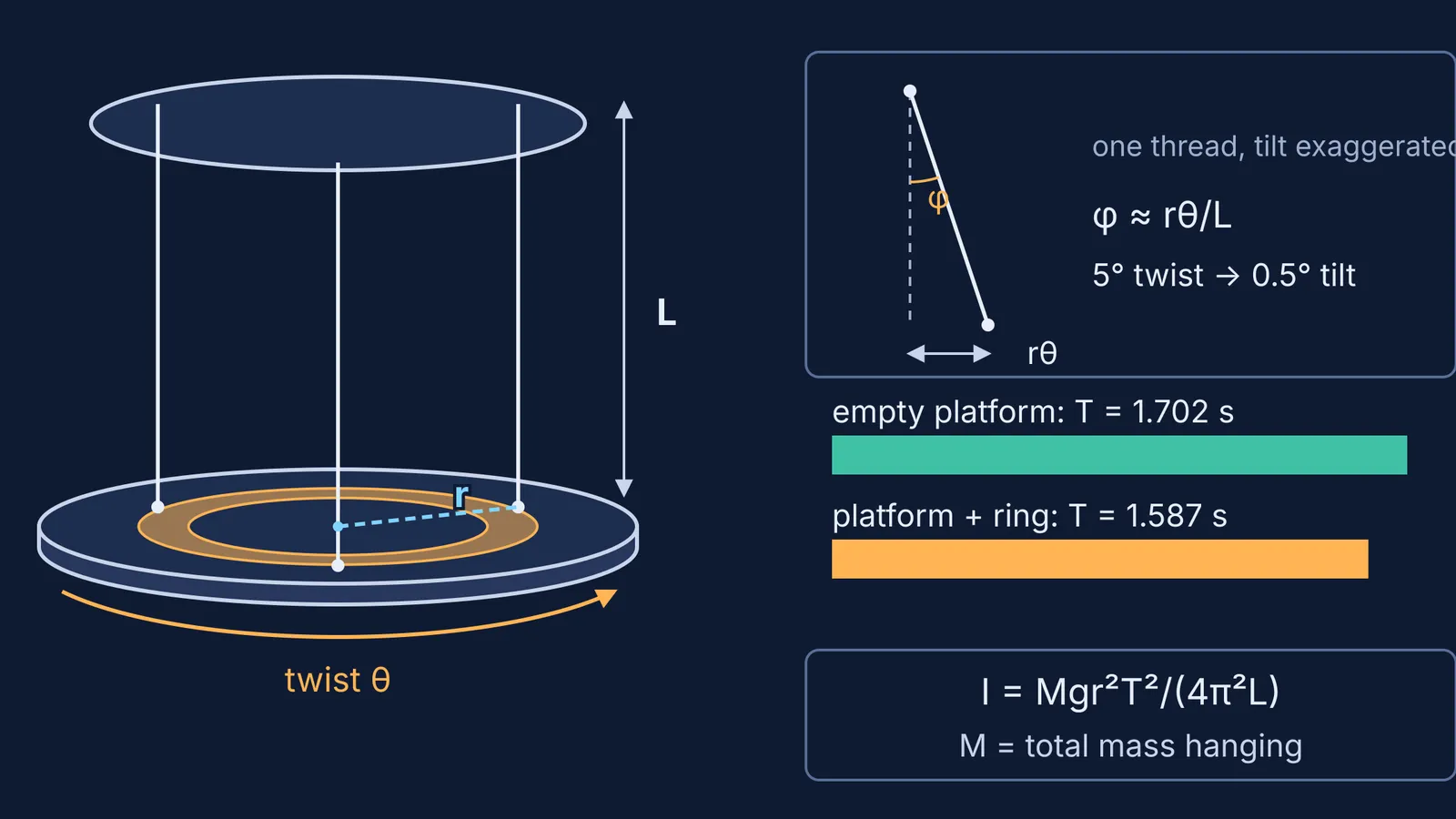
A flat circular platform hangs from a fixed support by three equal, vertical threads of length L. The threads are attached at the same distance r from the platform's centre, spaced 120° apart, and at the same radius on the support above. You twist the platform through a small angle about its vertical axis and let go. It swings back and forth about that axis, and you time the swings.
The object you want to measure is laid on the platform with its centre of mass on the axis. The change in the period tells you its moment of inertia.
Why does it swing like a torsional pendulum?
In a torsional pendulum the restoring torque comes from a twisted wire, and T = 2π√(I/C), where C is the wire's torsion constant. That case is worked in the time period of a torsional pendulum. In a trifilar suspension nothing is twisted. Gravity does the restoring.
Here is why. Twist the platform by a small angle θ. Each attachment point moves sideways along an arc of length rθ. The threads stay the same length, so each one tilts by a small angle φ with
φ ≈ rθ/L
A tilted thread holds the platform slightly higher than a vertical one. The rise is L(1 − cos φ) ≈ Lφ²/2 = r²θ²/(2L). The whole hanging mass M rises by this amount, so the potential energy gained is
U = Mg r²θ²/(2L)
This has the same form as a twisted wire, U = ½Cθ², with an effective torsion constant
C = Mgr²/L
Gravity, acting through the tilted threads, gives a restoring torque proportional to θ. That is the condition for angular simple harmonic motion.
How do you find the moment of inertia from the period?
Put C = Mgr²/L into T = 2π√(I/C):
T = 2π√(IL/(Mgr²))
Rearranged for the unknown:
I = Mgr²T²/(4π²L)
Here M is the total mass hanging from the threads, and I is the total moment of inertia about the vertical axis. Both include the platform.
Write I = Mk², where k is the radius of gyration. The mass cancels:
T = (2πk/r)√(L/g)
So the period does not depend on how heavy the load is. It depends only on how far out its mass is spread. This is the key to reading the results below.
Worked example: the moment of inertia of a ring
These are illustrative readings, chosen so that you can check every step. Take g = 9.81 m/s².
Set-up. The platform is a uniform disc of mass 2.0 kg and radius 12 cm, so its moment of inertia is ½MR² = ½ × 2.0 × 0.12² = 0.0144 kg m². The threads are L = 1.0 m long and attached at r = 10 cm = 0.10 m.
Calibrate with the empty platform. Twenty swings take 34.04 s, so T = 1.702 s. Check: I = 2.0 × 9.81 × 0.10² × 1.702² ÷ (4π² × 1.0) = 0.0144 kg m². The apparatus agrees with the formula for a disc.
Add the ring. A ring of mass 1.5 kg, inner radius 6 cm and outer radius 8 cm, is laid on the platform with its centre on the axis. Twenty swings now take 31.74 s, so T = 1.587 s.
Total mass. M = 2.0 + 1.5 = 3.5 kg.
Total moment of inertia. I = 3.5 × 9.81 × 0.10² × 1.587² ÷ (4π² × 1.0) = 0.0219 kg m².
Subtract the platform. I_ring = 0.0219 − 0.0144 = 0.0075 kg m².
Check against theory. For a thick ring, I = ½m(a² + b²) = ½ × 1.5 × (0.06² + 0.08²) = 0.0075 kg m². They agree.
Check the units: kg × m/s² × m² × s² ÷ m = kg m². That is a moment of inertia.
Notice that adding 1.5 kg made the period shorter, not longer. The formula T = (2πk/r)√(L/g) explains it. For the empty disc, k² = R²/2 = 0.0072 m². For the ring, k² = (a² + b²)/2 = 0.0050 m². The ring's mass sits closer to the axis, on average, than the disc's mass does, so the combined k² falls to 0.0219 ÷ 3.5 = 0.0063 m², and the period falls with it.
What makes the measurement accurate?
Small swings. The formula uses cos φ ≈ 1 − φ²/2. With r = 0.10 m and L = 1.0 m, a 5° twist tilts each thread by only 5° × 0.10 ÷ 1.0 = 0.5°, well inside the small-angle range.
Many swings. A stopwatch reaction error of about 0.2 s spread over 20 swings changes T by 0.01 s, not 0.2 s. Time 20 or more swings, and repeat.
Pure rotation. If the platform also sways sideways like a simple pendulum, the timing is spoilt. Release it gently by twisting, not pushing.
Equal, parallel threads. All three must have the same length and be attached at the same radius on the support and the platform, or the rise is no longer r²θ²/(2L).
Centred load. If the object's centre of mass is a distance d from the axis, the measured value includes an extra md² from the parallel-axis theorem.
The same idea, using the period of a swinging body to measure something hard to measure directly, runs through Kater's reversible pendulum, which used it to measure g. If you want to see how changing r, L or the load changes the period, the Simulation Lab has interactive simulations for ideas that are easier to see than read.
Quick checklist
Restoring torque comes from gravity through tilted threads, not from a twisted wire.
Thread tilt: φ ≈ rθ/L. Effective torsion constant: C = Mgr²/L.
Period: T = 2π√(IL/(Mgr²)). Moment of inertia: I = Mgr²T²/(4π²L).
M and I are totals. Subtract the platform's I, never its mass alone.
Period depends on the radius of gyration, not on the mass.
Keep twists small, centre the load, and time at least 20 swings.


