

On this page
In the summer of 1817, Captain Henry Kater hung a brass bar from a knife edge in London, counted its swings, then turned it upside down and did it again. His paper, read to the Royal Society on 29 January 1818, records experiments from June and July 1817 (Kater, Philosophical Transactions, 1818; full OCR text of the paper).
What problem was Henry Kater trying to solve?
Kater wanted the length of the pendulum "vibrating seconds" in London, because that length fixes g. A seconds pendulum takes one second per swing, so its period is 2 s, and T = 2π√(L/g) gives g = π²L. For a refresher, see measuring g with a simple pendulum and the L–T² graph.
The trouble is that no real pendulum is simple. A real bar is a compound pendulum, and its equivalent length runs from the pivot to the centre of oscillation, which earlier experimenters calculated from the body's shape. In his paper, Kater noted that this required "the uniform density and known figure of the body employed, (requisites difficult if not impossible to be ensured in practice,)".
How does a reversible pendulum measure g?
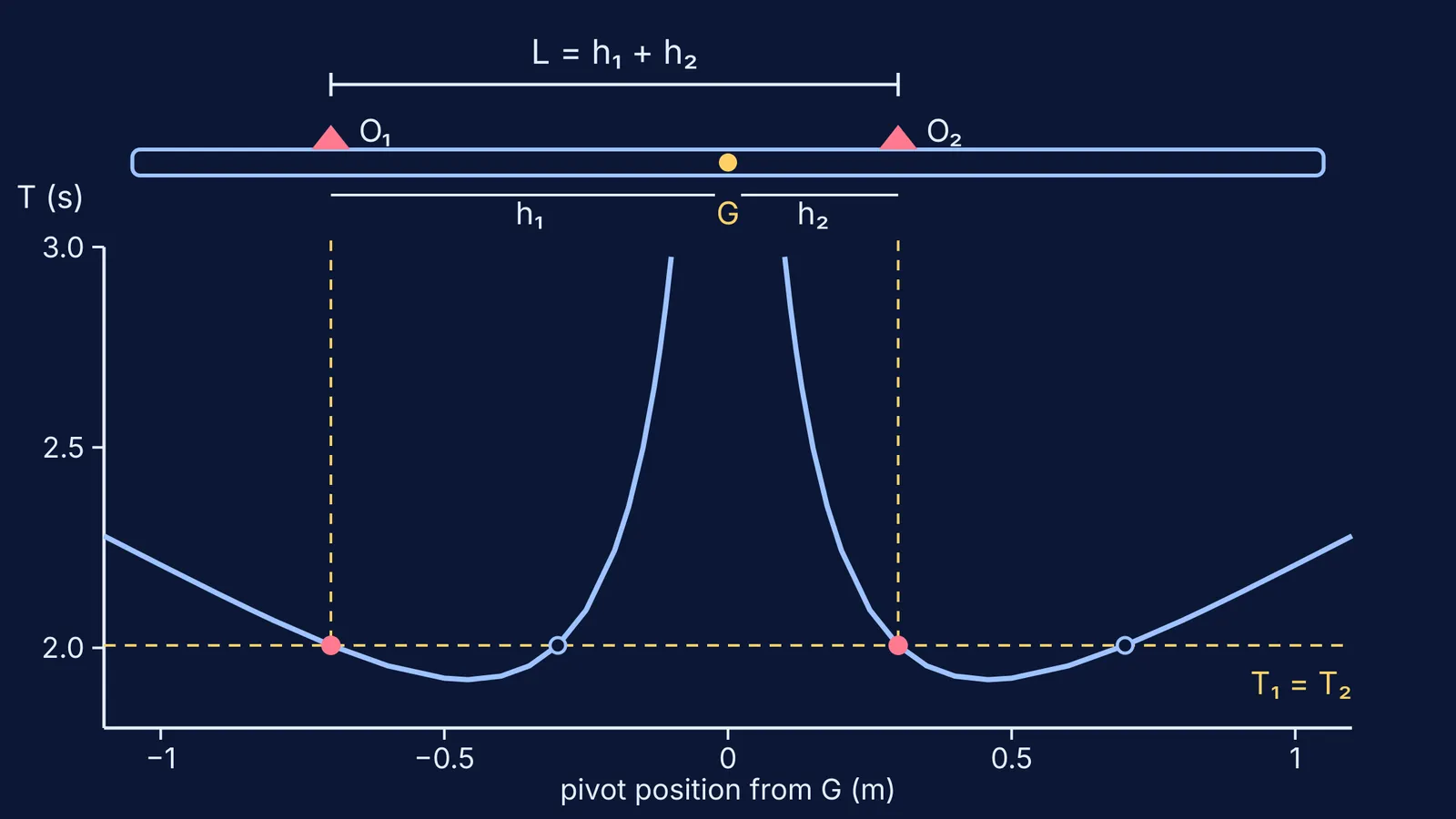
Take a rigid body pivoted at distance h from its centre of mass G, with radius of gyration k about G. Virtual Labs' theory page on Kater's pendulum gives its period as T = 2π√((h² + k²)/(gh)). It swings like a simple pendulum of length l = h + k²/h.
Now put two knife edges on the bar, on opposite sides of G, at distances h1 and h2. Suppose the periods are equal but h1 and h2 are not. Setting h1 + k²/h1 = h2 + k²/h2 gives h1h2 = k², and then the equivalent length is l = h1 + h2. The distance between the two knife edges is the length of the equivalent simple pendulum.
Kater's paper puts it plainly: "the centres of suspension and oscillation are reciprocal". The idea goes back to Christiaan Huygens (Wikipedia: Kater's pendulum); read more in Huygens and the pendulum clock.
So Kater never had to find G or k. He moved a slider, adjusted "by means of a screw", until the swings both ways up differed by an "inconsiderable" amount. Then he measured the knife-edge gap with microscopes against a standard scale.
What if the two periods are not exactly equal?
Making the periods exactly equal is slow. According to Wikipedia's account, Friedrich Bessel showed in 1826 that you can stop when the periods are close and correct for the difference. From the two period equations, the Virtual Labs page derives:
8π²/g = (T1² + T2²)/(h1 + h2) + (T1² − T2²)/(h1 − h2)
When T1 and T2 are nearly equal, the second term is small, so h1 − h2 "does not have to be known as accurately as h1 + h2". Balancing the bar on an edge locates G well enough.
Worked example
These numbers are for a practice bar, not Kater's, run through Bessel's formula. The knife edges are 1.000 m apart. Balancing puts G about 0.70 m from edge 1 and 0.30 m from edge 2, so h1 − h2 ≈ 0.40 m. You time T1 = 2.0089 s and T2 = 2.0127 s.
Square the periods: T1² = 4.0357 s² and T2² = 4.0510 s².
First term: (4.0357 + 4.0510)/1.000 = 8.0866 s²/m.
Second term: (4.0357 − 4.0510)/0.40 = −0.0382 s²/m.
Add them: 8.0484 s²/m. So g = 8π²/8.0484 = 78.957/8.0484 ≈ 9.810 m/s².
If your balance point was 1 cm out, so h1 − h2 is really 0.38 m or 0.42 m, g comes out between about 9.808 and 9.813 m/s², a change under 0.03%. Drop the second term altogether and you get 9.764 m/s², about 0.5% low. The rough measurement only feeds the small correction.
How accurate was Kater's result?
Kater's paper gives London's seconds pendulum, corrected to a vacuum, sea level and 62°F, as 39.13860 inches on Sir George Shuckburgh's scale. That is about 0.99412 m, so g = π² × 0.99412 ≈ 9.8116 m/s². Wikipedia's account reports that his largest variation from the mean was 0.00028 inches, and that reversible pendulums stayed the standard for absolute gravity until free-fall gravimeters replaced them in the 1950s.
What can you take into a JEE problem or a lab practical?
Any rigid body pivoted away from its centre of mass is a compound pendulum. Write l = h + k²/h first.
Above the minimum period, two pivot distances share each period, with h1h2 = k². "Find another point with the same period" questions want exactly this.
The period is smallest at h = k, where l = 2k.
In the lab, measure h1 + h2 carefully and the small correction roughly.
For practice, try our physical pendulum and angular SHM problems. If the period-against-pivot curve is hard to picture, the Fermi Simulation Lab has interactive simulations for ideas easier to see than to read. If your working goes wrong partway, the Fermi Problem Library has a step-by-step solver that explains the reasoning rather than printing an answer.


