

On this page
A surveyor sets a total station on a tripod, points it at a glass prism on a pole more than a kilometre away, and presses a key. A few seconds later the screen shows the distance to the millimetre. The instrument sends out light, gets it back from the prism and works out the distance from a phase difference, the same idea you meet in the waves chapter. Here is how one common method, phase comparison, does it.
Why not just time the light pulse?
Light covers the distance twice, out and back. To find a distance D to 1 mm, you would have to time the round trip to 2 × 0.001 / c, about 6.7 picoseconds. Some instruments do time pulses, and many modern ones mix methods. How cars use time-of-flight lidar and radar is covered in how self-driving cars see the road, and ranging from a frequency sweep in how a car's radar measures distance with a chirp. Phase comparison takes a different route: it measures an angle instead of a time.
How does a total station measure distance with phase?
The instrument does not use the phase of the light wave itself. Light of about 690 to 860 nm has a wavelength under a micrometre, far too short to count. Instead it switches the brightness of the beam up and down at a steady modulation frequency f. The pattern of bright and dim travels outward like a wave with wavelength λ = v / f, where v = c / n is the speed of light in air.
The prism sends the beam straight back. The instrument compares the phase of the returning brightness pattern with the one it is sending at that moment. Because the light travels 2D, the phase difference φ satisfies
2D = (N + φ / 360°) × λ
where N is a whole number of complete wavelengths. Divide by 2:
D = (N + φ / 360°) × U, with U = λ / 2 = c / (2nf)
U is called the unit length. It is the scale the instrument measures on. Western Australia's land survey agency describes it the same way: unit length is half the modulation wavelength and comes from the fine measuring frequency (Landgate, Calibration of EDM instruments). A parameter table for Sokkia instruments lists older infrared models with a 15 MHz modulation and a 10 m unit length, and newer ones with higher frequencies and shorter units (Sokkia EDM distance parameters).
How does the instrument find the whole number of units?
A single phase reading tells you only the part past a whole unit. A phase of 90° at 15 MHz could mean 2.5 m, 12.5 m, 22.5 m and so on.
The fix is to measure again at lower frequencies. Each lower frequency has a longer unit, so it cannot tell millimetres, but it tells you which whole unit of the finer scale you are in. Instruments use several frequencies for this; the Sokkia table notes they are harmonics of a fundamental frequency.
Worked example: measuring 1,234.567 m
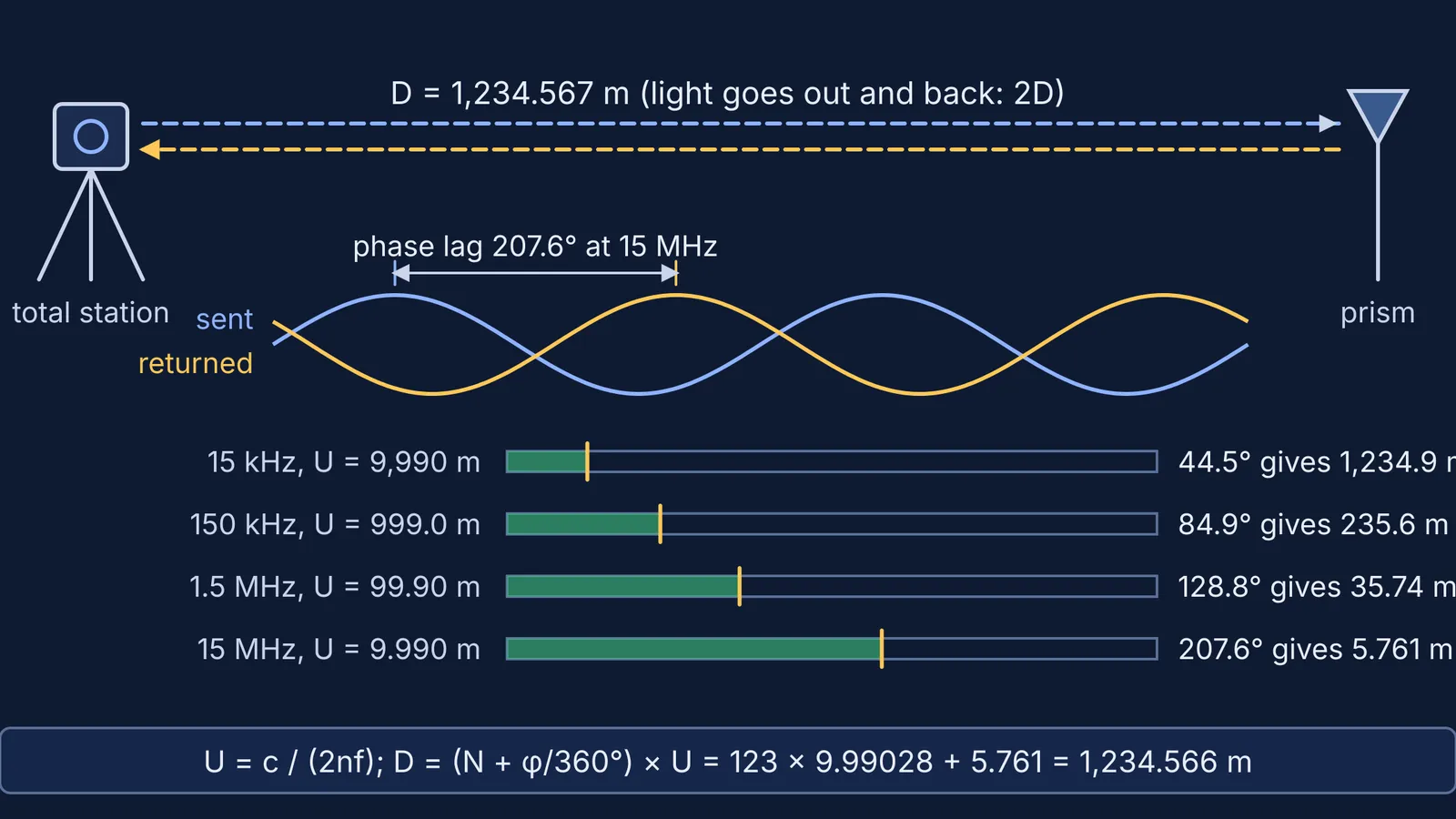
Values here are illustrative. Take c = 299,792,458 m/s and a refractive index of air n = 1.000280. Suppose the true distance is 1,234.567 m and the instrument uses four frequencies: 15 MHz for the fine reading and 1.5 MHz, 150 kHz and 15 kHz for the coarse ones. The phase meter reads to 0.1°.
Unit lengths. U = c / (2nf). At 15 MHz: 299,792,458 / (2 × 1.000280 × 15 × 10⁶) = 9.9903 m. At 1.5 MHz: 99.903 m. At 150 kHz: 999.03 m. At 15 kHz: 9,990.3 m.
Coarsest reading. At 15 kHz the phase is 44.5°. 44.5 / 360 × 9,990.3 = 1,234.9 m. Its resolution is 0.1 / 360 × 9,990.3 = 2.8 m, so D is about 1,235 m give or take 3 m.
Next reading. At 150 kHz the phase is 84.9°, giving 235.60 m past a whole unit. The candidates are 235.60, 1,234.63, 2,233.66 m and so on. Only 1,234.63 m fits step 2, so N = 1.
Next. At 1.5 MHz the phase is 128.8°, giving 35.743 m. With N = 12, D = 35.743 + 12 × 99.903 = 1,234.58 m, which fits step 3.
Fine reading. At 15 MHz the phase is 207.6°, giving 207.6 / 360 × 9.9903 = 5.761 m. With N = 123, D = 5.761 + 123 × 9.99028 = 1,234.566 m.
Precision. A 0.1° step at 15 MHz is 0.1 / 360 × 9.9903 m = 2.8 mm. The answer agrees with the true 1,234.567 m within that step.
Each coarse reading only has to be good to less than half the next unit length. Here 2.8 m is far less than 999.03 / 2, so the chain never picks the wrong N.
Why does the air temperature change the distance?
U = c / (2nf) contains n, the refractive index of air. Light is slower in air than in vacuum, so a unit is a little shorter than c / (2f). Ignore it and every reading is off by a fraction n − 1. With n − 1 = 280 × 10⁻⁶, a 1 km line would come out 28 cm too long.
For ranging, the right index is the group refractive index at the instrument's wavelength, because the modulation pattern travels at the group velocity. It depends on temperature and pressure. Using the atmospheric correction formula in the Sokkia document, near 15 °C and 1,013 hPa the correction changes by about 1 part per million for each 1 °C and for each 3.6 hPa. That is about 1 mm per kilometre per degree. This is why surveyors key the air temperature and pressure into the instrument, and the Landgate procedure lists wrong temperature and pressure as a cause of scale error.
What else limits the accuracy?
Cyclic error. Stray signal leaking from the transmitter into the receiver adds a small error that repeats every unit length. Landgate notes it can be about 5 to 10 mm, and it is one reason instruments are checked on baselines.
Instrument and prism constants. The light path inside the prism and instrument adds a fixed offset, corrected by calibration.
Frequency stability. U depends on f, so a drift of 1 ppm in the oscillator gives a 1 ppm scale error.
Before electronic instruments, the same lines were measured with steel tapes, with corrections for sag and pull; see the surveyor's steel tape and its corrections. To see how two waves with a phase offset line up, try the Simulation Lab. For JEE-style numericals on waves and optics, Fermi Test Prep offers personalised preparation for JEE Main & Advanced with an AI tutor, live classes, adaptive mocks, mentorship and a study plan that updates based on mastery.
Quick checklist
The phase is measured on the brightness modulation, not on the light wave.
Round trip: 2D = (N + φ/360°)λ, so the unit length U = λ/2 = c/(2nf).
At 15 MHz, U is about 9.99 m; 0.1° of phase is 2.8 mm.
Lower frequencies, with longer units, fix the whole number N.
n − 1 of about 280 × 10⁻⁶ is 28 cm in 1 km; about 1 ppm per °C and per 3.6 hPa.
Phase comparison is one method; pulse and hybrid instruments also exist.


