On this page
A self-driving car borrows three tricks from physics: it photographs the world with light, bounces radio waves off it, and times laser echoes. AI then turns the measurements into one answer: what is around me, and where is it going?
What does each sensor in a self-driving car do?
The self-driving company Waymo's support page says its lidar measures "the size and distance of objects 360 degrees around our vehicle and up to 300 meters away", cameras pick out pedestrians and stop signs more than 500 metres away, and radar measures "an object's speed and direction", which helps in rain, fog and snow.
Cameras catch visible light on a sensor, as your phone does. Only they read colour, so they see traffic lights, lane paint and signs. They do not measure distance directly, and glare and darkness hurt them.
Radar sends out radio waves and listens for echoes. The car radar in a University of Washington experimental study runs in the 76-77 or 77-81 GHz band. At 77 GHz the wavelength is about 3.9 mm, hence the name millimetre-wave radar. The idea is old: Christian Hülsmeyer built a radio-echo ship detector in 1904.
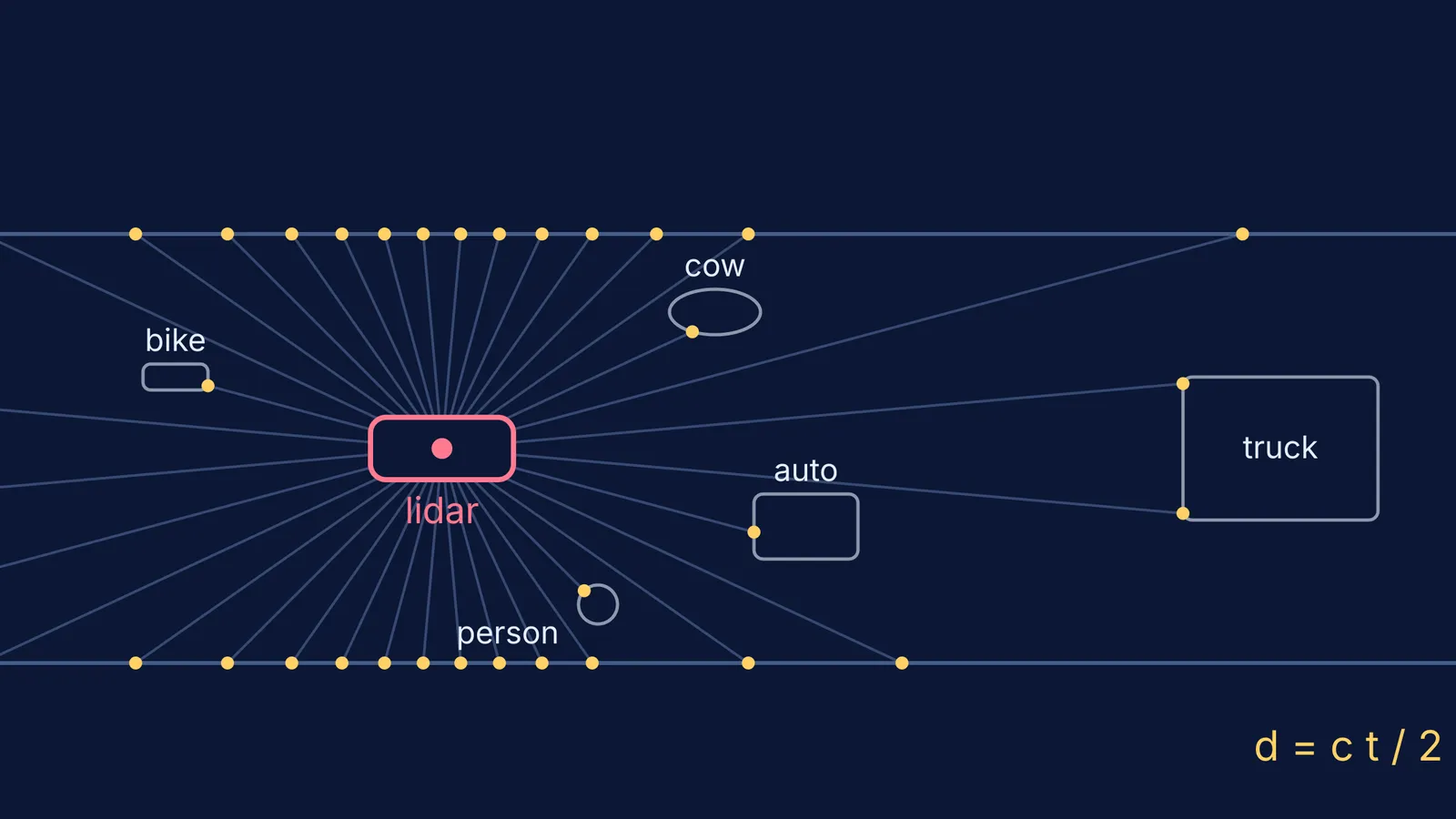
Lidar fires short infrared laser pulses and times each echo. Many use 905 nm light, which reaches the retina, so eye-safety rules limit their power and, in effect, the range of many car lidars to around 100 m, according to a 2019 Laser Focus World article.
How do lidar and radar measure distance and speed?
You can check both with Class 11 physics. The speed of light is exactly 299,792,458 m/s, a defined value listed by NIST; we round it to 3 × 10^8 m/s.
Lidar: distance from time. The pulse goes out and comes back, so d = c × t / 2.
A cyclist is 30 m ahead, so the round trip is 60 m.
t = 60 / (3 × 10^8) = 2 × 10^-7 s, or 200 nanoseconds.
A timing error of 1 nanosecond moves the answer by c × 10^-9 / 2 = 15 cm.
Radar: speed from the Doppler shift. An echo from a moving object comes back at a slightly different frequency. For radar the shift is f_d = 2 v f / c, where the 2 again comes from the round trip.
An autorickshaw closes in at 10 m/s (36 km/h). The radar runs at 77 GHz.
f_d = 2 × 10 × 77 × 10^9 / (3 × 10^8) ≈ 5,100 Hz.
That is about 5 kHz on a 77,000,000 kHz signal, yet radar picks it up (in practice as a phase change between chirps), which makes it the speed specialist.
If the Doppler shift feels abstract, try our Doppler effect simulation guide; the Fermi Simulation Lab has interactive simulations for ideas that are easier to see than to read.
How does AI combine camera, radar and lidar?
No single sensor is enough, so the car asks each the question it answers best:
Is that light red or green? Camera, the only one that sees colour.
How fast is that truck closing in, in heavy rain? Radar.
Exactly where is the kerb, in 3D? Lidar.
This is called sensor fusion. Software lines up every reading in one map, and neural networks label what is in it, for example by giving every pixel of a camera image a label such as road, car or pedestrian. They learn from labelled examples; our explainer on AI, machine learning and deep learning shows where they fit.
Why are Indian roads so hard for self-driving cars?
A network only knows what its training images showed it. Researchers from IIIT Hyderabad, Intel and UC San Diego built the India Driving Dataset because popular datasets assumed clear lanes and a few well-defined kinds of road user. The IDD paper describes 10,004 images labelled with 34 classes, from 182 drive sequences in and around Hyderabad and Bangalore.
The team added labels missing from Cityscapes, a widely used benchmark: autorickshaw, animal, billboard, and "drivable fallback" for unmarked ground a car could still use. The paper notes that "Pedestrians often cross the road at arbitrary locations, rather than crosswalks," that bikes and autorickshaws are less likely to follow lanes and signals, and that fog, dust and smog make scenes look more varied.
The stakes are high: India recorded 4,61,312 road accidents and 1,68,491 deaths in 2022, according to the government release on the road ministry's annual report.
Try it yourself: three questions
A lidar echo returns after 400 ns. How far away is the object? (Answer: 60 m.)
Why can radar see through fog when a camera cannot? Hint: compare a 3.9 mm wavelength with the size of a fog droplet.
On your next ride, spot three things a model trained only on neat, well-marked streets has never seen.
If you get stuck on the physics, Fermi's AI tutor works out what you already know and builds a plan for the session, so you can go from echoes to the Doppler formula step by step.