

On this page
In the early 1900s, ship collisions in fog were a major hazard. The sinking of vessels due to poor visibility was a constant threat to passenger liners and cargo ships alike. In 1904, a 22-year-old German inventor named Christian Hülsmeyer offered a novel solution: a device that used radio waves to "see" through the fog (Wikipedia). He called it the Telemobiloscope, and it was the world's first working radar system.
What was the Telemobiloscope?
At the turn of the century, wireless telegraphy was just beginning to change maritime communication. While others focused on sending Morse code over long distances, Hülsmeyer had read about Heinrich Hertz's discovery that electromagnetic waves bounce off metallic surfaces. He realized this principle could be used to detect ships that were completely hidden by darkness or heavy fog. On 30 April 1904, he filed a German patent (DE 165546) for his "Telemobiloskop", a device explicitly designed to warn a ship's crew of an approaching metallic vessel.
The physical mechanism relied on transmitting an invisible pulse of energy and waiting for a physical echo. On 17 May 1904, Hülsmeyer demonstrated his invention in the courtyard of the Dom Hotel in Cologne. The apparatus successfully detected a metal gate hidden behind a heavy curtain, proving that radio waves could find a target that the human eye could not see.
How did Hülsmeyer's early radar work?
The Telemobiloscope was built using the early wireless technology of its day. It used a spark-gap transmitter to emit what were then called "Hertzian waves", directed into a beam by a simple parabolic antenna. (For more on the physics of such waves, see how we calculate the energy density and intensity of an EM wave). Unlike modern radar systems that use clean, continuous waves on a specific frequency, a spark-gap transmitter produced a noisy, broadband burst of static electricity.
When these waves travelled across the water and struck a metal object, such as the hull of a ship, they reflected back. A highly directional receiver on Hülsmeyer's apparatus picked up the echo. At the heart of this receiver was a "coherer" — an early form of radio detector consisting of a small glass tube filled with loose metal filings.
Normally, the loose filings had high electrical resistance. But when the reflected radio waves struck the antenna, the electromagnetic energy caused the filings to clump together, or "cohere". This suddenly allowed an electrical current to pass through the tube, triggering a relay that rang a loud electric bell on the bridge. A small mechanical tapper then struck the glass tube to shake the filings loose, resetting the device for the next echo. A rotating compass-like mechanism allowed the crew to sweep the beam around the ship and determine the exact direction of the obstacle. If you are studying how waves reflect and refract, the Fermi Concept Library explains the physics behind electromagnetic echoes.
How did he calculate distance without a timer?
Modern radar determines distance by measuring exactly how long a radio pulse takes to return. In 1904, electronic timers fast enough to measure the microsecond delay of a light-speed wave did not exist. The original Telemobiloscope could only say a ship was there, not how far away it was.
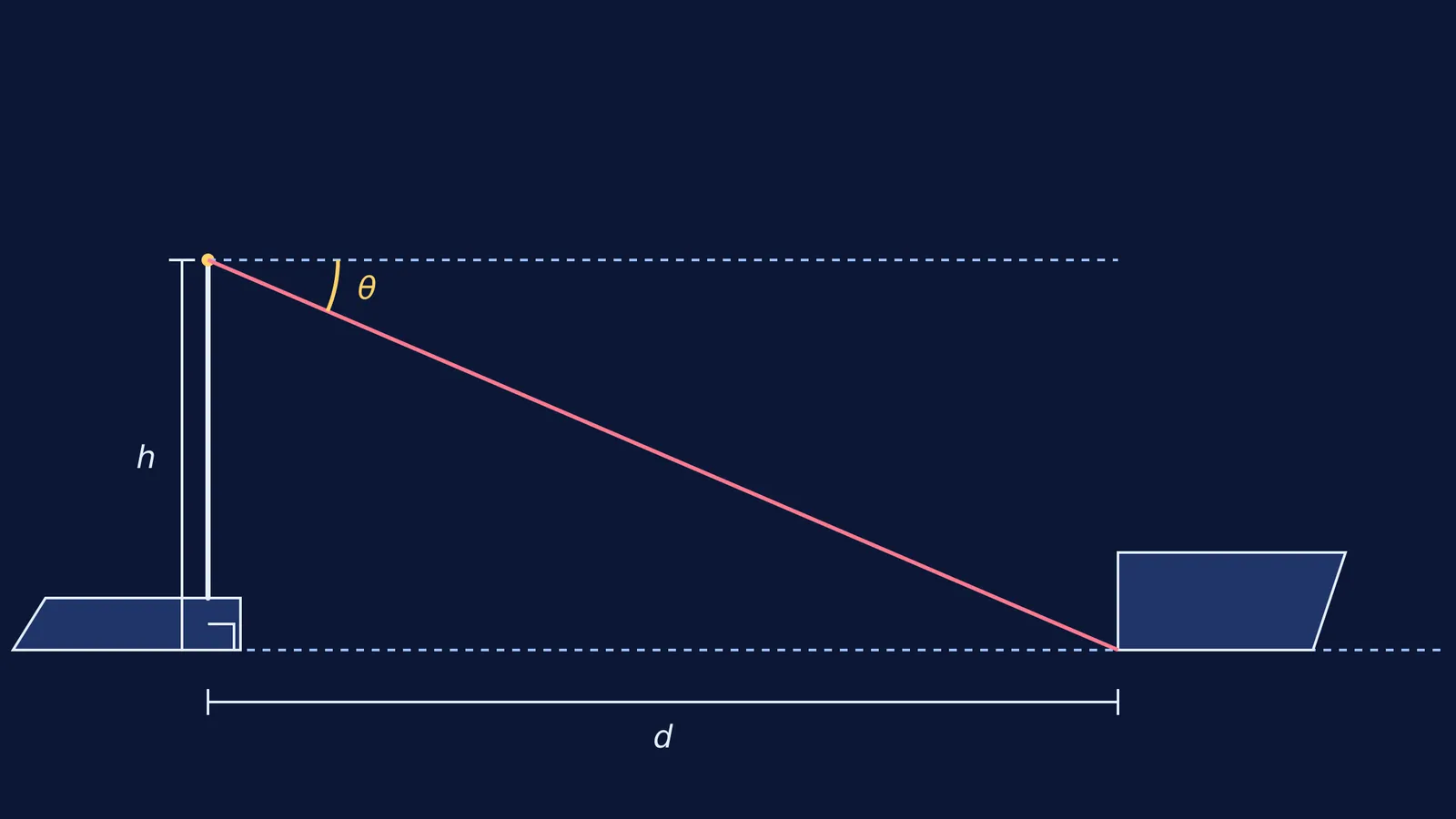
To solve this, Hülsmeyer turned to geometry. In a subsequent 1906 patent (DE 169154), he introduced a method to calculate the range using trigonometry. He proposed mounting the antenna at a known height (h) on the ship's mast. The operator would tilt the highly focused receiving antenna downwards until it picked up the strongest echo from the target ship's hull.
By reading the angle of depression (θ) from the horizontal, the distance (d) to the target could be found with a simple right-angled triangle formula: d = h / tan θ. If you get stuck setting up right-angled triangles in physics, the Fermi Problem Library has a step-by-step solver that explains the reasoning rather than just printing an answer.
Why did the 1904 invention fail to catch on?
Despite successful trials, including a demonstration on the ship-tender *Columbus* in Rotterdam in June 1904, the Telemobiloscope failed commercially. Shipping executives were impressed by the demonstration, noting that the bell rang immediately whenever a vessel passed at a distance.
However, the device had a major problem for practical use: it lacked tuning circuits. This meant it could not filter out the growing chatter of standard wireless telegraphs used by other ships, leading to false alarms. (Decades later, Edwin Armstrong and the FM radio built to beat static would solve similar interference problems in broadcasting). Furthermore, Marconi's Wireless Telegraph Company dominated the maritime market, and shipping companies saw no need for a separate, unproven collision-warning system when they had wireless telegraphy.
The legacy of the grandfather of radar
After a failed 1905 trial at the Hook of Holland and a subsequent rejection by a London shipping conference, Hülsmeyer abandoned the project. He went on to patent over 180 other inventions (Wikipedia), building a successful engineering career in boiler and apparatus construction.
It took decades for the military to reinvent radar for World War II, utilizing the cathode-ray tubes and timing circuits that Hülsmeyer lacked. Radar would soon transform not only warfare but astronomy, as pioneered by scientists like Ruby Payne-Scott and radio bursts from the Sun. His early contribution was eventually recognized. At a 1953 conference, British radar pioneer Robert Watson-Watt acknowledged Hülsmeyer's early genius, telling him, "I am the father of radar, whereas you are its grandfather" (Wikipedia).


