On this page
After the Second World War, Australian radar scientists turned their aircraft-warning aerials into radio telescopes. The Sun was sending out radio noise, and the first question was simple: where on the Sun does it come from? Ruby Payne-Scott was among the first to answer it, using a radar aerial on a cliff above the sea. This post covers her work and works through the interferometer physics.
Who was Ruby Payne-Scott?
A chapter of the 2010 biography by W. M. Goss and R. X. McGee, Under the Radar, gives her life as 28 May 1912 in Grafton, New South Wales, to 25 May 1981 in Sydney.
In a 2012 conference paper, Goss calls her the first woman radio astronomer. She began radar research at the Radiophysics Division of Australia's CSIR in August 1941, observed the plane of the Galaxy at 11 cm in March 1944, and from October 1945 made solar noise observations that continued until she left in mid-1951.
What did the first papers show?
The first paper in Australian radio astronomy, by Joseph Pawsey, Payne-Scott and Lindsay McCready, appeared in Nature in February 1946. Goss notes it used data from 2 to 23 October 1945.
Their longer paper in the Proceedings of the Royal Society in 1947 reports that radiation from the Sun at 200 MHz was "always hundreds of times greater" than expected from the Sun's visible surface, and sometimes greater by a factor of 10⁴. It came with sudden bursts lasting from a fraction of a second to a minute, and its strength rose and fell with sunspots.
How did she find where the bursts came from?
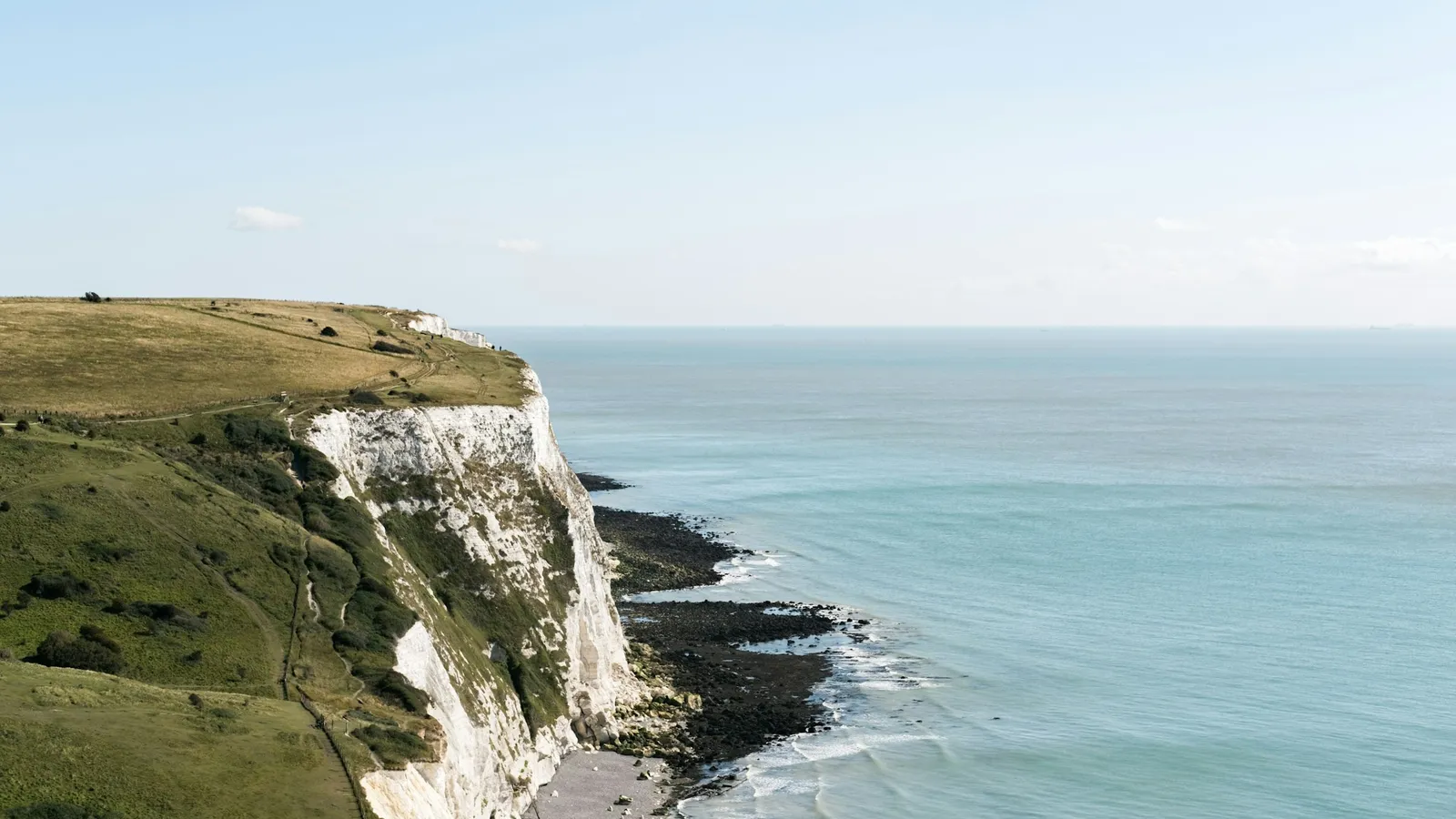
On Australia Day, 26 January 1946, Payne-Scott used a 200 MHz sea-cliff interferometer to observe bursts from a large sunspot group. Goss describes this as the first interferometry in radio astronomy. The bursts came from a region smaller than about 6.5 arcminutes, much smaller than the 40-arcminute radio Sun, with a brightness temperature above 3 × 10⁹ K. The instrument fixed the position in one dimension, which tied the bursts to a major sunspot.
How does a sea-cliff interferometer work?
The aerial sits at height h above the sea. As the Sun rises, its waves arrive at a small angle θ above the horizon. The reflected wave travels farther than the direct one, by about 2h sin θ. As θ grows, this path difference changes, and the signal swings between strong and weak.
Worked example with a sample cliff height:
Wavelength. λ = c/f = 3.0 × 10⁸ / 2.0 × 10⁸ = 1.5 m.
Sample height. Take h = 80 m (a hypothetical value for illustration).
Fringe spacing. One full swing happens each time 2h sin θ changes by λ, so Δ(sin θ) = λ/2h = 1.5/160 ≈ 0.0094.
In degrees. For small angles that is about 0.0094 rad, roughly 0.54°.
A source smaller than the fringe spacing gives deep swings. A wide source smears them out. Deep minima are how she knew the burst region was small. Common mistakes: forgetting that the reflected wave travels the extra distance twice, and mixing degrees and radians. Our post on interference and resultant intensity covers the two-wave sum.
What did she find next?
In a 1947 Nature letter with Yabsley and Bolton, Relative Times of Arrival of Bursts of Solar Noise, Payne-Scott compared bursts on 200, 75 and 60 MHz, with a few on 30 MHz, chiefly from July and August 1946. Each frequency had its own receiver and recorder, and loudspeakers gave "aural confirmation". Goss and McGee's biography credits this period at Dover Heights with the discovery of the solar burst types now called Type I, II and III, and a later chapter covers Type III bursts in 1948.
The 1947 Royal Society paper also pointed out that the shape of a radio source could in principle be found "by Fourier synthesis". Goss quotes Martin Ryle crediting McCready, Pawsey and Payne-Scott with that idea in 1952. Under the name aperture synthesis, it became the way radio interferometer arrays, such as India's GMRT, build up images.
Why did her career end in 1951?
Goss records that she left CSIRO about a year before the 1952 URSI meeting in Sydney, that her son was born in November 1951, and that there was no maternity leave at CSIRO at the time. She did not return to research.
What can a student take from how she worked?
Reuse what you have. A wartime radar aerial became a research telescope.
Ask where, not just what. Locating the bursts linked them to sunspots.
Look at the structure behind your results. Her setup pointed toward Fourier synthesis.
If two-wave interference is hard to picture, the Fermi Simulation Lab has interactive simulations for ideas that are easier to see than read.
Next step: redo the fringe spacing for 60 MHz with the same 80 m height, and say whether the fringes get wider or narrower.